

When the AI Titans Were Told to “Hold Hands” — and Two of Them Didn’t

Bloomberg, CNBC, Reuters, Business Insider, and AlJazeera contributed to this report.
It was supposed to be a feel-good, unity-shot moment. Instead, it turned into the most replayed three seconds of the entire summit.
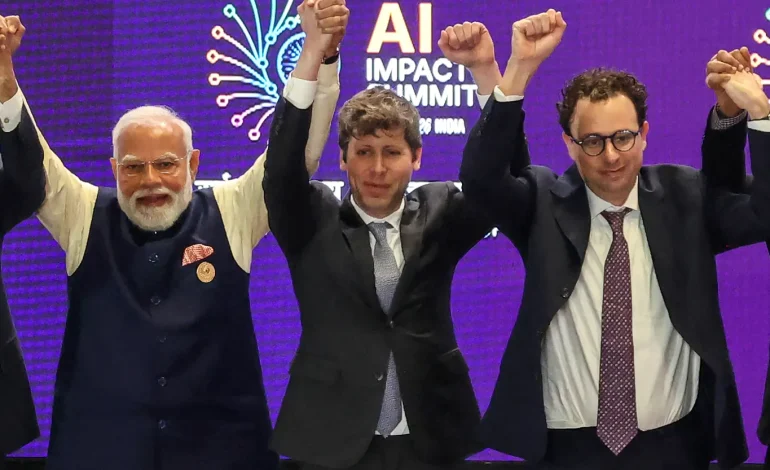
At the India AI Impact Summit in New Delhi, a lineup of the world’s most powerful AI executives gathered on stage beside Narendra Modi. The plan: a symbolic show of togetherness. The result: an internet classic.
As cameras flashed, Modi did what he’s done with global leaders before — clasped the hands of the executives next to him and raised them high. On one side stood Sundar Pichai. On the other: Sam Altman. The message was clear — collaboration, progress, shared ambition.
Around them, other tech heavyweights — including Demis Hassabis and Brad Smith — quickly followed suit, glancing sideways to grab a neighbor’s hand and lift it for the cameras.
But right in the middle of the lineup, standing shoulder to shoulder, were two men who couldn’t quite bring themselves to complete the chain: Altman and Dario Amodei.
They raised their arms. They held hands with the executives on their opposite sides. But between them? Nothing. No clasp. No symbolic link. Just two raised fists hovering inches apart.
The hesitation lasted only a moment. The screenshots will last forever.
Within minutes, clips of the awkward non-handshake were circulating across X and LinkedIn. Tech insiders called it the perfect snapshot of the industry’s biggest rivalry. One investor joked it looked like “when you’re forced to do a group project with your opp.” Another quipped: “AGI will arrive the day Dario and Sam hold hands.”
It wasn’t just a random awkward moment. The tension has context.
Altman’s OpenAI and Amodei’s Anthropic are locked in one of Silicon Valley’s fiercest AI battles. Both companies are racing to make their models — ChatGPT and Claude — the default interface for consumers, enterprises, and governments. Default means dominance. And dominance means billions.
Anthropic was founded in 2021 by former OpenAI researchers, including Amodei, after disagreements over safety priorities, commercialization, and leadership style. What started as a philosophical split hardened into a commercial war. Since then, both firms have raised massive funding rounds, signed high-profile partnerships, and competed for talent, enterprise deals, and public trust.
The rivalry spilled into prime time earlier this month during the Super Bowl, when Anthropic aired satirical ads poking at OpenAI’s plans to experiment with advertising inside ChatGPT. Altman fired back on social media, calling the ads “clearly dishonest” and criticizing what he described as misleading messaging.
So when the two CEOs found themselves shoulder to shoulder under Modi’s raised arms, the symbolism practically wrote itself.
Altman later downplayed the moment, saying he wasn’t entirely sure what was happening on stage. But the body language spoke volumes. While others linked up without hesitation, Altman appeared stiff, glancing away as hands were raised around him. Amodei mirrored the energy. No visible hostility — just unmistakable distance.
The summit itself was no small affair. It drew more than a dozen top AI leaders and reportedly attracted over $200 billion in investment pledges. Despite logistical hiccups — and even a last-minute withdrawal from Bill Gates — it positioned India as a serious player in the global AI conversation.
During their speeches, both CEOs struck thoughtful tones.
Amodei emphasized the serious risks of advanced AI: autonomous behavior, misuse by bad actors, and potential economic disruption. His company has long leaned into a “safety-first” identity, framing itself as a more cautious alternative in the race toward more powerful systems.
Altman, meanwhile, broadened the safety discussion to include what he called “societal resilience,” arguing that no single lab can ensure a positive AI future on its own. He acknowledged ongoing debates around monetization, including advertising formats, noting there’s still work to do to get it right.
On paper, both leaders were discussing responsibility, guardrails, and shared progress.
On stage, though, they couldn’t quite share a hand.
In truth, the non-handshake says less about personal animosity and more about market reality. These companies are competing for the same users, the same enterprise contracts, the same regulatory influence — and potentially the same place in history. When the stakes are that high, unity photos feel symbolic at best.
Still, it was a moment that captured the AI industry perfectly: visionary rhetoric about collaboration, wrapped in fierce behind-the-scenes competition.
The raised fists may have lasted only seconds. But in the age of screenshots and viral clips, that brief gap between two hands became the defining image of the summit — a quiet reminder that in the AI race, not everyone is ready to link arms.

The latest news in your social feeds
Subscribe to our social media platforms to stay tuned