




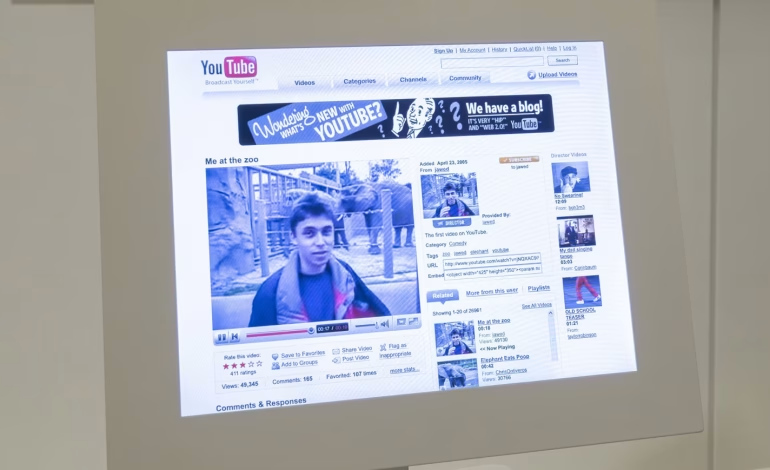

More than two decades after a grainy 19-second clip from a zoo quietly launched a new era of online culture, the Victoria and Albert Museum is treating the birth of YouTube as a design object. The London institution has acquired both a reconstruction of an early YouTube watch page and the platform’s first video, positioning them not as nostalgia, but as artefacts of digital history.
“The V&A has acquired a reconstructed early webpage and the first video ever uploaded to the platform by co-founder Jawed Karim,” a V&A spokesperson said.
At the centre of the display is “Me at the zoo,” the now-canonical clip of Karim standing in front of elephants at San Diego Zoo. Posted on April 23, 2005, the video has since accumulated hundreds of millions of views and tens of millions of likes — metrics that say as much about the evolution of online attention as they do about the clip itself. In it, Karim casually observes:
“The cool thing about these guys is that they have really really really long trunks.”
What the museum is preserving, however, goes beyond the video. Its digital conservation team spent a year and a half rebuilding the look and feel of the YouTube interface as it existed on 8 December 2006, the earliest version that can be reliably documented. The project was carried out with YouTube’s user-experience specialists and a London interaction design studio, underscoring that this is being approached as a question of design history rather than simple archiving.
“The reconstruction of the early YouTube watch page features the first-ever upload entitled ‘Me at the zoo,’” the museum said, framing the work as a way to capture how the platform was experienced, not just what it contained.
That distinction matters. Early YouTube was not yet the algorithmic, highly monetised ecosystem it would become; it was a sparse interface, a basic player, and a new model for participation. By restoring the layout, typography and navigation, the museum is effectively freezing a moment when the social web was still forming its visual language.
Neal Mohan, YouTube’s chief executive, placed the emphasis on that shift in scale and meaning. “By reconstructing an early watch page, we aren’t just showing a video; we are inviting the public to step back in time to the beginning of a global, cultural phenomenon,” he said.
For the V&A, the acquisition fits into a broader effort to treat digital environments as part of the design canon. Corinna Gardner, a senior curator of design and digital, described the project as “This snapshot of YouTube during the early days of web 2.0 marks an important moment in history of the internet and digital design.”
The installation is split between two sites: the video and its reconstructed interface are shown in the Design 1900–Now gallery in South Kensington, while a separate display in Stratford examines how the reconstruction itself was carried out. That second layer — the conservation process — reflects a growing museum concern with how to preserve technologies that were never meant to last.
The move also acknowledges how thoroughly platforms like YouTube have reshaped cultural distribution. Museums and galleries now routinely publish original material there, often reaching audiences that traditional streaming or broadcast channels cannot match.

The latest news in your social feeds
Subscribe to our social media platforms to stay tuned