

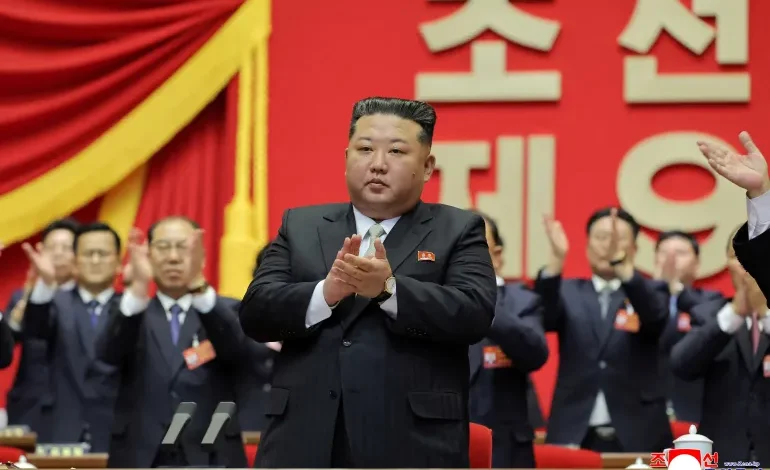

Kim Jong Un has secured another term at the top of North Korea’s ruling Workers’ Party, using the country’s most important political gathering to reinforce his authority and map out the next phase of policy for an isolated state still balancing economic strain with military ambition.
State news agency KCNA reported that Kim was re-elected as secretary-general on Sunday, the fourth day of the congress that takes place once every five years. The meeting also selected a new Central Committee and introduced changes to party rules, though no details were released. The process follows a familiar pattern in Pyongyang: the congress serves less as a forum for debate than as a choreographed moment to confirm leadership and signal priorities for the coming half-decade.
Kim has led the country since the death of his father in 2011, and constitutional changes adopted in 2019 formalised what had long been political reality by giving him what was described as “monolithic” power over state affairs. The latest re-election extends a rule that has already lasted 15 years and underscores the absence of any visible challenge to his position.
In his opening speech, Kim framed the previous five years as a “proud period … in implementing the socialist cause of our own style”, while acknowledging the constraints imposed by international sanctions and what he called “the global public health crisis”. The message was consistent with the line he has promoted for several years: economic recovery and higher living standards are now presented as urgent tasks, even as military development remains central.
“Today, our Party is faced with heavy and urgent historic tasks of boosting economic construction and the people’s standard of living and transforming all realms of state and social life as early as possible,” he said. “This requires us to wage a more active and persistent struggle without allowing even a moment’s standstill or stagnation.”
The language points to a familiar tension in North Korean policy. For decades, nuclear weapons and military strength were prioritised even during periods of severe food shortages and famine — crises the government has historically denied. Under Kim, the economic question has been pushed more prominently into official rhetoric, but always alongside continued investment in strategic weapons.
That dual track was on display in the days leading up to the congress, when Kim presided over a ceremony unveiling nuclear-capable rocket launchers. He called the system “wonderful” and “attractive”, adding, “When this weapon is used, actually, no force would be able to expect God’s protection.”
At the congress itself, Kim declared that the country had passed through its “worst difficulties” and was entering a period of “optimism and confidence in the future”. Such language is typical of major party gatherings, which are designed to project stability and forward momentum regardless of the underlying economic data, which remains largely opaque to the outside world.
Other senior officials, including Foreign Minister Choe Son Hui, also addressed the meeting, reinforcing the sense that the congress is intended to align the political, diplomatic and economic apparatus behind a single, centrally defined plan.
The latest news in your social feeds
Subscribe to our social media platforms to stay tuned