






The original story by Shira Ovide for the Washington Post.
A flashy new math trick had Silicon Valley, Wall Street and Washington convinced that artificial intelligence single-handedly rescued the US economy last year. Now a growing chorus of economists says that story might be more mirage than miracle.
The headline claim was simple and dramatic: tech companies’ huge spending on AI — the data centers, chips and software — accounted for half or more of US growth in 2025. To fans in the White House, that looked like an economic renaissance powered by cutting-edge tech. To critics on the left, it read like evidence the economy is dangerously hooked on a single industry. But scratch the surface, and it gets murkier.
Some big-name forecasters now say AI added almost nothing to measured US growth. Economists at firms from Morgan Stanley to JPMorgan Chase — and analysts inside Goldman Sachs — have argued that when you properly account for what’s being imported into those AI data centers, the bump to GDP evaporates. As Joseph Briggs put it: the AI story was “very intuitive,” but that intuition may have stopped people from digging deeper.
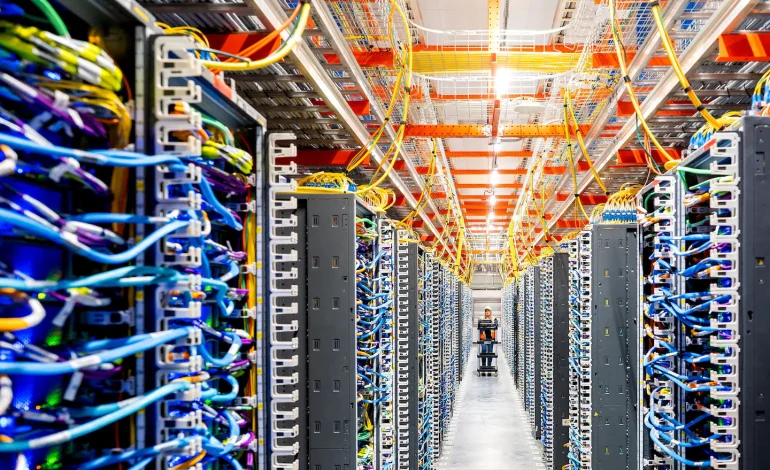
So what’s the accounting trick? The official GDP tally records only the value added inside the United States. If a US firm spends $1 billion on servers, but most of those chips and gear are made overseas, a big chunk of that spending boosts production abroad — not US GDP. And analysts estimate that roughly three-quarters of the cost of an AI data center is the computer gear and chips that often come from factories in Asia, where firms like Nvidia design and source many components.
That math leads to the uncomfortable conclusion: a huge headline number for AI spending can translate into a tiny or even zero contribution to US GDP growth once imports are stripped out. Some teams crunching the numbers now say AI’s boost to growth last year ranges from sizable to basically nil.
But not everyone agrees the skeptics are being over-pedantic. Economists such as Hannah Rubinton have produced calculations that put a big slice — as much as about 39% in one early tally — of 2025 growth on AI-related investment. Rubinton says that total may be the upper bound, and she concedes the headline narrative probably ran a little ahead of what the data can actually prove.
“It’s not like AI is propping up the economy,” she told colleagues after final growth numbers came in.
Others push back the other way: even if imports mute AI’s direct contribution to GDP, the spending still moves money through the US economy — construction crews building data centers, land deals, logistics, and the ripple effects in local labor markets. Analysts such as Joe Brusuelas argue that the narrow accounting fight misses the bigger point: AI is reshaping demand for workers and materials, and those changes matter even if official statistics can’t neatly capture them yet.
Then there’s the political angle. For the White House, the AI-growth framing has been useful ammunition to argue against heavy-handed regulation. Opponents, from progressive lawmakers like Alexandria Ocasio-Cortez to skeptical investors, view the same numbers as a sign of dangerous concentration and fragility.
Even analysts who think AI is important say the original headlines oversold it. Joseph Politano, who tracks sector contributions closely, estimates AI added maybe 0.2 percentage points to last year’s 2.2% growth — material, but far from the dominant engine some early takes suggested.
The debate underscores a deeper problem: official economic data weren’t built to capture the effects of distributed, software-driven investments that depend heavily on globally sourced hardware. That’s likely to mean years of back-and-forth as researchers refine methods and update estimates.
Meanwhile, the spending binge itself is anything but theoretical. Five big US tech firms alone are projected to pour hundreds of billions into AI infrastructure this year — money that hires workers, drives up demand for concrete and construction, and fattens some investors’ portfolios. As Tom Barkin has noted, the current economy looks driven by both the AI ecosystem and wealthy consumers — a tandem that can hide weaknesses elsewhere.
Don’t throw away the AI story — it’s real, visible and powerful in pockets — but don’t assume it’s the magic tonic for the whole economy. For now, the headline-grabbing claims that AI “propped up” US growth look like an overreach. As analysts keep peeling back import-heavy spending and noisy monthly data, the picture will keep shifting. And in the meantime, politicians and CEOs will pick whichever numbers help their case.



The latest news in your social feeds
Subscribe to our social media platforms to stay tuned