





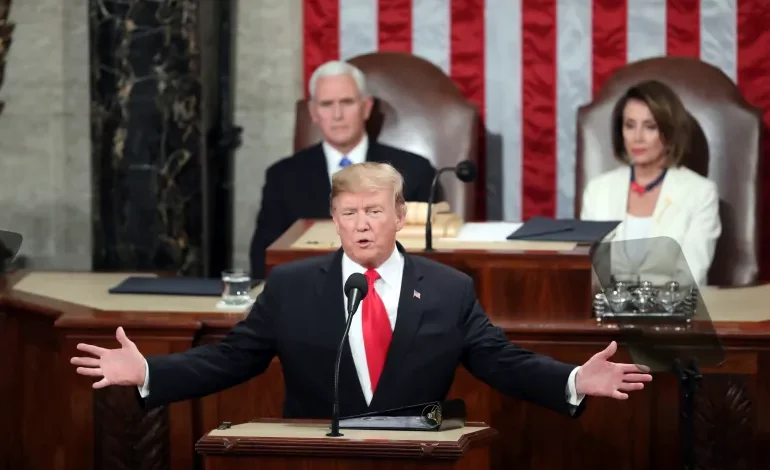

Donald Trump walks into his first State of the Union of his second term with something few modern presidents have had at this stage: near-total control over his party, an executive branch reshaped in his image and most of the legal threats that once defined his political future effectively gone. The speech, delivered before both chambers of Congress at 9pm in the House chamber, will follow the traditional script — a president presenting a confident narrative about the country — but the backdrop is anything but conventional.
The comeback story still frames everything. Four years after leaving office under the shadow of defeat, a Capitol attack and multiple criminal indictments, Trump is now presiding over a government run by a loyalty-first cabinet, has pardoned those jailed over the January 6 assault and is pushing an expansive interpretation of presidential authority. That arc alone gives the address a different weight: it is less about introducing an agenda than about consolidating a governing model.
Yet the political clock is already ticking toward the midterms. Republican control of Congress — the key to turning executive ambition into durable policy — is at stake in November, and the speech doubles as a campaign message aimed beyond the chamber.
As in almost every modern election cycle, the real test is the economy. Trump continues to describe it as a success story, but the data and public mood tell a more complicated story. Wall Street has held up and employment has remained steady, yet growth slowed at the end of 2025 and inflation-linked cost-of-living pressures remain central to how voters judge their own situation. Polling reflects that gap: approval of his economic management sits well below majority levels.
“I have to listen to the ‘fake news’ talking about affordability,” Trump said during a speech in Georgia last week.
“I’ve won affordability,” he added. “I had to go out and talk about it.”
The tension between message and lived experience is likely to run through the address. It is also sharpened by Trump’s decision last year to fire Bureau of Labor Statistics Commissioner Erika McEntarfer, a move that fuelled broader concerns about trust in federal economic data — an unusual position for an administration trying to sell economic success.
Trade, once one of Trump’s most reliable applause lines, now comes with legal and political complications. The Supreme Court’s rejection of his emergency-based global tariff framework marked one of the most significant institutional checks on his second-term agenda. Trump has already signalled he will continue imposing tariffs through other legal routes, framing the court defeat as a technical obstacle rather than a strategic retreat.
“As President, I do not have to go back to Congress to get approval of Tariffs,” the US president wrote in a social media post on Monday. “It has already been gotten, in many forms, a long time ago!”
At the same time, the trade deficit has continued to grow, undercutting the central justification for the original policy and giving critics — including some Republicans — a rare point of leverage.
Immigration will be the other defining pillar. The administration’s mass deportation drive and sweeping changes to asylum and refugee systems have moved from campaign rhetoric to daily enforcement reality. Federal agents have carried out large-scale operations across the country, a strategy that supporters describe as long overdue and opponents call a dragnet. The issue has become more volatile after the deaths of two US citizens during immigration operations in Minneapolis and the federal government’s refusal to allow independent state investigators into those cases.
In structural terms, this State of the Union is less about proposing new legislation than about defending an expanded concept of executive power. Trump is speaking from a position of strength inside Washington, but to a country that remains deeply divided over the results.


The latest news in your social feeds
Subscribe to our social media platforms to stay tuned