
EXCLUSIVE: New Cuba Crisis Part 2. Fuel, Exile, and Power.
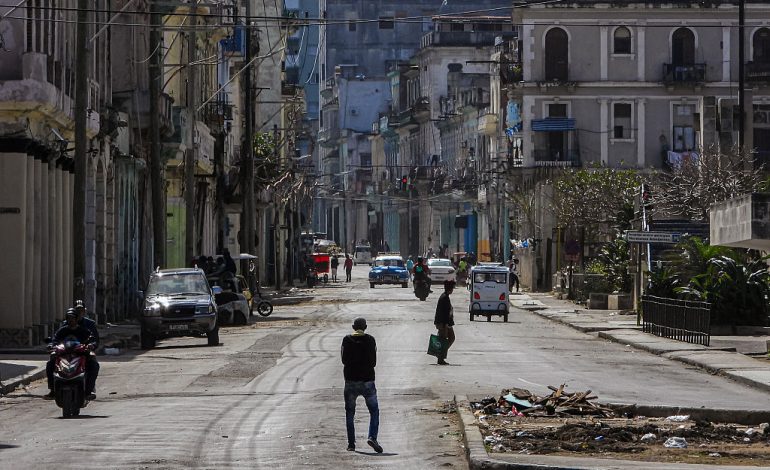
When we first covered the emerging oil embargo strangling Cuba, it felt like history knocking on a door we thought had been sealed since 1962. The follow-up reporting has revealed the picture beyond a rhetorical escalation. Oil tankers have stopped arriving. Insurance firms are spooked. Shipping companies are backing away.
And on the island, the lights are flickering.
But the story goes deeper. The current oil embargo on Cuba is about power – political, historical, and personal. It’s about exile politics in Miami, about the long shadow of the Cold War, and about the role of one man in particular: Marco Rubio.
To understand how we got here, you have to widen the lens.
On January 29, 2026, President Donald Trump signed an executive order designating Cuba an “unusual and extraordinary threat” to US national security. The move reinstated Cuba on the State Sponsors of Terrorism list – just one day after the Biden administration had removed it at the end of its term. The designation opened the door to aggressive secondary sanctions and, crucially, threats against any country or company exporting fuel to the island.
The result was swift. Venezuela, Cuba’s primary supplier, which recently suffered an open US intervention, halted shipments after facing direct US pressure. Mexico followed. According to reporting from The New York Times and CNN, insurers began refusing coverage for tankers bound for Cuban ports.
The situation echoes the Cuban Missile Crisis. The US insists this is economic pressure, not military brinkmanship. Cuban officials call it collective punishment. The United Nations has warned of humanitarian collapse.
The older US embargo – codified under the Helms-Burton Act in 1996 – was already among the most comprehensive sanctions regimes in the world. The oil blockade marks a shift from economic constraint to energy strangulation. Oil powers 80 percent of Cuba’s electricity grid. It keeps hospitals running, water pumped, buses moving, crops transported.
Remove oil, and the system begins to fail everywhere at once.
Dr. Salim Lamrani, Professor of Latin American History at the Université de La Réunion, specializing in relations between Cuba and the United States, the author of ‘Cuba, the Media and the Challenge of Impartiality’, argues that this policy isn’t exactly new:
“The objective pursued by the United States is to overthrow the Cuban Revolution by creating a severe humanitarian crisis affecting the entire population, particularly the most vulnerable groups. The United States has pursued this same objective since the imposition of the first economic sanctions in July 1960: to ‘spread hunger and despair in order to overthrow the government.‘”
The difference now is the bluntness. By targeting oil, the administration is going after the spine of Cuban society.
Dr. Aviva Chomsky, professor of history and the Coordinator of Latin American, Latino and Caribbean Studies at Salem State University, the author of ‘A History of the Cuban Revolution’ and co-editor of ‘The Cuba Reader: History, Culture, Politics,’ describes the moment as “both the same, and much worse”:
“US policy has always been to undermine the revolution and the economy and to make the population suffer. But never has the US had such utter power to enforce this on the entire world. The fuel blockade seems aimed at bringing complete social and economic collapse. If a Russian ship tries to challenge the blockade, are we going to be back to the brinkmanship of the Missile Crisis? Or are Trump/Rubio really hoping to impose death by starvation, thirst (since the supply of clean water depends on fuel), and communicable disease on the entire population, as they are in Gaza? It’s a truly horrifying moment.”
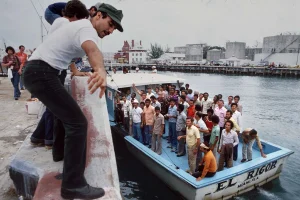
In his recent article for ZNetwork, Dr. Lamrani explores the economic history behind the current crisis. The US embargo against Cuba dates back to 1960, when Washington cut off sugar purchases and imposed trade restrictions after Fidel Castro’s government nationalized American-owned property. Diplomatic ties were severed in 1961. The Bay of Pigs invasion followed. Then the missile crisis.
Many assumed that with the collapse of the Soviet Union, tensions would ease. Instead, Congress doubled down. The Torricelli Act (1992) and Helms-Burton Act (1996) hardened the embargo into law, limiting a president’s ability to unilaterally lift it.
Dr. Chomsky points out that internal US correspondence from 1959 reveals early debates about controlling the revolution before settling on overthrowing it. The hostility wasn’t reactive to Soviet alignment predating it:
“US policy – or rather, US aggression – has waxed and waned over the years rather than evolving in any particular direction. One might have guessed that with the end of the Cold War and the fall of the USSR/socialist bloc, US antipathy towards Cuba might soften, but in fact the push for regime change was exacerbated in the 1990s with the Torricelli and Helms-Burton Acts, the latter essentially turning the embargo into a blockade. The push for regime change really began even before the end of 1959. If you look at internal US government correspondence at the time, you can see them debating over the first few months after the revolution about whether they will be able to control the new government and keep it in line. By June, when Cuba declares its Agrarian Reform, they decide that they would rather overthrow it and replace it with a more pliant government. They were upset that Castro seemed determined to put the interests of Cuba’s population ahead of the interests of US investors – they literally said that. Overall there hasn’t been much difference between Democrats and Republicans, either – remember it was Kennedy who oversaw the Bay of Pigs and the Missile Crisis. Obama did make some significant overtures towards respecting Cuban sovereignty. But that was reversed under Trump I, and Biden stuck with the Trump rather than the Obama approach. Now, of course, things are at a real low point – Trump II seems determined to turn Cuba into another Gaza.”
The Conversation recently asked whether this blockade might succeed where decades of sanctions failed. Cuba has survived 66 years of economic warfare. But oil is different. Oil is modern society’s oxygen.
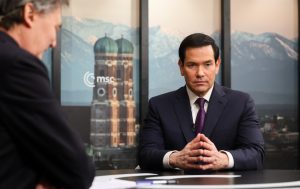
To reduce US policy to one person’s ambition would be simplistic. But to ignore the Cuban-American political machine would be naïve.
The early Cuban exile community that settled in Florida in the 1960s was disproportionately white and upper-class – business owners, professionals, landholders who had lost property in the revolution. They were fiercely anti-Castro, politically organized, and influential. Over decades, they built lobbying networks, media platforms, and fundraising operations that shaped US policy.
The Nation has chronicled how Republican candidates increasingly relied on Cuban-American voters in South Florida, hardening their rhetoric on Havana. The organized “Cuba lobby” became a durable force in Washington.
Marco Rubio is both a product and a driver of this ecosystem. Dr. Lamrani argues that Rubio has made the overthrow of the revolutionary government his personal mission:
“Marco Rubio, whose parents fled the dictatorship of Fulgencio Batista in 1956 – not the Cuban Revolution led by Fidel Castro – owes much of his political career to the Cuban community descended from the former Batista regime. He has set himself the goal of overthrowing the revolutionary government in Havana by any means necessary, including by triggering a severe humanitarian crisis on the island.
He is behind the presidential decree signed by President Trump on January 29, 2026, which designates Cuba as an “unusual and extraordinary threat” to the national security of the United States. To justify such a measure, Washington points out that Cuba maintains, among other things, relations with… Russia and China – exactly as the United States itself does.
Cuba is also accused of supporting international terrorism and has been placed on the blacklist of so-called state sponsors of terrorism. To assess the credibility of this list, it is worth recalling that the Biden administration removed Cuba from it in January 2025, on the final day of its term. The very next day, the first day of his new term, Trump reinstated Cuba on the list. By way of comparison, Nelson Mandela remained on this list until 2008, including throughout his entire presidency of South Africa.
Moreover, on January 29, 2026, the Trump administration adopted drastic measures aimed at depriving the island of oil, threatening trade sanctions against any country that exports fuel to Cuba, directly or indirectly. In Cuba, many critical infrastructures depend on oil: schools, hospitals, the drinking water supply system, 80 percent of the electricity grid, as well as transportation and numerous production facilities. Since then, the two main oil suppliers, Venezuela and Mexico, have stopped delivering this essential resource.”
The diaspora itself, however, is no longer monolithic. Since the 1980s, Cuban migration has diversified. Newer arrivals are more racially mixed and often less ideological. Many maintain close ties to family on the island. Dr. Chomsky emphasizes that these communities are not clamoring for war or starvation tactics. They want opportunity – for themselves and their relatives:
“The right-wing diaspora is very well-organized and well-funded, and it definitely plays a role. And Marco Rubio is glorying in his powerful position. But US determination to overthrow Fidel Castro began before there even was a Cuban diaspora. And Fidel Castro’s death didn’t seem to mitigate the US position either. It’s worth noting, though, that the organized “Cuba lobby” does not necessarily represent all or even most of the Cuban diaspora. The 1960s generation mostly came from the white upper classes, who were intent on overthrowing Cuba’s government. But since the 1980s, Cuban migration has come to look a lot more like migration from elsewhere in the Caribbean. It’s much more multiracial, and it’s people who come because their future looks hopeless at home, and they want a better life and hope that they can find more opportunity here. They are much less ideological – they have lived the good, the bad, and the ugly of the Revolution and have a much more nuanced view of what it accomplished and what it failed to accomplish. And they still have close family and friends on the island – the last thing they want is the embargo, a war, or a blockade that is going to cause more suffering for those who remain there.”
Diaspora politics are complex. The Army University Press has written about how diasporas influence American foreign policy, often amplifying hardline stances. The Lansing Institute recently outlined US “strategic options” for dismantling Cuban authoritarianism. Yet academic work from Cambridge on Cuba’s own “diaspora statecraft” shows Havana has also cultivated ties with emigrants, seeking remittances and political moderation.
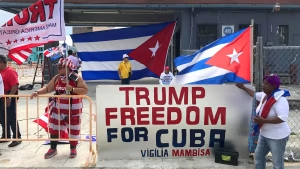
Exile politics can cut both ways. In Venezuela, overseas opposition networks have shaped narratives and lobbying efforts, as documented by the International Crisis Group. Cuba’s story is distinct but rhymes.
While the right-wing diaspora is organized and influential, it does not speak for every Cuban-American. That nuance often disappears in Washington soundbites.
The oil squeeze is landing on an economy already buckling.
According to reporting from Associated Press and Miami Herald, Cuba entered 2026 facing food shortages, inflation, and a struggling tourism sector. The pandemic decimated visitor numbers. US sanctions limited access to credit and trade. Domestic reforms moved slowly.
Now fuel is running out.
Dr. John Kirk, professor emeritus at Dalhousie University (Canada), paints a stark picture. Cuba produces roughly 30 percent of its fuel needs, but the oil is heavy in sulfur and limited in use:
“Social conditions in Cuba at the moment are grim – mainly the result of the Trump administration’s embargo on any country that supplies fuel to Cuba. Oil had previously come from Venezuela (until President Nicolás Maduro was taken by US forces) and then from Mexico (until threats of extra tariffs and the upcoming USMCA trade negotiations were mentioned). Cuba can produce an estimated 30% of fuel for its needs – but it is heavy in sulfur and can only be used for certain functions. The Financial Times recently reported that it has fuel for 2-3 more weeks before it runs out.
Try and imagine what life is like when there is no fuel. There is virtually no public transportation. There are daily blackouts throughout the country. (Friends in Havana told me that two days ago they went 10 hours without electricity). Factories are closed down. Getting water is increasingly difficult at places where electricity is used to pump it. There is a major difficulty in bringing food from the field to city markets. There is no garbage pickup – resulting in mounds of garbage piling up. Healthcare is also affected when there is no fuel for generators. Cuban media had a story last week that 37,000 pregnant women are unable to have ultrasound scans, and access to x-rays, CT scans, and any tests requiring electricity has been cut back.
Cuba is facing a humanitarian crisis – the result of a policy of choking off oil to the island.”
The situation quickly becomes dire. Euronews quotes the health minister warning that the healthcare system is being pushed to the brink. Fortune and Dow Jones have described a country edging toward systemic failure.
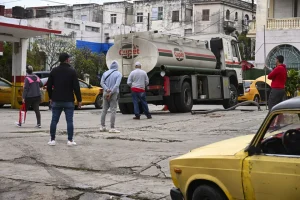
The UN has warned of humanitarian collapse. Religious organizations like the World Council of Reformed Churches have issued statements condemning the blockade. Even business outlets such as the Financial Post note that segments of Cuba’s emerging private sector – once touted as a reform bright spot – are suffocating under fuel shortages.
This is what comprehensive energy denial looks like in practice. Not dramatic explosions. Slow degradation.
The blockade has not gone unanswered.
Russian President Vladimir Putin publicly condemned the sanctions in remarks carried by Euronews and Democracy Now!. China’s Foreign Ministry also keeps reiterating the country’s stance against the embargo. Caribbean leaders meeting at the 2026 CARICOM summit warned against military escalation, according to The Guardian. Canada has explored humanitarian aid options, reported the Associated Press.
Grassroots solidarity efforts are underway. A “Nuestra América“ convoy is expected to arrive in Havana in March, carrying supplies. Campaigners in Britain have welcomed a Cuban solidarity flotilla, as covered by the Morning Star. CounterPunch describes small Global South nations expressing solidarity against what they call Washington’s “barbaric blockade.”
Meanwhile, Rubio has been meeting Caribbean leaders, pressing them to align with US policy, as reported by France 24.
The risk of escalation lingers. If a Russian-flagged tanker attempts to dock in Havana, does the US interdict it? Dr. Chomsky raises the specter of missile-crisis-style brinkmanship. The administration insists this is economic statecraft, not naval warfare. Yet oil tankers are physical objects. They sail through contested waters.
Will this blockade succeed where six decades of sanctions have not?
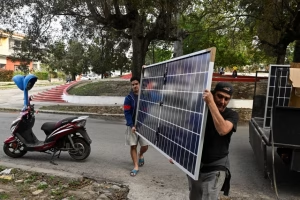
Cuba’s government has proven resilient. It survived the “Special Period” of the 1990s after Soviet subsidies evaporated. It adapted to tourism, remittances, and limited private enterprise. It endured the pandemic.
But this moment feels different. Oil is foundational. Dr. Kirk’s description – no buses, no garbage pickup, hospitals on edge – suggests not just hardship but systemic breakdown.
And yet, regime change via deprivation carries moral and strategic risks. Humanitarian crises rarely unfold neatly. They generate migration surges, regional instability, and unpredictable political outcomes. They can harden nationalism rather than dissolve it.
Rubio and his allies argue that only maximal pressure can force democratic transition. Critics counter that collective punishment entrenches the very leadership it seeks to topple.
The diaspora remains divided. Some cheer the squeeze. Others fear for family members on the island. International actors weigh solidarity against caution. The United States, confident in its economic might, is betting that this time the pressure will break Havana.
History offers no simple answer. The embargo has outlasted 11 US presidents and multiple Cuban leaders. It has shaped generations.
Now the question is whether an oil embargo – targeted, immediate, and unforgiving – will rewrite that history or simply deepen the suffering in a long, unresolved conflict.
For the people of Cuba, the debate is measured in hours of electricity, in bus routes canceled, and in hospital generators humming through the night.
And in the uneasy sense that a Cold War ghost has returned, this time with a fuel gauge hovering near empty.

The latest news in your social feeds
Subscribe to our social media platforms to stay tuned