





Trump’s $1,000 Pitch: a Quick Fix for Retirement — or a Political Stunt?

The Washington Post, Axios, CNBC, the Hill, and CBS News contributed to this report.
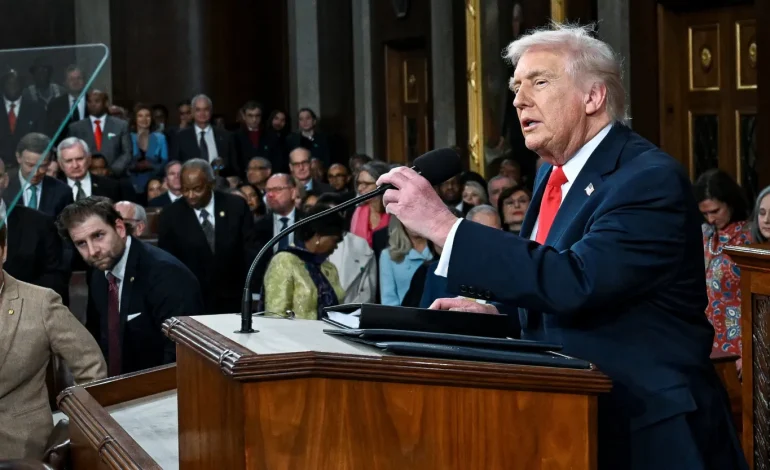
President Donald Trump rolled out a shiny, simple-sounding promise in Tuesday night’s State of the Union: give the roughly 54 million Americans who don’t have workplace retirement plans access to an account like the federal Thrift Savings Plan, and toss in up to $1,000 a year as a match. The line landed well in the chamber — applause, TV headlines, campaign fodder — but under the polished surface there are legal limits, messy details, and real doubts about how much the idea would actually help the people it’s supposed to help.
Here’s what matters, and what to watch.
On paper, the proposal feels simple: portable accounts, low fees, a government match. The White House is pointing to the federal model and to a provision in the Secure 2.0 law already on the books that creates a “Saver’s Match” — effectively up to $1,000 per year for qualifying savers who put in $2,000. Trouble is, the executive branch doesn’t get to just wave a wand and send cash to millions of private-sector workers. The government can build account infrastructure and nudge take-up, but it can’t unilaterally appropriate money or compel enrollment. Congressional action is needed to lock in broad matching and the kind of automatic enrollment the White House hinted at.
Treasury Secretary Scott Bessent said the administration is eyeing reconciliation to push the idea through — a legislative route that can bypass some Senate hurdles — but that still requires votes and tradeoffs.
People selling the plan as a cure-all point to the $1,000 match tucked inside Secure 2.0. But that match only kicks in for households under certain income caps (the administration has mentioned figures like $25,000 for singles and about $41,000 for couples in some briefings), and only if those workers actually contribute $2,000 themselves. In other words: you don’t get a free $1,000 unless you first find $2,000 to put aside — a tall order for many low-income households.
John Lettieri of the Economic Innovation Group frames the pitch as closing a real gap. He argues that directing retirement tax breaks and matching down the income ladder can help people build wealth over time. And yes: getting people into markets with matching contributions is a proven way to raise balances over decades.
But not everyone is convinced it will move the needle where it’s needed most.
Teresa Ghilarducci — who’s worked on similar ideas — says making accounts simple and automatic could be a big deal. If people can check a box on a tax form and have an account follow them between jobs, that removes a key behavioral hurdle.
Still, Matt Bruenig points out the hard truth: many low-income Americans simply can’t spare $2,000 a year. Surveys show a tiny fraction of households under certain income thresholds actually save for retirement. What’s more, automatic accounts don’t solve urgent cash-flow problems — people choose short-term survival over long-term saving when times are tight.
KC Boas notes another wrinkle: retirement accounts often double as emergency savings, for better or worse. If accounts lack liquidity options or if people are afraid of penalties, they might never fully commit. And certain public benefits are means-tested; lawmakers will need to figure out whether savings in these new accounts would count against programs like Supplemental Security Income.
Jason Fichtner urges caution: any plan should be additive — not a swap that chips away at other safety-net supports lower-income people rely on.
The pitch helps from a messaging perspective: it’s an electoral-friendly idea that sounds like helping “forgotten” workers. But delivering it is a different beast. A White House can build account systems, enlist private firms, and nudge people toward savings. To guarantee a universal match or full auto-enroll, Congress has to legislate funding and rules. That means votes. That means compromises. And that means the policy that emerges could look very different from the State of the Union soundbite.
A coalition of financial firms, unions and companies — names like Charles Schwab, AARP, DoorDash and Uber have reportedly engaged around similar bills — suggests there’s some cross-sector appetite for a legislative fix. But skeptical voices like Romina Boccia argue that taxpayers shouldn’t be asked to underwrite broad matches, and that the retirement system would be better served by simplifying tax-advantaged accounts rather than creating more complexity.
Practical changes with real impact tend to be modest and structural: automatic enrollment at small firms, portable accounts tied to workers, low-fee default portfolios, and targeted matching that reaches people who can and will save if the barriers are removed. Coupling those with financial coaching, emergency-savings options, and protections so that benefits don’t wipe out means-tested aid could make the difference between a PR win and a policy win.
For now, the takeaways are plain. The State of the Union pitch puts retirement access back on the national scoreboard — and that’s worth something. But the $1,000 line? It’s aspirational until Congress signs off, money is appropriated, and the messy details are worked out. Until that point, the plan is mostly a powerful talking point, not a delivered benefit.


The latest news in your social feeds
Subscribe to our social media platforms to stay tuned