

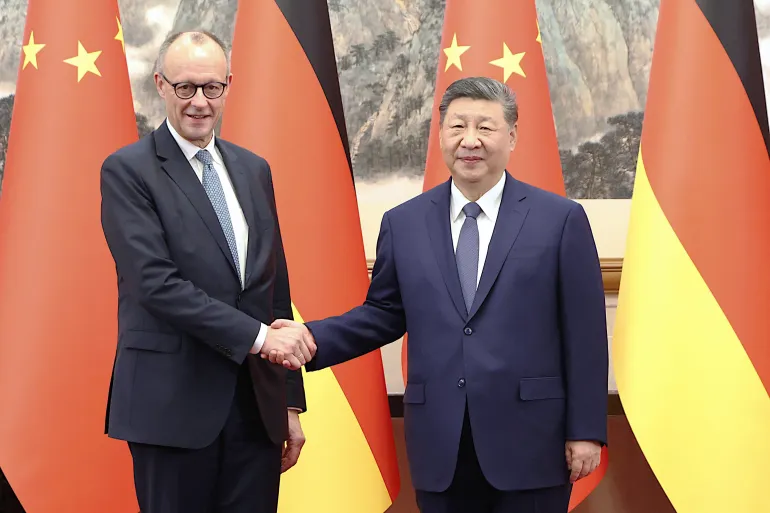


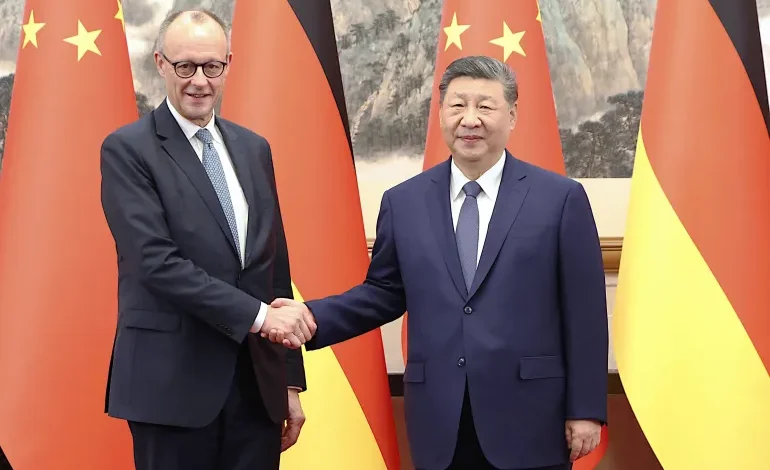

Friedrich Merz arrived in Beijing promising a reset in economic relations, and his first meeting with Xi Jinping produced the familiar language of partnership — along with a clear acknowledgement that the relationship now runs through a more complicated global landscape.
Xi told the German chancellor the two countries should be “reliable partners that support each other” and act as “defenders of free trade”, according to state broadcaster CCTV, framing the relationship as a stabilising force at a time of tariff disputes and geopolitical tension. He added that China supported Europe’s self-reliance and hoped the bloc would “work with China in the same direction” to uphold their strategic partnership.
For Merz, the trip was about maintaining Germany’s long-standing economic ties with its largest trading partner while confronting the growing imbalance in that relationship.
“There are challenges, which we should talk about today, but the framework in which we operate is exceptionally good, and we have worked together very well over the past decades,” he said, describing a partnership that remains essential for German industry even as competition from Chinese manufacturers intensifies.
The numbers illustrate the shift. Chinese exporters built a 90-billion-euro trade surplus with Germany last year, a gap that has quadrupled since 2020. “This dynamic is not healthy,” Merz said, urging Beijing to reduce market distortions and create fairer conditions for European firms while also encouraging Chinese investment in Germany.
Beijing, for its part, leaned into the broader political context. In talks earlier with Premier Li Qiang, the Chinese leadership called for joint efforts to “safeguard multilateralism and free trade”, an implicit contrast with the tariff policy of United States President Donald Trump. The message was that economic cooperation between the world’s second- and third-largest economies can serve as a counterweight to global fragmentation.
The visit also produced a tangible commercial signal. Merz said China had agreed to buy “up to 120” aircraft from Airbus, presenting the deal as evidence that high-level diplomacy still delivers for Europe’s export-driven economy.
Taiwan also surfaced in the talks, with Merz stating that any “reunification” must be peaceful — a formulation that reflects Europe’s attempt to maintain economic engagement with China while drawing clear lines on security issues.
Both sides wrapped the visit in the language of cooperation, issuing a joint statement backing a ceasefire in Ukraine based on the UN Charter, calling for fair competition and mutual market access, and pledging continued dialogue on climate and the green transition. Agreements and memorandums were signed on climate change and food security, and Merz announced further ministerial visits in the coming months, underlining the intention to keep communication channels open.
“The more turbulent and intertwined the world becomes, the more China and Germany need to strengthen strategic communication and enhance strategic mutual trust,” Xi said, capturing the logic behind the trip: a relationship that is simultaneously more necessary and more contested.
The latest news in your social feeds
Subscribe to our social media platforms to stay tuned