


Citizen scientists discover record-breaking coral on Great Barrier Reef

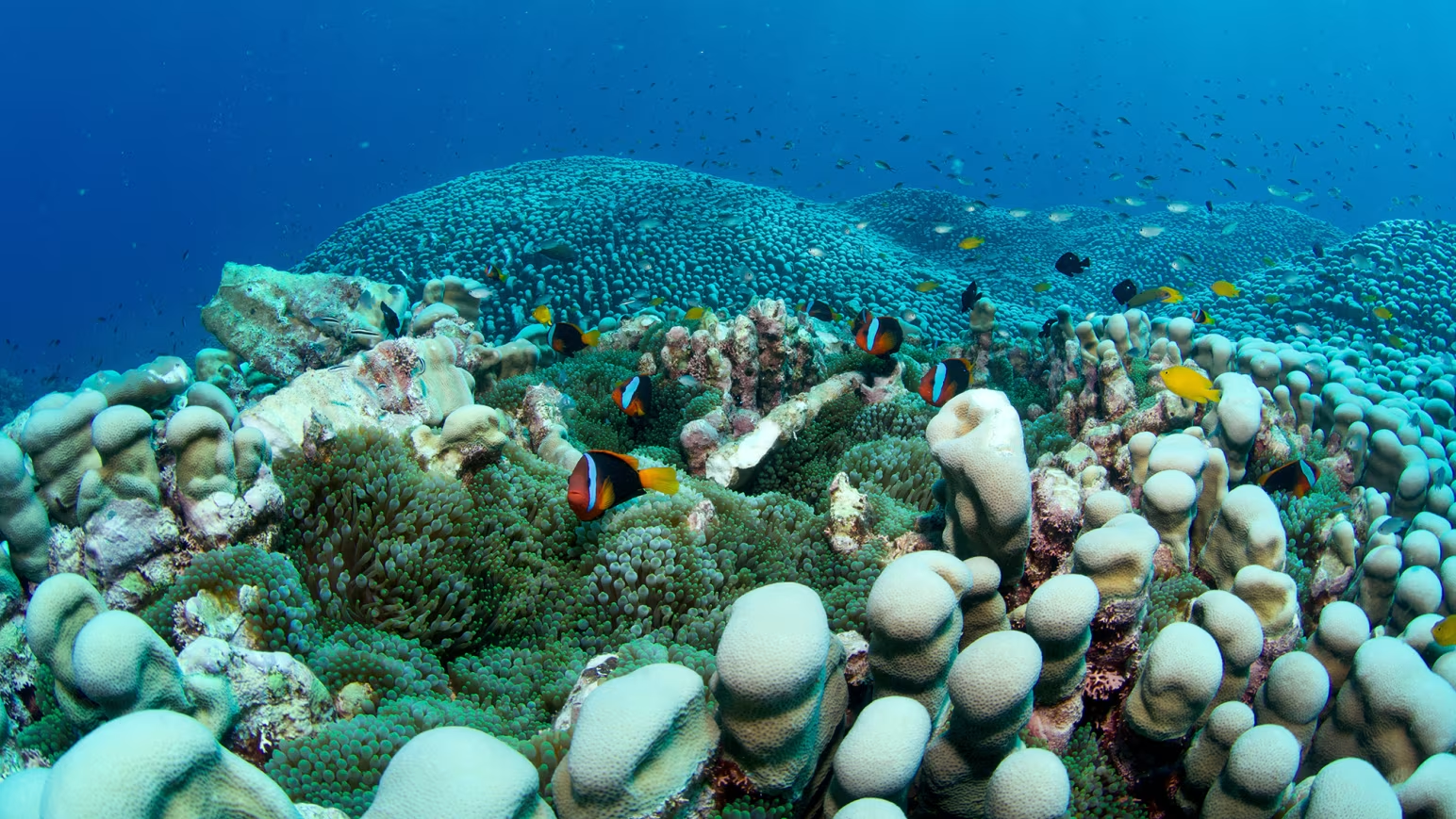
A routine survey trip turned into one of the most significant coral discoveries in recent years when a mother and daughter mapping reefs off Australia located what is now considered the largest documented coral colony on the planet.
Stretching about 111 metres — roughly the length of a football pitch — and covering close to 4,000 square metres, the massive Pavona clavus formation has been verified as “the largest documented and mapped coral colony in the world,” according to conservation group Citizens of the Reef. Its scale places it among the most important coral structures ever recorded on the Great Barrier Reef.
The find was made late last year by marine operations coordinator Sophie Kalkowski-Pope and her mother, veteran diver and underwater photographer Jan Pope, while they were surveying reef health as part of the Great Reef Census. Pope had already noticed the formation during an earlier dive and returned with her daughter to measure it properly.
“When we hopped in the water, immediately I could recognize the significance of what we were seeing,” Kalkowski-Pope said, describing how it took a continuous three-minute swim simply to cross the J-shaped coral from end to end.
Its size was confirmed using manual underwater measurements combined with high-resolution surface imagery. Researchers then used the data to build a detailed 3D model — a tool that will allow scientists to return to the site and make direct comparisons over time to track growth, damage or recovery.
That modelling, said Serena Mou of Queensland University of Technology’s Centre for Robotics, provides a baseline for long-term monitoring and offers a rare opportunity to watch how a single giant coral structure responds to environmental change.
Scientists are now studying the conditions that allowed such an enormous colony to form. The site experiences strong tidal currents but is relatively sheltered from tropical cyclone waves — a combination that may have protected it from the physical damage that affects many other reef areas.
The exact location has not been made public in order to “reduce the risk of unintended impacts,” a reflection of how vulnerable even the most resilient coral systems have become.
The discovery lands at a time when coral ecosystems globally are under severe stress. The Great Barrier Reef — the largest living structure on Earth — has been hit repeatedly by mass bleaching, and more than 80 percent of the world’s reefs have been affected by a global bleaching event that began in 2023 as ocean temperatures reached record highs. Bleaching strips corals of the algae that feed them, often leading to death.
Against that backdrop, the find is being framed not just as a scientific milestone but as evidence of where recovery and protection efforts might be focused. The Great Reef Census, which involves more than 100 vessels collecting reef imagery, is designed to identify precisely these kinds of strongholds.
“The Great Reef Census helps us to locate the most important sources of reef recovery, helping scientists and managers better target their protection,” said Pete Mumby of the University of Queensland.
The project is built on large-scale public participation — “people power,” as Citizens of the Reef CEO Andy Ridley described it — using the fact that thousands of boaters and divers are already on the water to gather data at a scale traditional research programs struggle to match.

The latest news in your social feeds
Subscribe to our social media platforms to stay tuned