


Behind fortified walls on the outskirts of Marrakesh, the Bin Ennakhil estate is designed to disappear from public view. Its 4.6 hectares are arranged as a sequence of enclosed spaces: marble fountains feeding mosaic courtyards, gold-draped salons opening onto olive groves and more than 2,000 palms, a carved-ceiling hammam and a pool set in manicured gardens. It is a property built for privacy — and, in the summer of 2019, it briefly became the focus of a last, hurried financial manoeuvre by Jeffrey Epstein.
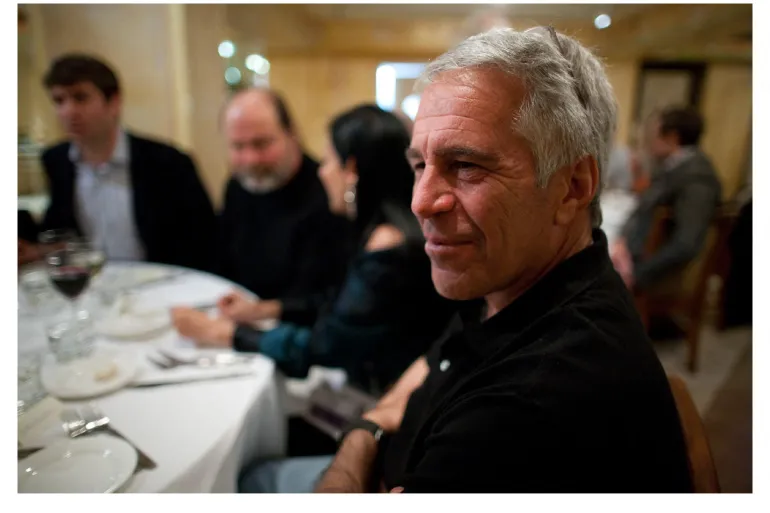
A wire transfer request dated July 4, 2019, and bearing Epstein’s signature, sought to move funds for the purchase of the palace in a country with no extradition treaty with the United States. Two days later, he was arrested at Teterboro Airport in New Jersey on federal charges of sex trafficking and conspiracy.
Newly released US Department of Justice documents show that the attempted purchase was not a late impulse but the culmination of months of negotiations. Emails indicate that by February 2019 a deal was taking shape to acquire the property for about 25 million euros through a layered offshore structure involving a British Virgin Islands trust and a Liechtenstein company. The proposed buyer was listed as “The Haze Trust”, and the arrangement, a broker noted, would “save 7% in government taxes”.
The correspondence was handled by Karyna Shuliak, described at the time in media reports as Epstein’s girlfriend and an employee of his companies, who conducted the talks on his behalf.
But by early 2019 the financial channels that had long facilitated Epstein’s transactions were beginning to narrow. Internal banking records show a wire transfer linked to “Epstein, Jeffrey E.” was marked “Rejected” by Deutsche Bank on March 13. The documents do not specify the reason, though the bank was in the process of closing his accounts that year.
Around the same period, Epstein turned to Charles Schwab, which opened three accounts in April for companies connected to him, including Southern Trust, the entity involved in the Marrakesh deal. On June 26, Southern Trust instructed Schwab to transfer roughly 11.15 million euros to a Swiss account belonging to Marc Leon, the realtor handling the sale. The next day the bank received a request to reverse the transaction, and the money was scheduled to be returned on July 10.
The July 4 wire request for $14.95m — submitted two days before Epstein’s arrest — failed for a more immediate reason: the earlier funds had not yet been credited back, leaving the account without sufficient balance. That transfer was cancelled on July 9.
By late July, internal communications among federal investigators were already referring to an attempt to send money to Switzerland. Schwab told Reuters it had concerns about the real estate transfers “in light of negative media surrounding Jeffrey Epstein” and the possibility that he posed a flight risk ahead of a bail hearing.
The records capture a moment when Epstein’s long-standing ability to move money through complex international structures was colliding with intensifying legal scrutiny. Tens of millions of dollars were being sent abroad and then pulled back as compliance teams flagged transactions and banks reassessed their exposure.
Morocco had appeared in Epstein’s network years earlier. Emails examined by France Télévisions show that in 2002 Daniel Siad, described by witnesses as a recruiter for Epstein, sent him a photograph of a young woman in Marrakesh with the message: “Cute French girl in Marrakech.” A woman later questioned by French police said Siad “wanted me to meet girls for Epstein, to give him massages, prostitution” and showed her images of Moroccan girls to gauge his interest. She told investigators she refused because she did not want “another girl to suffer”.
For years after his 2008 Florida conviction for soliciting a minor for prostitution — which resulted in a widely criticised plea agreement and a 13-month sentence — Epstein returned to a life that moved between properties in Manhattan, Palm Beach, the US Virgin Islands and Paris, maintaining ties in finance, academia and politics. That changed in late 2018, when the Miami Herald published an investigation that brought new testimony from accusers and triggered a renewed federal case.
His arrest on July 6, 2019, halted the palace negotiations. Searches of his homes in New York, Florida and the Virgin Islands yielded electronic devices and, according to court filings, hundreds or possibly thousands of sexually suggestive photographs of girls. A proposed $100m bond that would have allowed him to remain under house arrest in his Manhattan residence was rejected by US District Judge Richard M Berman, who ruled that Epstein posed a danger to the community and a serious flight risk.
The Marrakesh estate was never purchased. Instead of the seclusion offered by its courtyards and gardens, Epstein was held at the Metropolitan Correctional Center in Manhattan, confined to a small cell behind steel doors. Weeks later, he was found dead there. The New York City medical examiner ruled the death a suicide.


The latest news in your social feeds
Subscribe to our social media platforms to stay tuned