


EXCLUSIVE: Caribbean aid can’t run Cuba’s power grid
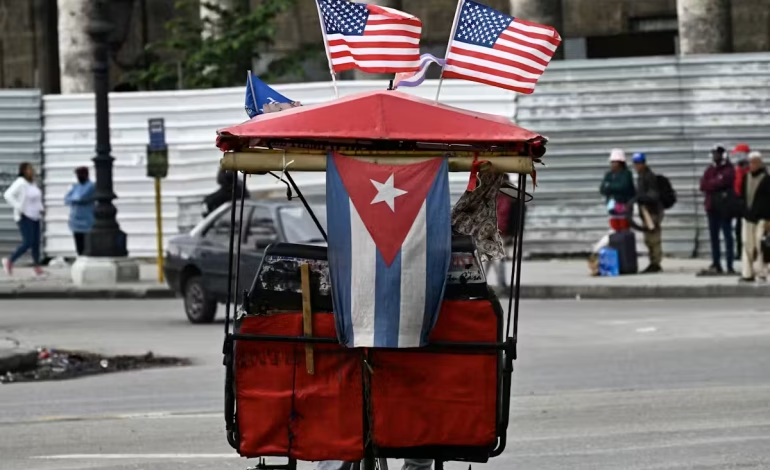


Caribbean governments are moving to soften the impact of a deepening crisis in Cuba, but the region’s own messaging has started to reveal an uncomfortable reality: food parcels and medical kits can steady a population for a moment, yet they do not solve the problem that is actually shutting the island down.
That was the backdrop to last week’s Caribbean Community (Caricom) summit in St Kitts and Nevis, a four-day meeting that ended with a pledge to deliver humanitarian assistance to Cuba. The commitment was announced at a press conference on Friday, with Caricom chair Terrance Drew saying the 15-country bloc would respond “in a significant way to help the humanitarian situation in Cuba” within a month. The summit took place as US Secretary of State Marco Rubio met Caribbean leaders to discuss Washington’s regional relationships, and as tensions escalated after US forces arrested Venezuelan leader Nicolás Maduro and the Trump administration imposed an oil blockade on Cuba in January.
At the opening of the meeting, Jamaica’s Prime Minister Andrew Holness framed the stakes in practical terms: “severe economic hardship, energy shortages and growing humanitarian strain”, and the risk that those pressures could spill across borders. Caricom’s aid promise fits that logic — keep conditions from collapsing outright, reduce the incentive for destabilising migration flows, and demonstrate regional solidarity.
But the deeper question is whether anyone can address the core shortage: fuel.
William LeoGrande, a professor of government at American University, put it bluntly to The Wyoming Star:
“It is possible that China or Russia might come to Cuba’s assistance. Rusia has pledged to provide support, but a Russian oil tanker that was reportedly on its way to Cuba has changed course. Mexico is reportedly trying to convince Washington that it be allowed to provide some oil as humanitarian aid, and has already provided some food and medicine. And Canada has announced it will provide humanitarian aid. But although humanitarian aid is important, it is just a bandaid if no one dares to ship oil to Cuba.”
That line captures the bind forming around Cuba. Assistance is being promised and, in some cases, already delivered. Mexico, as LeoGrande notes, has reportedly sent food and medicine and is trying to persuade Washington to allow an oil shipment on humanitarian grounds. Canada has announced it will provide humanitarian aid. Those moves matter, especially when blackouts and transport shortages ripple outward into every part of daily life. Yet none of it changes the structural problem if suppliers and shippers treat the fuel embargo as a hard red line.

The summit’s politics hinted at why even a coordinated regional response might struggle to take a sharper shape. Asked whether Caricom would issue a joint statement condemning US military intervention in the region — a campaign that has included strikes against suspected drug-smuggling boats — Drew said the bloc was still gathering information to “ensure … a complete and comprehensive response”. Caribbean analyst Peter Wickham suggested internal disagreement is a key obstacle, pointing to Trinidad and Tobago’s Prime Minister Kamla Persad-Bissessar, who has publicly praised the US campaign and argued it has reduced crime at home. In that environment, Caricom can coordinate some assistance, but it has less room to act as a unified political front.
Drew leaned into that limitation, telling reporters:
“Caricom does not have a homogeneous … or a single foreign policy – that is left up to sovereign states.”
He added that the organisation is not a political union, a reminder that the bloc’s strength is convening, not coercing. That matters because Cuba’s crisis is now inseparable from US pressure tactics, and Caricom’s membership includes governments that read Washington’s actions very differently.
Still, even without a common political line, the region is trying to manage the fallout. Drew also said Caricom and the US would work towards a new cooperation framework covering migration, security, trade, disaster recovery and technical assistance, superseding older arrangements like the Caribbean Basin Initiative. That is the broader diplomatic setting in which aid to Cuba is being discussed: Caribbean leaders are trying to keep channels open to Washington while simultaneously facing a crisis Washington has helped intensify through its oil blockade.
What emerges is a two-track reality. The public-facing track is humanitarian: get supplies in, relieve pressure, show the region is not indifferent. The harder track is energy: whether any country, company, or shipper is willing to move fuel to Cuba under the shadow of US enforcement. LeoGrande’s point is that the second track is the one that decides whether the first track is meaningful beyond the short term.
For Cuba, that is not an abstract distinction. Fuel underwrites electricity generation, refrigeration, transport, and the ability of hospitals and water systems to function consistently. For Caricom, it is also not abstract: prolonged instability in Cuba is not neatly containable, particularly for nearby states that would feel knock-on effects through migration, commerce and regional security.

The latest news in your social feeds
Subscribe to our social media platforms to stay tuned