

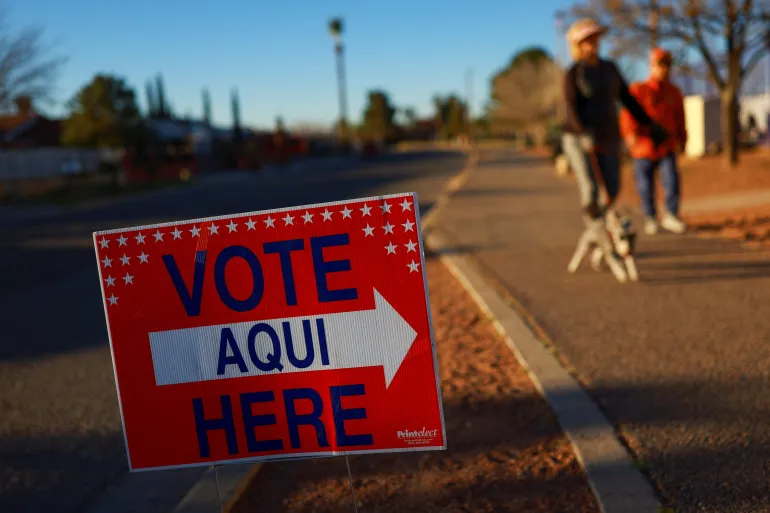



US President Donald Trump says he will refuse to sign any new legislation until Congress passes a bill imposing stricter identification requirements for voters, escalating a long-running political fight over election rules ahead of the November midterm elections.
In a post on his Truth Social platform on Sunday, Trump said he would block other legislative action unless lawmakers approve the SAVE America Act, a measure designed to tighten documentation requirements for voters.
“I, as President, will not sign other Bills until this is passed,” Trump wrote.
The statement reinforces Trump’s continued focus on election administration even as international developments dominate global headlines.
Trump has for years argued that US elections are affected by widespread fraud, despite repeated analyses finding such cases to be extremely rare and historically insignificant.
The SAVE America Act, which passed the House of Representatives in February, would introduce stricter requirements for proving citizenship when registering to vote and for verifying identity when casting ballots on Election Day.
The legislation would also create criminal penalties for election officials who register voters without the required documentation. Under the version approved by the House, states would be required to compare their voter registration rolls against a federal database in order to identify potential non-citizen voters.
Voting rights groups have long warned that stricter documentation rules can effectively exclude large numbers of eligible voters. Advocates often point to the fact that roughly half of US citizens do not possess a valid passport, which is one of the most widely accepted forms of proof of citizenship.
The proposal faces steep resistance in the Senate. Democrats have pledged to block the bill, which would need 60 votes to overcome procedural hurdles. The chamber is currently divided between 53 Republicans and 47 Democrats and Democratic-aligned independents.
Senate Minority Leader Chuck Schumer sharply criticized the measure, describing it as “Jim Crow 2.0”, a reference to the segregation-era laws that historically suppressed Black voting rights in the United States.
He also warned that Trump’s refusal to approve other legislation until the bill passes could paralyze the legislative process.
According to Schumer, the president’s position would produce “total gridlock in the Senate”.
The dispute is unfolding as political tensions rise ahead of the midterm elections, which will determine whether Republicans retain control of both chambers of Congress. Historically, the president’s party tends to lose seats during midterm cycles, and recent polling related to the Iran war, economic concerns and Trump’s overall approval ratings has created uncertainty for Republican candidates.
Trump has also urged his party to “nationalise” elections, a controversial suggestion given that under the US Constitution, elections are administered by state governments rather than federal authorities. Voting rights advocates have long argued that this decentralised structure serves as a safeguard against federal interference.
At the same time, the Justice Department has asked nearly every state to provide access to their voter registration rolls. Several states have challenged the request in court, arguing that the demand is “illegal”.
Federal law enforcement actions have also fueled political tensions. In January, the FBI seized voting records and ballots from the 2020 election during a raid on an election facility in Fulton County, Georgia.
The state remains central to Trump’s long-standing claim that his defeat in the 2020 election to former President Joe Biden resulted from a “stolen” vote.
Trump has never provided evidence supporting those allegations, and courts across the country have repeatedly rejected claims of election fraud tied to the race.

The latest news in your social feeds
Subscribe to our social media platforms to stay tuned