




A large, retired NASA spacecraft may plunge back into Earth’s atmosphere as early as Tuesday evening — years earlier than scientists originally predicted.
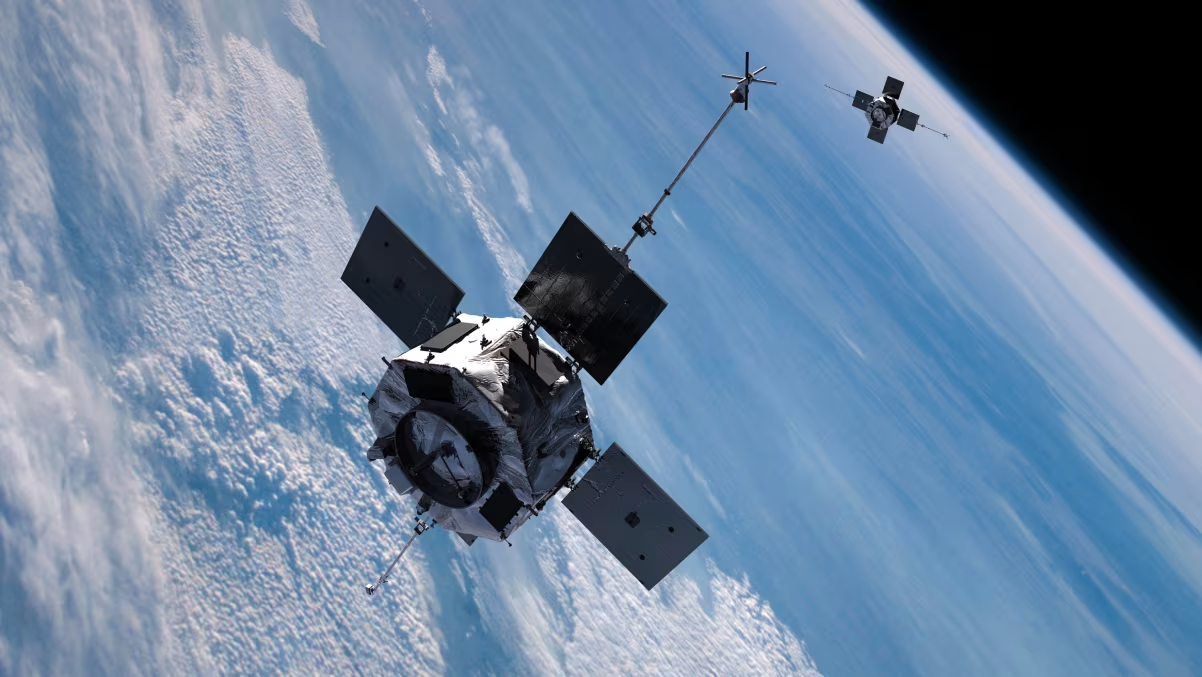
According to NASA and the US Space Force, the defunct Van Allen Probe A, which weighs about 1,323 pounds (600 kilograms), is expected to reenter the atmosphere around 7:45 p.m. ET on Tuesday. However, officials say the timing remains uncertain within a window of about 24 hours.
Most of the spacecraft will likely burn up during the fiery descent, but NASA says some fragments could survive the reentry and reach the ground.
The probability of debris harming a person is estimated at about 1 in 4,200. While that may sound concerning, experts say the risk is still relatively low compared with other everyday hazards.
“We’ve had things that have reentered have a 1 in 1,000 chance, and nothing happened; if we have a few that are 1 in 4,000 or 5000, it’s not a horrible day for mankind,” said Dr. Darren McKnight, a senior technical fellow at space-tracking company LeoLabs.
Even so, the estimated risk is higher than in some previous reentry events. For example, when China’s Tiangong-1 space station fell back to Earth in 2018, the odds of debris striking a person were estimated to be less than one in a trillion.
The spacecraft now returning to Earth is one of NASA’s Van Allen probes, a pair of satellites launched in 2012 to study the planet’s radiation belts. These belts are regions of highly energetic particles trapped by Earth’s magnetic field, stretching from roughly 400 miles to more than 58,000 kilometers above the planet.
Scientists study these belts because they play an important role in protecting Earth.
“The belts shield Earth from cosmic radiation, solar storms, and the constantly streaming solar wind that are harmful to humans and can damage technology, so understanding them is important,” NASA said.
During their mission, the two probes made several important discoveries about how the radiation belts behave, including identifying a temporary third radiation belt that can appear during intense solar activity.
Although the satellites were designed for a shorter mission, they remained operational for years before finally running out of fuel in 2019.
From the beginning, NASA planned for the spacecraft to eventually fall back to Earth and burn up in the atmosphere. Mission planners carried out manoeuvres at the end of the mission to remove leftover fuel and ensure atmospheric drag would slowly pull the satellites out of orbit.
Originally, scientists expected the spacecraft to remain in orbit until around 2034.
But the Sun’s current activity cycle has accelerated the process. In 2024, researchers confirmed that the Sun had entered a period known as solar maximum, when solar activity becomes much more intense. Those conditions expanded Earth’s upper atmosphere and increased drag on the spacecraft, pulling it down faster than expected.
As a result, the probe is now returning to Earth nearly a decade ahead of schedule.
NASA says this approach helps prevent dead spacecraft from drifting indefinitely in orbit, where they could collide with operational satellites or space stations.
The issue of space debris has become a growing concern as the number of satellites in orbit continues to increase. Experts warn that collisions between abandoned objects and active spacecraft could create large clouds of debris that threaten other missions.
“There’s been a lot more awareness of the importance of this issue,” said Marlon Sorge, a space debris specialist with The Aerospace Corporation.
In fact, experts say objects from space reenter Earth’s atmosphere more frequently than many people realize.
“We get about one object a week — a dead rocket body, another payload that isn’t maybe as high a profile as this. So that happens about once a week that some mass will survive to the ground,” McKnight said.



The latest news in your social feeds
Subscribe to our social media platforms to stay tuned