




With input from Reuters, USA Today, the Wall Street Journal, Bloomberg, and AutoNews.
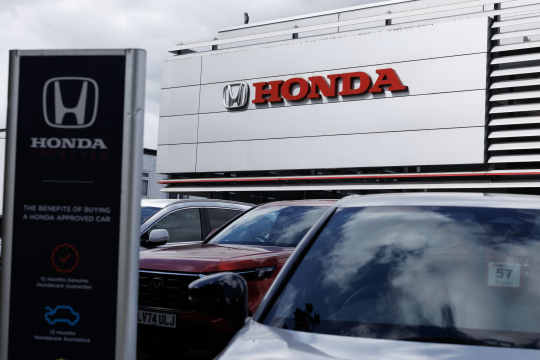
Honda slapped a massive ¥2.5 trillion (about $15.7 billion) write-down on its electric-vehicle push on Thursday, and it’s more than a one-off accounting headache — it’s a signal that bigger problems are waiting, especially in China.
The automaker said it will restructure its EV operations — mostly in the United States — cancel three US-built battery models and take hits on some China assets. That move pushes the company toward its first annual loss since it went public almost 70 years ago. The US pullback includes ditching the Saloon, the Honda 0 SUV and the Acura RSX that were set to roll out after the CES debut.
Why the reversal? Demand in the United States sagged after President Donald Trump rolled back incentives, and the economics of making those models just didn’t add up. Battery EVs made up only about 2.5% of Honda’s roughly 3.4 million global sales last year — roughly 84,000 cars — so the market simply hadn’t caught up to the scale Honda had been betting on.
There’s a cash sting, too: the company expects up to ¥1.7 trillion in outflows largely tied to supplier compensation and shutdown costs. That’s why people inside and outside the industry called the number shocking — budgets were committed, factories prepped, and then the plug was pulled right before mass production.
But the US retreat might be the easy part. Fixing the business in China could be a much steeper climb. The firm warned it can’t match newer Chinese rivals on fast development cycles and software-led features — think advanced driver assistance and slick, software-first user experiences. In China, Honda sold only about 17,000 battery EVs last year — barely a sliver of its local volumes and a small fraction of the global EV tally.
There’s also the joint-venture question. Honda’s tie-up with Sony Group on the Afeela sedan is under review, the company said — another area where strategic clarity will be needed.
Honda is swapping a scorched-earth reset for a hybrid-first pause in the US and doubling down on cost and market plays in places like India. Short term, it’s a painful clean-up. Long term, unless it narrows the tech gap in China and rethinks software and speed-to-market, this could be the start of a deeper rethink for Japan’s once-unshakeable carmakers.



The latest news in your social feeds
Subscribe to our social media platforms to stay tuned