

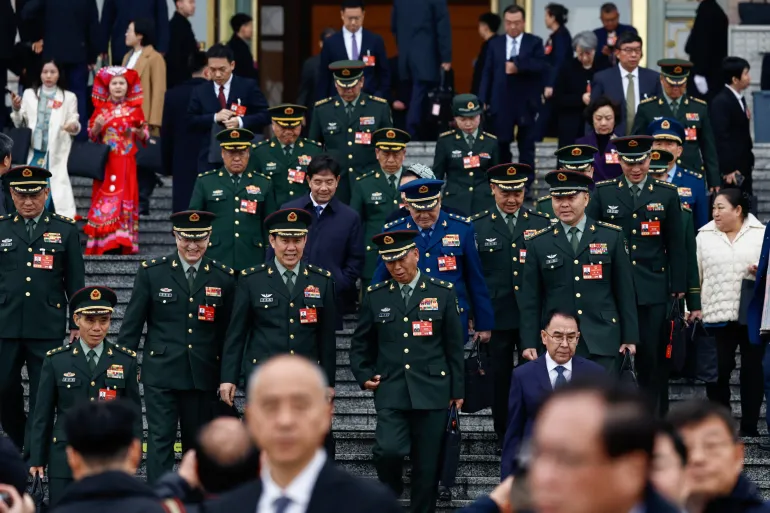


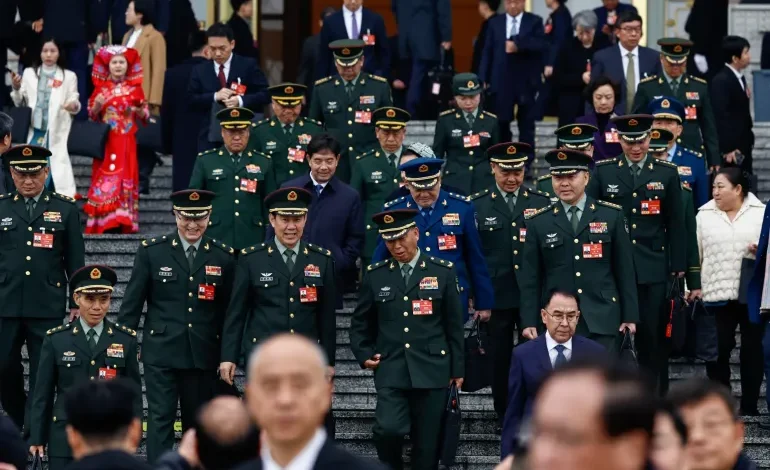

China’s annual “two sessions” are designed to project stability and control. This year, the absences told a different story.
As thousands of officials gathered in Beijing for the country’s most important political meetings, at least a dozen active and retired military officers were notably missing. Among them was General Zhang Youxia, one of the highest-ranking figures in China’s military hierarchy, now under investigation for “suspected serious violations of discipline and law”.
His absence is not an isolated case but part of a broader pattern. President Xi Jinping’s anticorruption campaign, launched shortly after he came to power in 2012, has long targeted both senior officials and lower-level cadres. What appears to be changing now is the scale and focus of the latest sweep.
Recent moves suggest a renewed and more expansive push inside the People’s Liberation Army. According to analysts, the campaign now reaches beyond top leadership circles into operational commanders, political commissars and officers across multiple military regions and branches.
In official rhetoric, the justification remains consistent. Corruption is framed not just as a governance issue, but as a direct threat to military effectiveness.
“Corruption is the biggest cancer eroding combat effectiveness. The more thoroughly we eliminate hidden dangers, the more promising the century-long battle against corruption will be,” China’s official military newspaper said.
That language reflects a shift in emphasis. The latest military work report placed anticorruption efforts alongside core priorities such as political discipline and loyalty, suggesting that internal control is being treated as a strategic concern rather than a secondary one.
Timing also matters. The campaign comes as the PLA approaches its 100th anniversary in 2027 — a milestone tied to long-term modernisation goals. Cleaning up internal structures appears to be part of preparing the military for that moment.
Analysts point to deeper systemic issues. The investigation into figures like Zhang may reflect longstanding problems within the military’s personnel system, where decisions made in previous roles can surface years later.
“My interpretation is that the leadership has discovered longstanding problems in the PLA’s personnel system. That may explain why a large number of generals and admirals have been removed or investigated while many positions remain unfilled – because officers across the system, possibly even senior colonels, are undergoing re-evaluation and investigation,” said Tristan Tang.
“As a result, when a unit commander is purged, it does not necessarily mean there was a problem within that unit; the issue may stem from actions taken in a previous post,” he added.
The visible outcome is a military structure in flux. High-level removals, ongoing investigations and unfilled positions point to a system being actively reshaped — even if that process temporarily disrupts its own chain of command.
The latest news in your social feeds
Subscribe to our social media platforms to stay tuned