



Bloomberg, CNN, BBC, the Wall Street Journal, and the Financial Times contributed to this report.
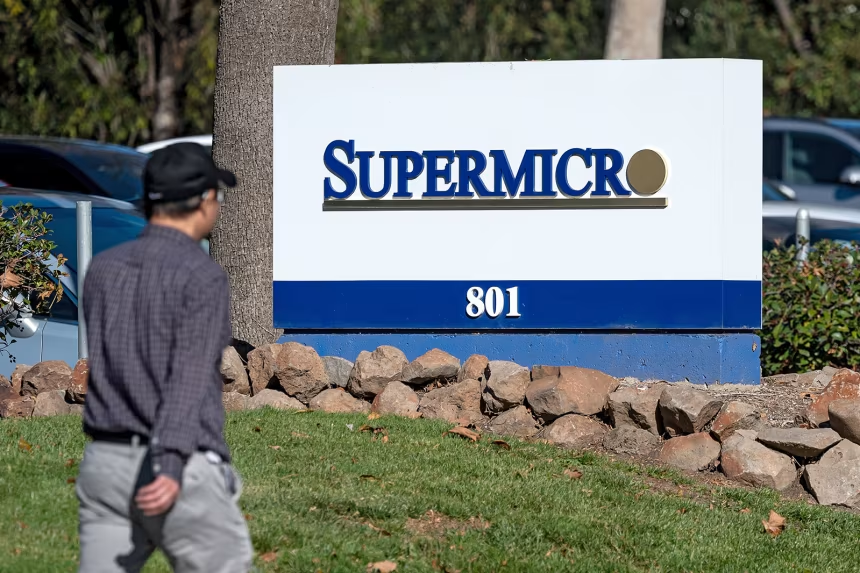
A co-founder of Super Micro Computer and two others have been charged in what federal prosecutors say was a sprawling scheme to funnel billions of dollars’ worth of AI-powered servers to China, skirting US export rules in the process.
The Justice Department says Yih-Shyan Liaw, known as Wally; Ruei-Tsang Chang, known as Steven; and Ting-Wei Sun, known as Willy, worked together to move about $2.5 billion in servers containing Nvidia artificial intelligence chips to Chinese buyers without the required licenses. Prosecutors accuse the trio of conspiring to violate export controls, smuggling goods from the United States and defrauding the government.
Liaw, who co-founded Super Micro Computer and sat on its board, was arrested in California on Thursday and later released on bail. Sun, who worked as a contractor, is being held pending a detention hearing. Chang, who worked out of Super Micro’s Taiwan office, remains at large.
Super Micro itself is not named in the indictment.
Still, the company moved quickly to distance itself from the case. In a statement Thursday, it said Liaw and Chang have been placed on administrative leave and that its relationship with Sun has been terminated. The company said the conduct described by prosecutors runs directly against its own policies and compliance rules, and added that it is cooperating fully with investigators.
The alleged scheme, according to the indictment, was built around a classic playbook: paperwork, shell entities and enough sleight of hand to make illicit shipments look legitimate. Prosecutors say the defendants used a pass-through company in Southeast Asia to place orders that hid the real destination of the servers. They then allegedly worked with company executives to create false records showing the servers were bound for a different end user.
That was only part of it. The indictment says the group also used a shipping and logistics firm to repackage the servers into unmarked boxes before sending them on to China. To get around audits, they allegedly staged “dummy” servers – fake, nonworking replicas that looked like the real thing – so inspectors would think everything was aboveboard while the actual machines were already on the move.
Prosecutors say the deception got so elaborate that some of the dummy servers were staged in a warehouse rented by the pass-through company. Sun allegedly photographed and filmed the setup for an auditor who, according to the indictment, was offsite and being entertained at the company’s expense instead of doing a real inspection.
In another instance, surveillance cameras reportedly caught people using hair dryers to peel off labels and attach new ones, along with serial-number stickers, to boxes and dummy equipment. It is the kind of detail that gives the case a slightly absurd feel, except there is nothing funny about it from the government’s point of view.
Jay Clayton, US attorney for the Southern District of New York, said schemes like this do more than break rules. They threaten national security. His message was blunt: when sensitive technology is involved, enforcement has to be fast and serious or the law loses its force.
At the center of the case are Nvidia chips, the high-end semiconductors that power much of today’s AI boom. Those chips are among the most tightly controlled US exports because of national security concerns, especially when it comes to China. In plain English, they are exactly the kind of hardware Washington has been trying to keep from slipping out of the country without permission.
Nvidia said it works closely with customers and the government on compliance, and warned that trying to divert controlled US computer systems to China is a losing move. The company also said it does not support such systems once they are unlawfully diverted.
The case lands in the middle of a wider fight over how much advanced AI hardware should be allowed to flow into China at all. The US government has tried to block Beijing from getting its hands on the most advanced chips, though it has also adjusted some export rules over time. That tug-of-war has made the whole area messy, expensive and very easy to abuse if companies are willing to fake the trail.
Federal prosecutors say the fake trail in this case was built with unusual care and scale. Company-1, the unnamed Southeast Asia-based firm in the indictment, is believed to have bought about $2.5 billion in equipment and sent huge quantities of servers with controlled US AI technology to China. The government says no export license was ever obtained.
This is not the only recent case of alleged AI-chip smuggling. In a separate matter in August 2025, two Chinese nationals were arrested and charged with illegally shipping millions of dollars’ worth of Nvidia chips to China through a chain of companies and shipping firms.
That broader pattern is what makes this case stand out. It is not just about one shipment or one rogue actor. Prosecutors are describing a network built to disguise the movement of highly sensitive tech at industrial scale, using fake paperwork, fake machines and fake destinations to get around the rules.
For Super Micro, the indictment is a reputational hit even though the company is not named as a defendant. The firm has spent years building itself into a major server supplier in the AI era. Now it finds itself tied, at least by personnel, to a case that cuts straight to the core of Washington’s national security concerns.
And for federal investigators, that seems to be the point of the charge sheet: not just to punish one alleged scheme, but to send a message that the AI supply chain is being watched closely, and that trying to quietly move restricted hardware to China is still a very bad bet.



The latest news in your social feeds
Subscribe to our social media platforms to stay tuned