




The Wall Street Journal, Bloomberg, Market Watch contributed to this report.
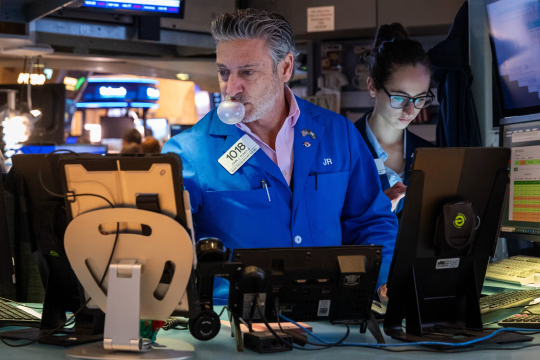
Wall Street tried to catch its breath on Friday, but the mood stayed shaky.
US stocks slipped as traders weighed a familiar but ugly mix: war, oil, and inflation. The big worry is still the same one that has been hanging over markets all week — the US effort to reopen the Strait of Hormuz and keep the conflict from turning into a full-blown energy crisis. That matters because every extra day of disruption keeps pressure on oil, shipping, inflation, and growth.
Brent crude, the global benchmark, was hovering around $109 a barrel after touching $119 on Thursday morning before sliding back later in the day. That pullback gave markets a little relief. Just not enough.
US stock indexes fell again after two straight sessions of losses, and all three major benchmarks are now on track for a fourth consecutive weekly decline. Europe was softer too after a stronger open, while Asia mostly finished in the red. Gold, meanwhile, kept sliding after a rough stretch that has now seen the metal fall in six of the last seven sessions. Treasury yields moved higher, and the dollar firmed.
It has been one of those markets where almost nothing feels stable. Oil spikes, then eases. Stocks bounce, then fade. Gold gets sold off. Bonds get hit. Traders are basically waiting for the weekend to see whether the war takes a sharper turn, shows signs of cooling, or just grinds on in the same ugly way.
Some of the pressure eased after Israeli Prime Minister Benjamin Netanyahu said Israel would no longer target energy infrastructure. That helped spark a little hope that both sides might step back from hitting the kind of facilities that can really blow up the global economy. Netanyahu also said Israeli forces would help the US try to reopen the Strait of Hormuz and suggested the war could end faster than people expect.
That is the optimistic reading. The messier version is still unfolding.
Iran kept up attacks on Arab states in the Persian Gulf. Kuwait shut several units at its Al Ahmadi refinery after repeated strikes. The UAE and Saudi Arabia said they intercepted missiles and drones overnight. Bahrain reported a warehouse fire. Israel said it hit infrastructure across Iran, including in Tehran. More than 4,200 people across the region have died since the war started.
And there is still no real sign this is winding down quickly. The Pentagon is said to have asked Congress for another $200 billion to fund the war, which is not exactly the kind of number that suggests a short operation. Defense Secretary Pete Hegseth brushed off talk of a quagmire and said the US is still “on plan.” Markets, naturally, are less comforted by slogans than by facts.
The worry is that even if oil has come off its highs, the damage has already been done. Prices do not have to stay at the top for the inflation shock to spread. Traders are also watching whether the war starts to change the policy response. Europe is already paying attention.
European Central Bank Governing Council member Joachim Nagel said the ECB may need to raise rates as soon as next month if inflation pressure keeps building because of the Iran war. That is a pretty stark reminder that this is no longer just about oil producers and tanker routes. It is about central banks, borrowing costs, and whether the war starts leaking into the broader global price level in a way that will be hard to reverse.
Gold is telling its own story. The metal is heading for its biggest weekly drop in six years, even after weeks of geopolitical panic. That sounds counterintuitive until you remember how gold trades in moments like this. It tends to shine when people expect lower rates or deeper fear. Right now, soaring oil and gas prices are pushing inflation concerns higher, which makes easier monetary policy less likely. That is bad news for gold, which does not pay interest.
Silver, palladium and platinum were also under pressure. So the precious-metals trade is no longer the obvious safe haven it looked like earlier in the week.
The war’s ripple effects are not stopping at energy and finance. In China, Alibaba and Tencent shed a combined $66 billion in market value in about a day after investors lost patience with their AI plans. That has its own set of reasons, but it adds to the broader sense that risk appetite is getting thinner everywhere. When investors are nervous, they stop pretending every growth story is a straight line.
There were a few corporate side stories too. JPMorgan is reportedly piloting a system to monitor whether junior bankers are overworking themselves by comparing claimed hours with digital activity. Unilever is considering a sale of its food business to McCormick, which would be a major reshaping of the company. And in India, several drugmakers are getting ready to sell generic versions of Novo Nordisk’s weight-loss drugs once patents expire, which should hammer prices down fast.
Still, the most immediate macro story is India, where the rupee sank to a record low as traders worried that a prolonged Middle East conflict will widen the country’s current-account gap. That makes sense. India imports most of its crude oil and a huge share of its liquefied petroleum gas, so it is especially exposed if oil keeps climbing. A weaker rupee and pricier crude are a nasty combination.
And then there is the bigger point investors are circling around: the war keeps forcing market participants to ask whether this is a shock that fades in days, or one that hangs around for months. That answer will determine whether oil’s recent pullback matters much at all.
For now, Friday looked less like a breakout and more like a pause. Traders are waiting to see whether the weekend brings escalation, some sort of diplomatic opening, or just more of the same. That uncertainty alone is enough to keep markets nervous.
Right now, the message is simple: oil may have backed off a little, but Wall Street still does not trust the calm.



The latest news in your social feeds
Subscribe to our social media platforms to stay tuned