



The original story by Camila Domonoske for NPR.
When the Strait of Hormuz goes almost dead quiet, the global oil market does not just get nervous. It gets punched in the mouth.
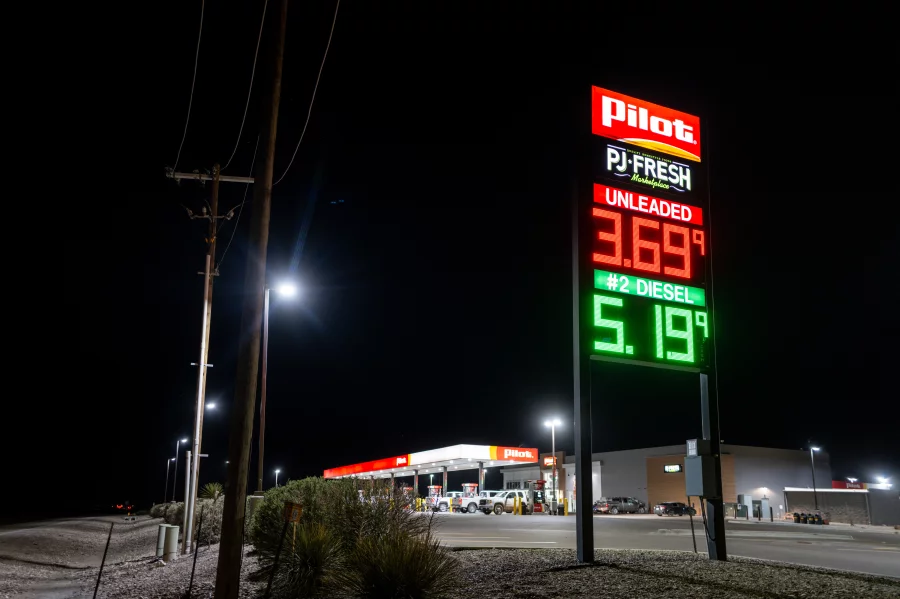
That narrow waterway normally carries about a fifth of the world’s oil and liquefied natural gas. When traffic through it nearly stops, crude prices can rocket past $110 a barrel and gasoline prices in the US follow right behind. Governments can try to cushion the blow. They are trying. But the uncomfortable truth is that the usual fixes are small compared with the size of the hole.
“The levers that we have in the short term are very limited,” said Avery Ash, chief executive of SAFE, a nonprofit focused on energy security and national security. “The worst time to try to be solving a crisis is when you’re in a crisis.”
He is right, and the reason is brutally simple: the problem is physical. Oil is stuck on one side of a choke point, or it is not moving fast enough, or it is not the right kind of crude for the refineries that need it. You can waive rules, release stockpiles, and cut taxes. You cannot conjure up millions of barrels a day out of thin air.
The first issue is spare capacity, which sounds comforting until you look at where it is.
Normally, if oil supply gets hit, markets look to countries that can ramp up production quickly. OPEC, led by Saudi Arabia, has some of that backup capacity because its members deliberately produce less than they could. As Ellen Wald, author of Saudi, Inc., put it, this is oil that is basically ready to go.
The catch is location. Most of that spare capacity is in Saudi Arabia and the United Arab Emirates, both on the Persian Gulf side of the Strait of Hormuz. That means the oil is sitting in the wrong place at exactly the wrong time.
“Spare capacity is only as good as the ability to get the oil out of where it’s being produced,” Wald said. In this case, that ability is badly compromised.
So what about pipelines?
There are some. Saudi Arabia has a line running east to west, moving crude to the Red Sea. The UAE has one too, allowing some oil to bypass the strait. But the pipes are not nearly large enough to replace the flow that has been blocked.
Dan Pickering, chief investment officer at Pickering Energy Partners, said roughly 20 million barrels a day are effectively backed up by the disruption, while only about 5 million are slipping around the edges through alternate routes. That leaves a 15-million-barrel gap. That is not a gap you patch with optimism.
Stockpiles are the next tool, and this one helps, just not nearly enough.
Oil-consuming countries keep emergency reserves for exactly this kind of crisis. The International Energy Agency’s 32 member countries just agreed to their biggest-ever release, more than 400 million barrels. That sounds huge, because it is huge. But the market is even bigger.
Bob McNally, founder of Rapidan Energy, estimates those reserves can probably be released at around 2 million barrels a day. Useful? Absolutely. Enough to solve the problem? Not even close.
“The stockpile releases are a good thing,” McNally said. “But they will not solve the brutal math problem.”
That phrase gets at the core of the issue. The math is brutal because the missing supply is too large, the disruption too concentrated, and the timeline too uncertain. Markets hate uncertainty almost as much as they hate shortages.
Then there are the tactical fixes that governments love because they sound decisive and are easy to announce. Some of them help at the margin. None of them are magic.
Take the Jones Act waiver. The US temporarily relaxed that rule, which normally requires ships moving between American ports to be US-made, US-crewed and US-flagged. In theory, that should make it easier to move gasoline around the country, especially from Gulf Coast refineries to the East and West Coasts.
In practice, the effect is tiny.
“We’re talking, you know, slowing the ascent of pump prices by pennies or tenths of a penny,” McNally said. “It’s a good step, but it’s not a game changer.”
That is the recurring theme here. Almost every response helps a little and solves very little.
Sanctions waivers work the same way. The Trump administration has already lifted some sanctions on Russian crude, and it has floated the extraordinary idea of loosening sanctions on Iranian oil in the middle of a war against Iran. That tells you how desperate the situation is. It also tells you how weak the alternatives are.
Kpler called the Russian waiver a “short-term logistical buffer,” especially for India, but not a full answer to the disruption from Hormuz. Vortexa estimated roughly a million barrels a day of the shortfall could be covered if sanctioned oil becomes easier to sell. Helpful, yes. Enough, no.
There is also the temptation to take the opposite approach and block US oil exports so more domestic crude stays at home. That idea comes up every time gas prices jump, and it sounds good until you remember how the US refining system actually works.
Ellen Wald says it would be a bad move. American oil is mostly light, sweet crude. US refineries, though, were built over decades to handle heavier, sour crude from abroad. So if exports are shut down, the mismatch gets worse, not better. The country ends up with crude it cannot process efficiently and refineries that are not set up for the stuff that is piling up.
That is the kind of structural problem that politicians like to talk around because it is not very campaign-friendly. But it matters. Global oil markets are built on specialization. Break that system and the pain comes back in another form.
Gas tax holidays are more popular because they feel immediate. Georgia is considering one that would save drivers 33 cents a gallon. That is real money, but it still does not come close to offsetting a sudden war-driven spike in fuel costs.
Patrick de Haan of GasBuddy points out another problem: if every state cut gas taxes, demand would probably rise again. More demand, higher prices. It is one of those annoying market truths that refuses to cooperate with political theater.
The same goes for the EPA’s summer gasoline rules. Relaxing them could shave somewhere between 10 and 30 cents a gallon, depending on location. That is not nothing. But it comes with a tradeoff: higher emissions and worse air quality just when summer driving usually pushes pollution upward anyway.
That is why these fixes are all nibbling at the edge while the real issue sits in the middle of the room. The missing supply is simply too large.
Pickering said 15 million barrels a day is hard to offset anywhere. He is not exaggerating. That is more or less the entire daily production of the United States, and the US is the biggest producer in the world. If the biggest producer cannot instantly plug the gap, nobody can.
Which brings everything back to the same bottleneck: the Strait of Hormuz.
That is the only real lever that can bring meaningful relief fast. Open the waterway, restore shipping, get crude and LNG moving again, and the pressure starts to ease. Leave it blocked, and every other policy response becomes a patch on a wound that keeps bleeding.
That is why governments are stuck with a frustrating truth. They can release reserves, waive rules, tweak taxes, and beg people to drive less. Those moves may soften the blow around the edges. But they do not change the central fact that oil prices are being driven by a supply shock large enough to overwhelm the usual tools.
Everything else is a delay. The strait is the fix.
And that is why Trump, or any world leader in this position, would have only one move that really matters: restore the flow through Hormuz. Everything else is just a temporary bandage on a very big problem.



The latest news in your social feeds
Subscribe to our social media platforms to stay tuned