

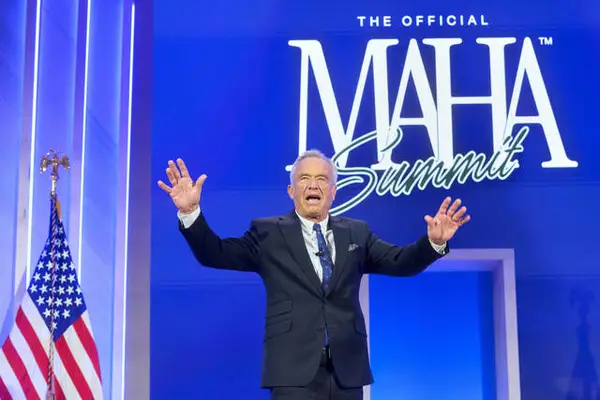



The “Make America Healthy Again” movement has gained traction inside the Trump administration, shaping policy discussions around vaccines, food regulation and federal health agencies. But as legal challenges mount, including a recent court ruling blocking parts of Secretary Robert F. Kennedy Jr.’s vaccine overhaul, a familiar problem is resurfacing: how durable these changes really are.
Mark Meckler, president of Convention of States Action, told the Wyoming Star that the movement’s reliance on executive power leaves it fundamentally exposed.
“Executive actions are inherently temporary because they can easily be reversed by the executive actions of a subsequent administration,” he said.
While he notes that policy reversals take time in practice, the structural vulnerability remains.
“The risks for MAHA is that a subsequent administration, Democrat or Republican, could easily reverse major gains of the MAHA movement, for example by changing the childhood vaccine schedule back to what it was before Sec. Kennedy and his new Vaccine Council pared it down.”
That tension is already visible. As federal policy shifts, access to vaccines and public health guidance is becoming more fragmented, often shaped by state-level decisions rather than a single national framework. At the same time, pushback from the scientific community is intensifying. A newly formed Independent Autism Coordinating Committee, created in response to changes in federal advisory bodies, is positioning itself as a counterweight to what critics describe as an ideological shift in public health policy.
The result is a landscape where authority is contested, not just politically, but institutionally. Meckler described that as evidence of a deeper structural issue. For him, executive action is not a stable foundation for long-term reform. The alternative he pointed to is more radical: constitutional change.
“Constitutional amendments, once approved are very durable. It takes a subsequent amendment to repeal them,” he said.
In practical terms, that could mean shifting core regulatory powers away from federal agencies altogether.
“So, for example, in regard to vaccine policy, one could propose and ratify an amendment that transfers all power over vaccine policy from the federal government to the states. The same is true in regard to food policy.”
That argument aligns with a broader push from states seeking more control over health and welfare programs. In areas like SNAP eligibility, several states have already moved to carve out exceptions to federal rules, particularly around what qualifies as “eligible” food. Meckler framed this as part of a wider rebalancing.
“Right now, many states are seeking exemptions from federal regulations so that they can opt unhealthy food products from SNAP eligibility. It is possible to give all control over such decisions to the states via a constitutional amendment.”
Legal battles are reinforcing that trend. Challenges to federal authority, whether in public health, food policy or administrative power, are increasingly testing the boundaries of what Washington can enforce. According to Meckler, those conflicts reveal a system under strain.
“The legal pushback shows that states wish to exert their own policy preferences in these areas, instead of a one size fits all policy from the federal government.”
He also questioned the legal foundations of that authority.
“Much of the authority they wield over the states has been granted by the courts, and have no real anchor points in the Constitution.” From his perspective, the growing number of disputes reflects a shift in momentum. “There is a growing movement from the states in favor of allowing them to chart their own courses.”
Still, the political reality is more complicated. While support for MAHA is broader than it might appear, polling suggests a significant share of parents identify with its core concerns, the coalition itself is not uniform. For many, the appeal lies less in ideology and more in a general unease about food systems, chronic illness and environmental exposure.



The latest news in your social feeds
Subscribe to our social media platforms to stay tuned