

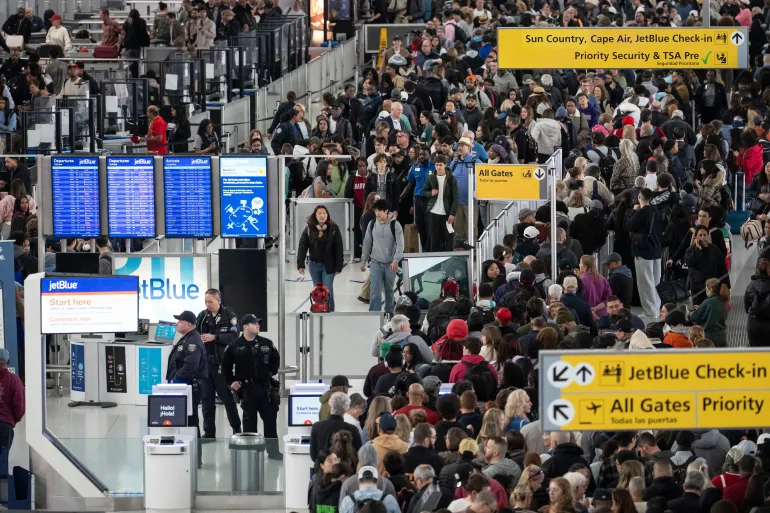




The US government is turning to an unusual solution to stabilise airport security: immigration agents.
President Donald Trump announced that Immigration and Customs Enforcement (ICE) personnel will be deployed across major airports starting Monday, as authorities struggle to manage growing disruption caused by a funding standoff in Washington.
The move follows weeks of visible strain. Since mid-February, tens of thousands of Department of Homeland Security employees — including Transportation Security Administration (TSA) screeners — have been working without pay after Congress failed to renew funding. The consequences are now showing up in real time.
More than 366 TSA workers have resigned, and absences have sharply increased, leaving major airports short-staffed. At some of the country’s busiest hubs, including Atlanta and New York’s JFK, queues have stretched for hours. In New Orleans, passengers were advised to arrive at least three hours early to make their flights.
“This loss significantly decreases TSA’s ability to meet passenger demand and leaves critical gaps in staffing, as each new recruit requires 4-6 MONTHS of training,” the Department of Homeland Security said.
The administration’s response is pragmatic but unconventional. ICE agents, who are trained in law enforcement rather than airport screening, will be assigned supporting roles — monitoring exit lanes and checking identification — allowing TSA officers to focus on core security tasks.
“I don’t see an ICE agent looking at an X-ray machine,” said Tom Homan, the senior border official overseeing the deployment, indicating that their role will remain limited.
The plan reflects the depth of the disruption. With workers unpaid and morale declining, some TSA officers have reportedly taken second jobs, while airports have begun informal efforts to support staff with food and basic supplies.
But the operational crisis is rooted in a political one.
At the centre of the standoff is a broader dispute over immigration policy. Democrats have refused to approve a full funding package for the Department of Homeland Security without reforms to ICE, particularly after controversial incidents during enforcement operations earlier this year. Republicans, in turn, have blocked partial funding measures, insisting on a comprehensive bill.


The latest news in your social feeds
Subscribe to our social media platforms to stay tuned