

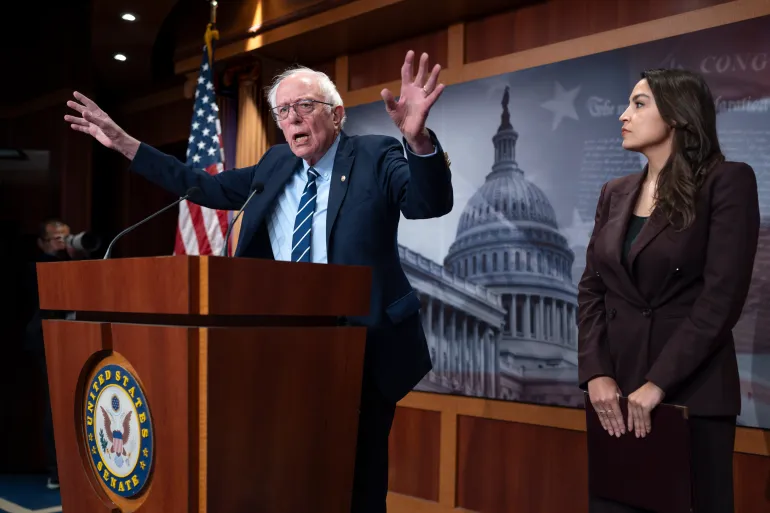





Two progressive US lawmakers are trying to slow down one of the fastest-moving parts of the tech economy — the physical infrastructure behind artificial intelligence.
Senator Bernie Sanders and Representative Alexandria Ocasio-Cortez have introduced legislation calling for a moratorium on new AI data centres, arguing that regulation has not kept pace with the technology’s rapid expansion.
The proposal would halt construction until federal safeguards are in place to address risks tied to jobs, civil liberties and environmental impact.
Sanders framed the issue as a gap between technological acceleration and political oversight.
“Bottom line: We cannot sit back and allow a handful of billionaire Big Tech oligarchs to make decisions that will reshape our economy, our democracy and the future of humanity,” he said.
“We need serious public debate and democratic oversight over this enormously consequential issue. The time for action is now. We need a federal moratorium on AI data centres.”
Ocasio-Cortez pointed to harms already emerging in the absence of clear rules, including surveillance risks and the spread of deepfakes.
“Congress has a moral obligation to stand with the American people and stop the expansion of these data centers until we have a framework to adequately address the existential harm AI poses to our society,” she said.
“We must choose humanity over profit.”
The push comes as data centres — often out of sight but central to AI systems — face growing resistance on the ground. These facilities require large amounts of electricity and water, placing pressure on local infrastructure and driving up energy costs in some communities.
According to Data Center Watch, at least 36 projects across the US were delayed or blocked between May 2024 and June 2025, affecting an estimated $162bn in investment. Opposition has cut across party lines, appearing in both Republican- and Democratic-led states.
Public sentiment appears to be shifting as well. An NBC News poll found that 57 percent of registered voters believe AI’s risks outweigh its benefits, while just 34 percent see the balance the other way. Positive views of AI remain relatively low.
Despite that, the legislation faces steep odds in Congress. Republicans control both chambers, and even within the Democratic Party there is no clear consensus on how aggressively to regulate AI.
Senator John Fetterman dismissed the proposal outright, warning it could undermine US competitiveness.
“The emerging chassis of AI must be built by America. We can put appropriate guardrails in place without handing the win on AI to China,” he said.
The broader policy direction from the White House also leans toward caution on regulation. The Trump administration recently released a national AI framework that emphasises reducing barriers to innovation while introducing targeted protections, rather than imposing broad restrictions.


The latest news in your social feeds
Subscribe to our social media platforms to stay tuned