




For more than a month, airport security in the United States has been running under pressure — not because of a sudden surge in travel, but because the people responsible for keeping it moving have not been paid.
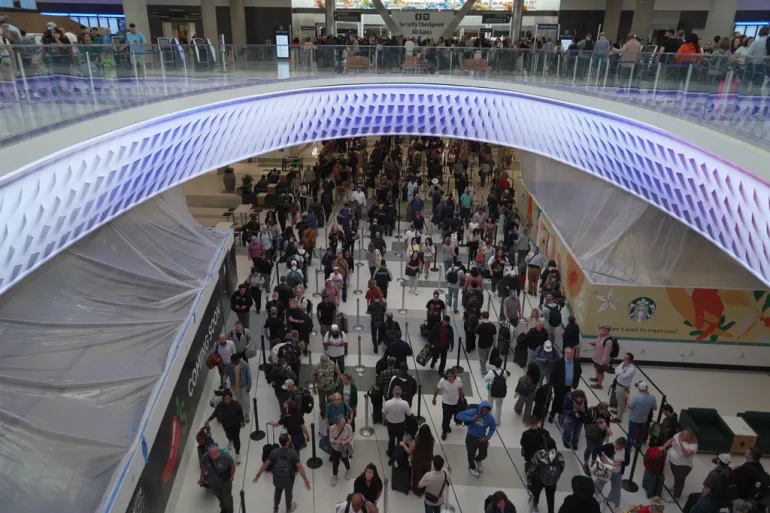
Employees of the Transportation Security Administration (TSA), who screen millions of passengers daily, have been working without pay since a partial government shutdown began affecting the Department of Homeland Security (DHS) on February 14. The impact is now visible across the country: long security lines, missed flights and a workforce that is increasingly stretched thin.
Videos circulating online show hours-long waits at major airports, while staffing levels continue to erode. Hundreds of TSA employees have either quit or stopped showing up for shifts, turning what is usually a tightly managed system into something far less predictable.
In response, the administration of US President Donald Trump has deployed agents from Immigration and Customs Enforcement (ICE) to help fill the gaps. The move has drawn criticism, with concerns focused on both their lack of relevant training and their reputation for aggressive enforcement tactics.
The disruption is unfolding at a particularly sensitive moment for global travel. The ongoing US-Israel war on Iran has already introduced additional complications, from flight disruptions to higher fuel costs and heightened security concerns. Against that backdrop, the strain on US airports is becoming harder to dismiss as a temporary issue.
Analysts say the situation is beginning to affect perceptions of the system itself. “For years we’ve bragged about how the US has the best and safest aviation system in the world,” said William McGee, a researcher and consumer advocate at the American Economic Liberties Project.
“I’m not sure that’s something we get to say anymore.”
Inside the TSA, the numbers point to a workforce under pressure. More than 450 employees have left since the shutdown began, according to a CNN report citing DHS official Lauren Bis. Call-out rates — workers not reporting for duty — have climbed from about two percent before the shutdown to around 10 percent last week.
But those averages mask sharper disruptions at specific hubs. At major airports in cities like New York, Atlanta and Houston, absentee rates have reportedly reached 30 percent or higher, creating uneven conditions across the network.
That unevenness is part of the problem. Delays don’t hit everywhere at once — they appear, ease and reappear elsewhere. McGee compares it to a game of “Whac-A-Mole”, where pressure shifts rather than disappears.
“The bottom line is that, if you have to travel right now, you need to be getting to the airport very early,” he said.
Travellers have been adjusting in real time, often unsuccessfully. Accounts on social media describe passengers arriving hours in advance and still missing flights after being stuck in security lines.
Airport operators are also feeling the strain, even if they are not directly tied to federal funding. A spokesperson for the Port Authority of New York and New Jersey said delays are now closely linked to staffing variability at security checkpoints.
“Over the last several days, we’ve begun to see that translate into long wait times at security checkpoints during certain periods depending on passenger volumes, TSA shift changes and staff breaks, and the number of TSA staff who come to work for each shift,” the statement says.
At the centre of the disruption is a political deadlock in Washington. Funding for DHS was left unresolved during earlier budget negotiations, with lawmakers agreeing to revisit it later. That compromise has since hardened into a standoff, driven in part by disputes over immigration enforcement and calls to reform agencies like ICE and Customs and Border Protection.
Efforts by Democrats to pass temporary funding for TSA have so far failed, leaving both parties blaming each other as conditions at airports continue to deteriorate.



The latest news in your social feeds
Subscribe to our social media platforms to stay tuned