
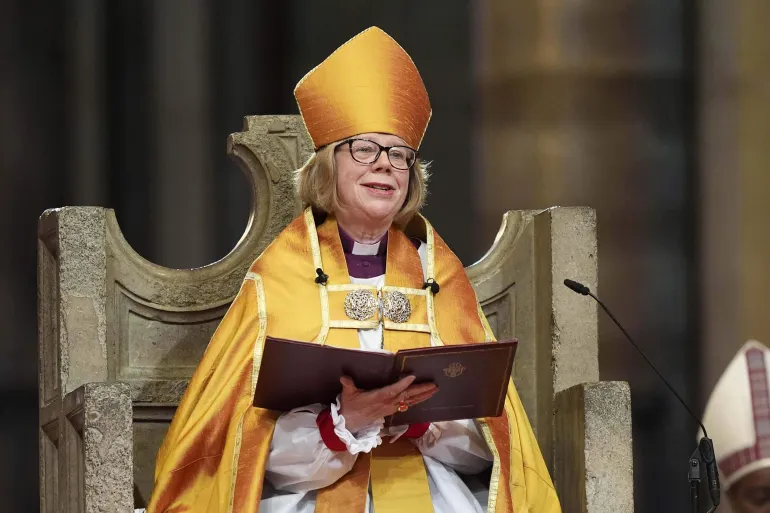



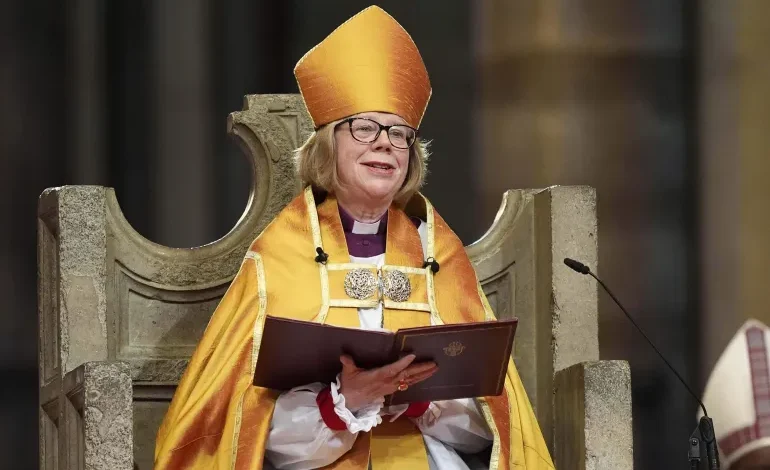

Sarah Mullally has been formally installed as archbishop of Canterbury, becoming the first woman to lead the Church of England and marking a historic shift for one of the world’s oldest Christian institutions.
The ceremony took place on Wednesday at Canterbury Cathedral, where Mullally took her seat on the 13th-century Chair of St Augustine before an audience of about 2,000 people. Among those present were Prince William and Catherine, Prime Minister Keir Starmer, and senior religious figures.
Although she officially assumed the role in January, the installation serves as the symbolic beginning of her public ministry. As archbishop, Mullally now becomes the spiritual head of the global Anglican Communion, which includes around 85 million members.
“As I begin my ministry today as archbishop of Canterbury, I say again to God: ‘Here I am’,” she said in her inaugural sermon.
Her appointment reflects a longer trajectory of change within the Church of England, which first ordained women as priests in 1994 and as bishops in 2015. Mullally’s elevation to its highest office marks a further step in that evolution.
The ceremony itself blended tradition with personal symbolism. At the start, Mullally knocked on the cathedral’s west door — a ritual gesture — wearing vestments that included a clasp inspired by her time as a National Health Service nurse. The service also featured prayers and readings in multiple languages, signalling the global scope of the Anglican Communion.
Her sermon touched on both contemporary conflicts and internal challenges. She prayed for “peace to prevail” in regions affected by war, including the Middle East, Ukraine, Sudan and Myanmar, while also acknowledging the Church’s past safeguarding failures.
Her predecessor, Justin Welby, resigned in 2024 following a child abuse cover-up scandal, an issue Mullally referenced as she emphasised the need to “remain committed to truth, compassion, justice and action”.
The ceremony also carried symbolic references to broader Christian unity. Mullally wore a ring originally given to former archbishop Michael Ramsey by Pope Paul VI in 1966 — a gesture tied to improving relations between Anglicans and Catholics after centuries of division dating back to Henry VIII’s break with Rome.
The timing of the installation, on the Feast of the Annunciation, added a theological layer to the moment, reinforcing themes of calling and acceptance.
Bishop Philip Mounstephen described the significance of the appointment in historical terms.
“It does signal a huge change that has taken place in the life of the Church,” he said.

The latest news in your social feeds
Subscribe to our social media platforms to stay tuned