




CNN, the Washington Post, the Guardian, the Wall Street Journal, and AP contributed to this report.
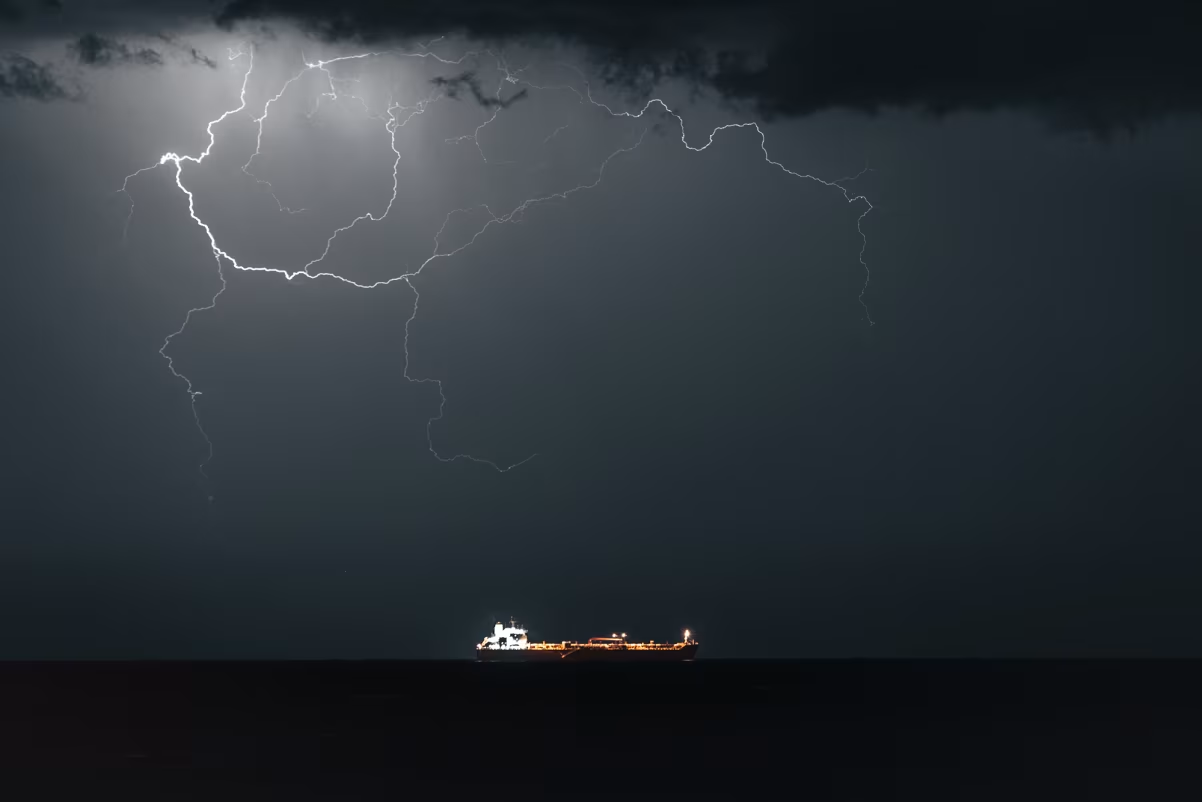
The global economy is stuck in a chokehold – and it runs straight through the Strait of Hormuz.
Fuel prices have surged. Markets have swung wildly. Recession fears are creeping back into the conversation. And at the center of it all is a narrow waterway off Iran’s coast that handles roughly a fifth of the world’s oil.
After weeks of trying to reopen it, President Donald Trump is now floating a different approach: step back and let others deal with it. He suggested the strait would “automatically open” if the US exits the conflict, even telling allies to “go get your own oil.”
That idea might sound simple. Energy experts say it’s anything but.
Walking away without securing the strait doesn’t solve the crisis – it just shifts the risk. Oil prices might dip briefly on the headlines, but the underlying problem wouldn’t go anywhere. If anything, it gets worse. Leaving Iran effectively in control of one of the world’s most critical chokepoints opens the door to higher long-term prices, disrupted supply, and a permanent layer of uncertainty in energy markets.
And markets hate uncertainty.
Right now, the disruption is already massive. Oil has swung from around $70 a barrel before the war to well over $100, at times pushing close to $120. That shock is feeding straight into inflation – gas in the US has already climbed past $4 a gallon for the first time since 2022 – and squeezing consumers globally.
Even if the US pulls back militarily, the economics don’t decouple. America may produce more oil than anyone else, but it’s still plugged into a global system. Prices are set internationally. Supply shocks abroad hit domestic wallets fast.
US refiners, for example, don’t just rely on domestic crude. They blend it with heavier imports from overseas. At the same time, the country still brings in refined products like gasoline and diesel to meet demand, especially in coastal regions. If shortages deepen in Europe or Asia, those regions will start bidding for American supply. That pushes prices up at home.
Producers won’t hold back barrels to keep US gas cheap. They’ll sell to the highest bidder. That’s how the market works.
Then there’s the risk premium. If the Strait of Hormuz remains unstable, traders will build that danger into prices. Every tanker passing through – or avoiding the route – comes with added cost. Insurance rises. Shipping slows. Volatility sticks around.
Even the idea of “ending the war” doesn’t fully fix that. Markets may rally on optimism, and oil might drop in the short term – as seen when crude briefly slipped below $100 and stocks jumped on hopes of a quick resolution. But the disruption lingers. Supply chains don’t reset overnight.
There’s also a political angle. Some see Trump’s comments as pressure on allies to step in. Others view it as posturing ahead of a possible escalation. Investors, for their part, aren’t entirely convinced. The messaging has swung between diplomacy and threats, and markets have learned to take it with caution.
Strip away the rhetoric, and one reality remains: the Strait of Hormuz is too important to ignore.
As long as it’s constrained, the global economy pays the price. Energy markets stay tight. Inflation sticks around longer than central banks would like. Growth takes a hit.
You can declare victory. You can pull troops out. You can shift responsibility.
But until oil flows freely through that narrow stretch of water again, the bill keeps coming.



The latest news in your social feeds
Subscribe to our social media platforms to stay tuned