

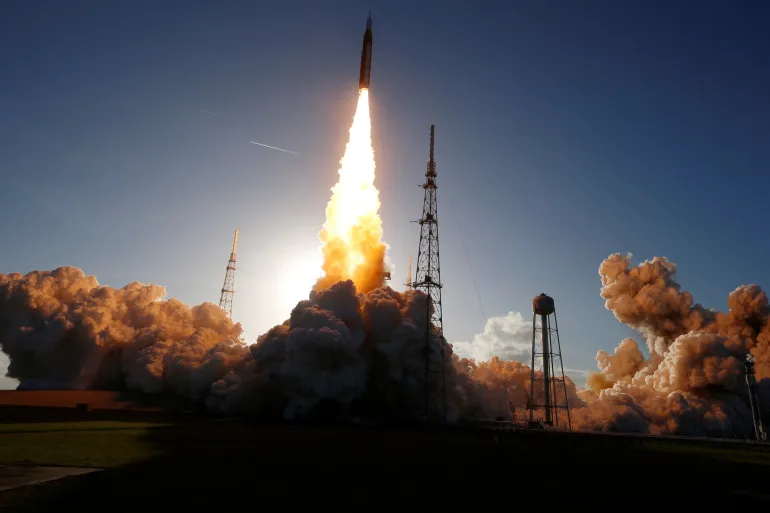



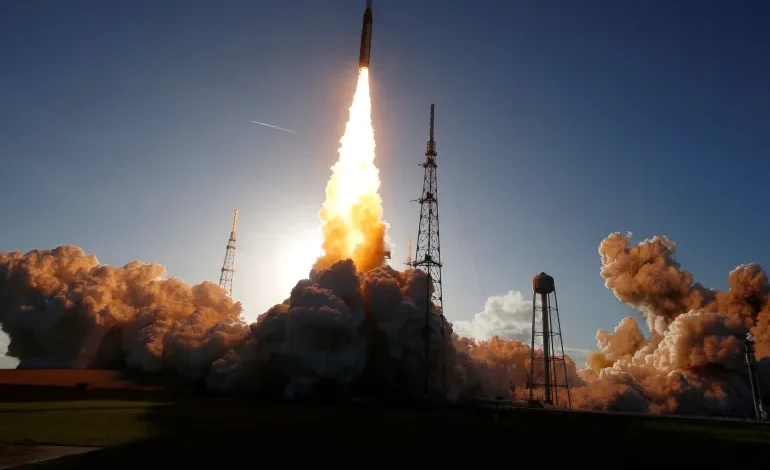

The Artemis II mission has lifted off from Florida, marking the first time in more than half a century that humans are travelling beyond low-Earth orbit and back toward the moon.
Launched from NASA’s Kennedy Space Center, the 32-storey rocket carried four astronauts on a nearly 10-day journey that will take them around the moon and back — a key step in the US space agency’s broader plan to return humans to the lunar surface and eventually push onward to Mars.
The crew includes NASA astronauts Reid Wiseman, Victor Glover and Christina Koch, alongside Canadian Space Agency astronaut Jeremy Hansen. Together, they are heading farther into space than any human mission since the Apollo era.
“On this historic mission, you take with you the heart of this Artemis team, the daring spirit of the American people and our partners across the globe, and the hopes and dreams of a new generation,” said launch director Charlie Blackwell-Thompson. “Good luck, Godspeed Artemis II. Let’s go.”
Shortly after liftoff, Wiseman confirmed the trajectory ahead: “We have a beautiful moonrise, we’re headed right at it.”
The launch followed a tense lead-up. Earlier tests had revealed a dangerous hydrogen leak, forcing delays, but this time fuel loading — more than 700,000 gallons — proceeded without major issues. Engineers also resolved last-minute technical problems, including a glitch in the rocket’s flight-termination system and a temperature anomaly in the Orion capsule’s abort system.
Now in flight, the mission will unfold in stages. The crew will first spend one to two days in high Earth orbit, checking life-support, navigation and communications systems. A key engine burn — known as translunar injection — will then send the spacecraft toward the moon.
Orion will loop behind the moon on a free-return trajectory, using lunar gravity to swing back toward Earth. At its farthest point, the spacecraft will reach distances not seen in human spaceflight for decades.
After completing the flyby, the crew will return to Earth, re-entering the atmosphere at roughly 40,000km/h before splashing down in the Pacific Ocean.
The mission carries symbolic weight as well as technical importance. With most of today’s global population born after the Apollo missions, Artemis is being framed as a new era of human space exploration.
“There are a lot of people who don’t remember Apollo. There are generations who weren’t alive when Apollo launched. This is their Apollo,” said NASA science chief Nicky Fox.



The latest news in your social feeds
Subscribe to our social media platforms to stay tuned