



The US Supreme Court has taken up one of the most consequential immigration questions in decades, hearing arguments over the Trump administration’s attempt to end automatic citizenship for anyone born on US soil.
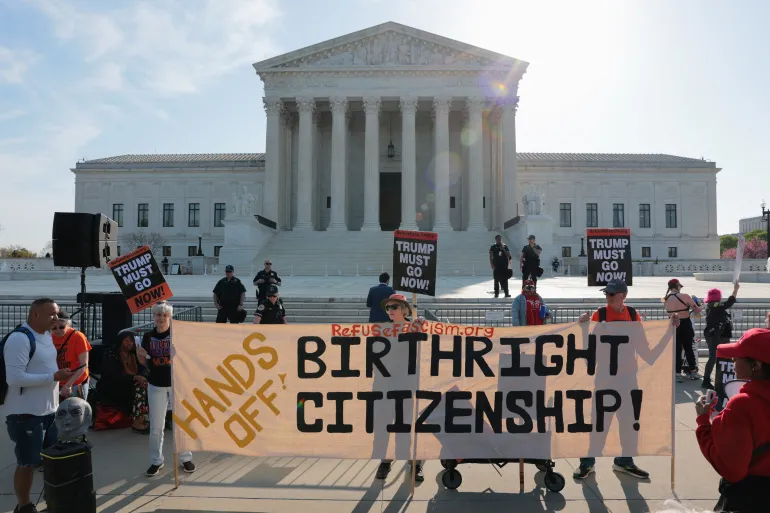
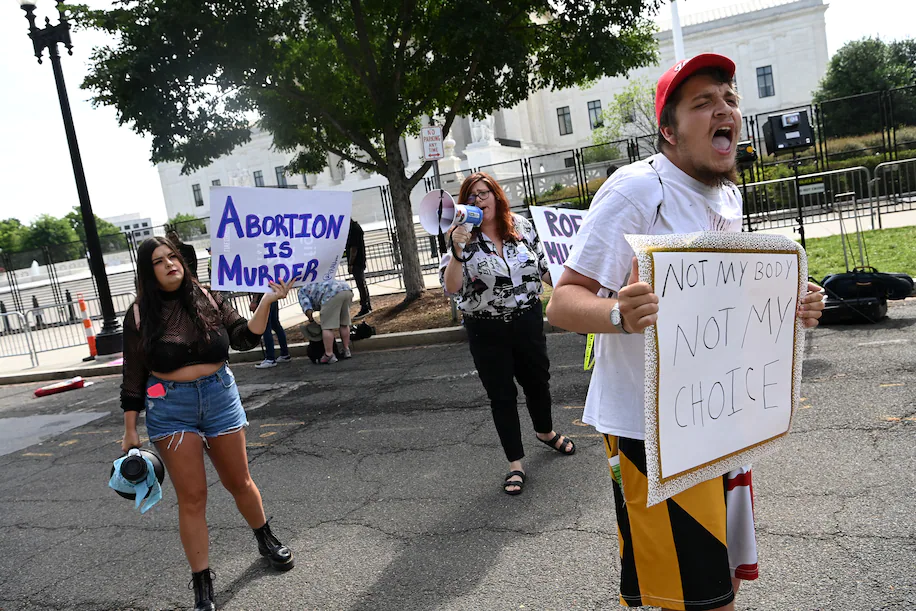
At the centre of the case is an executive order signed on January 20, 2025, which challenges a long-established interpretation of the Constitution. Outside the court, hundreds of demonstrators gathered, many tied to civil rights and immigration groups, framing the issue not as abstract law but as something immediate and personal.
Inside, the divide was clear. Lawyers challenging the policy argued that it runs directly against the 14th Amendment and decades of federal law built around it. The amendment, ratified in 1868, has long been understood to guarantee citizenship to nearly all individuals born in the United States, regardless of their parents’ immigration status.
The Trump administration’s legal team pushed back on that foundation, arguing that more than a century of practice rests on a “misreading” of the Constitution. Their position is that citizenship should not automatically extend to children of parents who are in the country without legal status or only on temporary visas.
The political weight of the case was hard to miss. Donald Trump attended the hearing in person — the first sitting US president to do so during Supreme Court oral arguments — a move critics saw as an attempt to influence the court. The current bench holds a 6-3 conservative majority, including three justices appointed by Trump.
For those gathered outside, the implications are immediate. “This hits close to home,” said Luis Villaguzman, a student fellow with the League of United Latin American Citizens. “Specifically when it comes to immigrants … mothers, who are pregnant, about to give birth … they will lose benefits and truly just lose a hope – a future in America.”
Others read Trump’s presence as a signal rather than a gesture. Roslyne Shiao, a protester from New Jersey, said it appeared to be an effort to “sway the court in his favour”, adding: “So the people need to be here.”
Trump himself did not stay for the full hearing. He left partway through and shortly after posted online: “We are the only Country in the World STUPID enough to allow ‘Birthright’ Citizenship!”
The argument, however, is not as isolated as that statement suggests. At least 30 countries maintain some form of birthright citizenship, according to the Pew Research Center.
Support for the administration’s view remains present in legal circles. Law professor John Eastman, a longtime advocate of reinterpreting the 14th Amendment, attended the hearing and said he was “impressed” by both sides, adding that the case “proves that it’s not a radical fringe idea”.
Within Trump’s policy circle, the framing is more direct. Adviser Stephen Miller argued that “birthright citizenship means the children of illegal aliens can vote to tax your children and seize their inheritance”.
The justices did not signal a clear outcome during the session, but the questions raised suggest the court is engaging seriously with both the constitutional text and the weight of precedent. A decision is expected later this year.

The latest news in your social feeds
Subscribe to our social media platforms to stay tuned