


Engineers say Colorado River crisis could use Wyoming’s ‘godfather of water’ about now

If the dead could bear witness, the ghost of Dr. Elwood Mead might be standing at the rim of the reservoir that bears his name, watching it drain toward oblivion, and muttering the same words he used when he first arrived in the Wyoming Territory 138 years ago. “The virtue of self-denial had not been conspicuous on the part of claimants,” is how the young engineer described what he found in 1888 when he surveyed the water claims filed in county courthouses across the territory. Years later, he noted that, “If the amount of water claimed had existed, Wyoming would have been a lake.”
That observation could run today word-for-word in a report on the Colorado River, which has never held as much water as users have attributed to it. The seven states that negotiated the 1922 Colorado River Compact divided 15 million acre-feet of water per year based on data from an unusually wet period. Now with Lake Mead a third full and dropping, Lake Powell at 25% capacity, and total system storage at just 37% and falling, the reckoning that partially began with rampant over-claiming on Wyoming creeks has arrived on a continental scale.
“He hated waste and craved efficiency,” said John Shields, a retired Wyoming interstate streams engineer who spent 30 years representing the state on Colorado River issues. “He created order out of chaos,” he said of Mead, the former head of the federal Bureau of Reclamation from 1924 until his 1936 death. “He would look around at the Colorado River situation right now and he would say chaos is ruling.”
The man who would become the father of Western water law arrived in Cheyenne in 1888 at age 30, a farm kid from southern Indiana with degrees from Purdue and Iowa State. As Anne MacKinnon documented for WyoHistory.org, it was not uncommon for someone to claim more water than actually flowed in a stream. One irrigator got 20 times as much water per acre as his neighbor just downstream. The absurdity came to a head when the city of Cheyenne asked Mead to regulate the 75 ditches above town so water could reach the city. Not one of the 75 ditches was named or located. Instead, a judge had made grants of water to people “who might live in Cheyenne, on their farm, or in Hong Kong.”
What happened next made Wyoming a legal beacon of the arid West. Working with constitutional convention delegates, Mead watched his principles written directly into the Wyoming Constitution, Article 8, which declared all water within Wyoming’s borders the property of the state. The new system established active state ownership of water, requiring a permit for any use, and an expert board of control instead of courts to decide water disputes, composed of people who actually knew water. The system tied water rights to actual use, not to paper claims.
Before there could be order, there had to be measurement. Mead designed a device to measure how much water flowed onto a field, allowing him to determine the “duty of water”—the amount actually needed to raise a crop. This calculation is how Wyoming’s original water law set the standard at 1 cubic foot per second for each 70 acres of farmland. “He is the godfather of measuring water in the West and recognizing the importance of it,” Shields said.
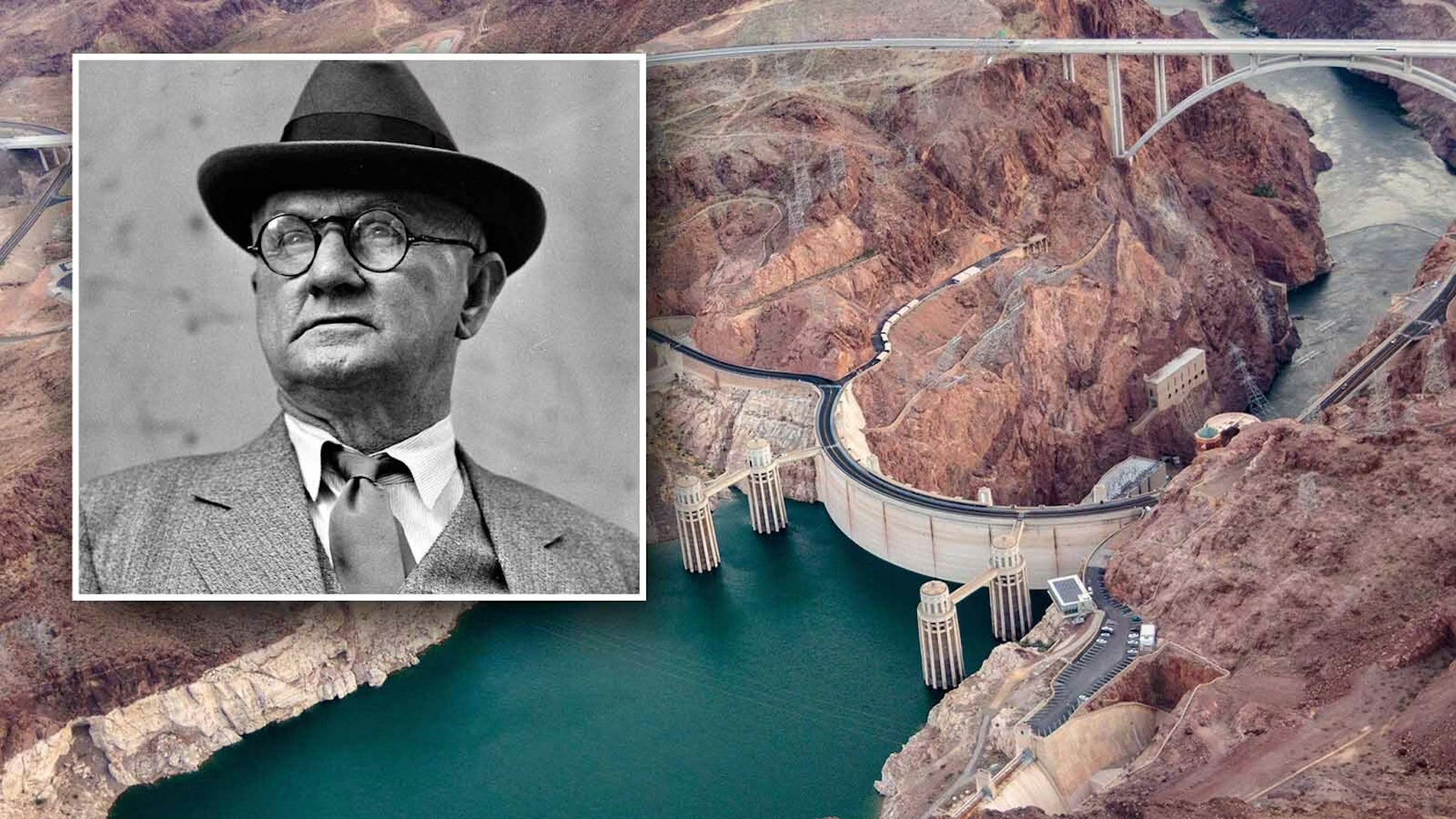
After 11 years as territorial engineer, Mead left for Washington in 1899, then had stints in Australia and at UC Berkeley before being appointed commissioner of the Bureau of Reclamation at age 66. As commissioner, he oversaw the construction of Hoover Dam, which created Lake Mead, the reservoir named for him after his death in office on Jan. 26, 1936.
Today, the Bureau of Reclamation’s latest projections show April-through-July inflow to Lake Powell at just 27% of normal. Snowpack across the upper basin sits at 62% of normal, with Utah and Colorado at record lows. Under the most probable scenario, Lake Powell could hit minimum power pool by December. The seven basin states have blown through two federal deadlines without a deal to manage Colorado River water.
Shields said the federal government and southern states have been watching a slowly moving freight train since 1999, and not enough steps have been taken. “Thank goodness Doctor Mead and others were smart enough to build approximately 60 million acre feet of storage on a river that everybody used to think flowed at about 15 million acre feet,” he said. “And of course, it’s less than that now. We find it’s more like 12 million acre feet.”



The latest news in your social feeds
Subscribe to our social media platforms to stay tuned