

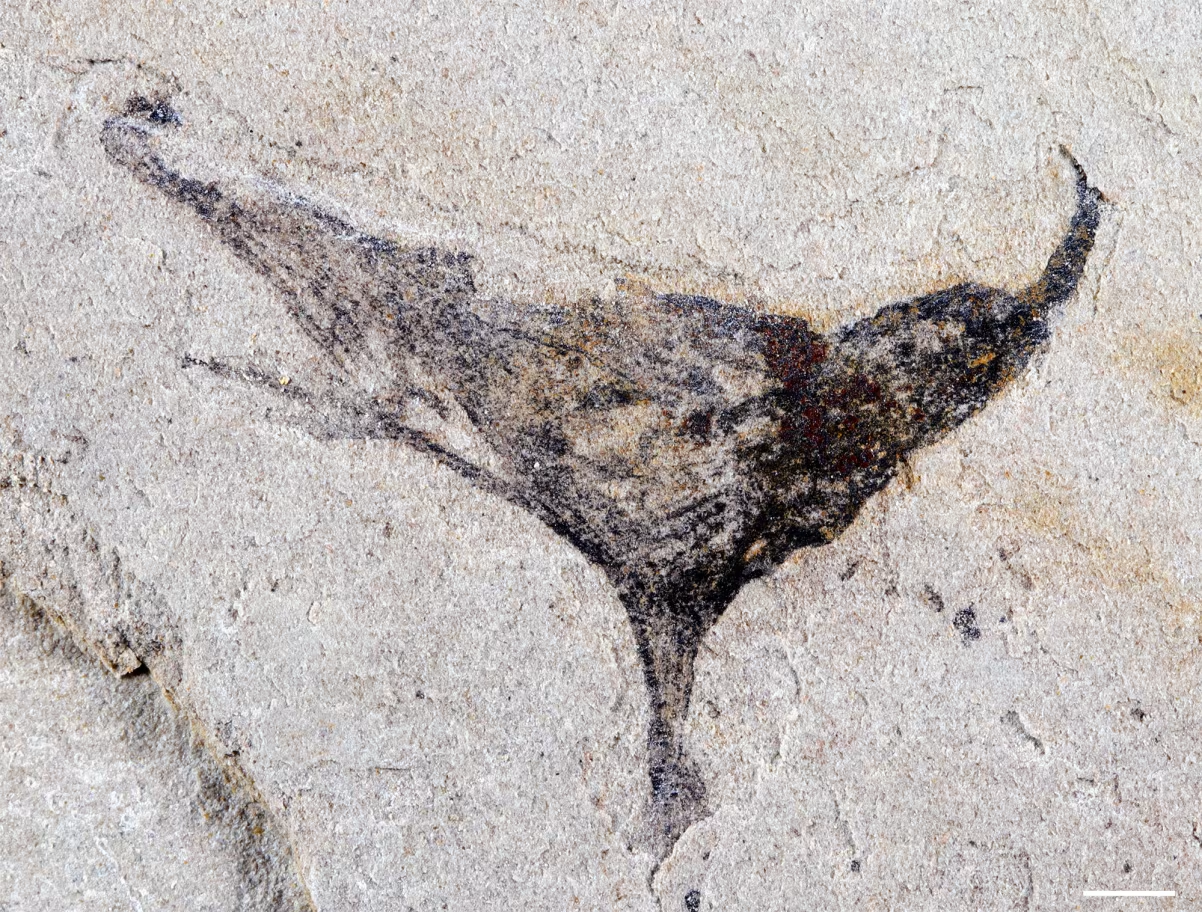




A small patch of rock in southwestern China is quietly reshaping a big idea in evolutionary science — when complex animal life actually began.
For decades, the Cambrian period has been treated as the starting point for complexity, a moment around 542 million years ago when life seemed to suddenly diversify into recognizable forms. Before that, the Ediacaran era was thought to host simpler, more enigmatic organisms. But new fossils from China suggest that boundary may have been drawn too sharply.
What researchers found at the Jiangchuan Biota site complicates the timeline. Preserved in unusual detail, these fossils include creatures with features that look strikingly familiar — symmetry, feeding structures, even hints of internal organs. These are not just vague impressions; entire bodies are visible, compressed into rock with a clarity rarely seen in fossils this old.
“We found what’s been long hoped for, which is a Cambrian-like preservation in the Ediacaran,” said study coauthor Ross Anderson. “We actually start to see some of the Cambrian-like organisms appearing in the Ediacaran when you have the right kind of preservation.”
The implication is subtle but significant. If the preservation is good enough, the distinction between Ediacaran and Cambrian life begins to blur. What once looked like a sudden evolutionary leap may instead be a continuation of processes already underway millions of years earlier.
The fossil site itself is modest in size — roughly the area of a dozen king-size mattresses — but dense in information. Around 700 fossils were recovered, with about 200 identified as animals. Many are tiny, less than an inch long, but collectively they offer a detailed snapshot of life between 554 and 539 million years ago.
“I’m amazed that during so few field seasons they found that much,” said Jo Wolfe.
Among the finds are forms that resemble both known Ediacaran organisms and creatures previously thought to appear only in the Cambrian. That overlap is what stands out most.
“It’s a fairly unusual situation to have a mixture of Ediacaran-style and Cambrian-style organisms in a single locality,” Wolfe said. “It’s blurring the boundaries between what are Ediacaran and Cambrian life-forms.”
Some fossils show bilateral symmetry — a defining feature of most modern animals — suggesting this body plan evolved earlier than expected. Others may belong to deuterostomes, the group that includes vertebrates. If confirmed, that would push the origins of our own evolutionary line deeper into the past.
“It really is a treasure trove of bilateral fossils, something that we did not have before,” Anderson said.
“It shows that our vertebrate ancestors were around at this pretty early stage in animal evolution,” he added. “I think that’s really exciting.”
Still, the picture is not entirely settled. Interpreting fossils this old comes with limits. Without DNA and with only a handful of visible features, scientists are often working with incomplete clues.
“The biggest difficulty with the Ediacaran organisms is that you have to hang your interpretation on very few characters,” Wolfe explained.
That uncertainty doesn’t undo the finding — it just defines its edges. What the fossils clearly show is that complexity did not appear out of nowhere. It was building, quietly, before the Cambrian made it obvious.
The Cambrian explosion remains important. It still marks a period of rapid diversification and the emergence of many major animal groups. But instead of a sudden beginning, it may be better understood as an acceleration — the visible phase of a process that had already started.
“In that sense, I still think the Cambrian is quite unique,” Anderson says. Still, the new evidence suggests that its roots “perhaps stretching back into the Ediacaran.”
For now, the Jiangchuan fossils open more questions than they close. What these animals were, how they lived, and how they connect to modern life are still being worked out.
“What were their ecologies? Where were they living? What kinds of organisms were they? I think that will inform us a lot about our own ancestry. That’s something I’m quite excited about from this deposit.”


The latest news in your social feeds
Subscribe to our social media platforms to stay tuned