

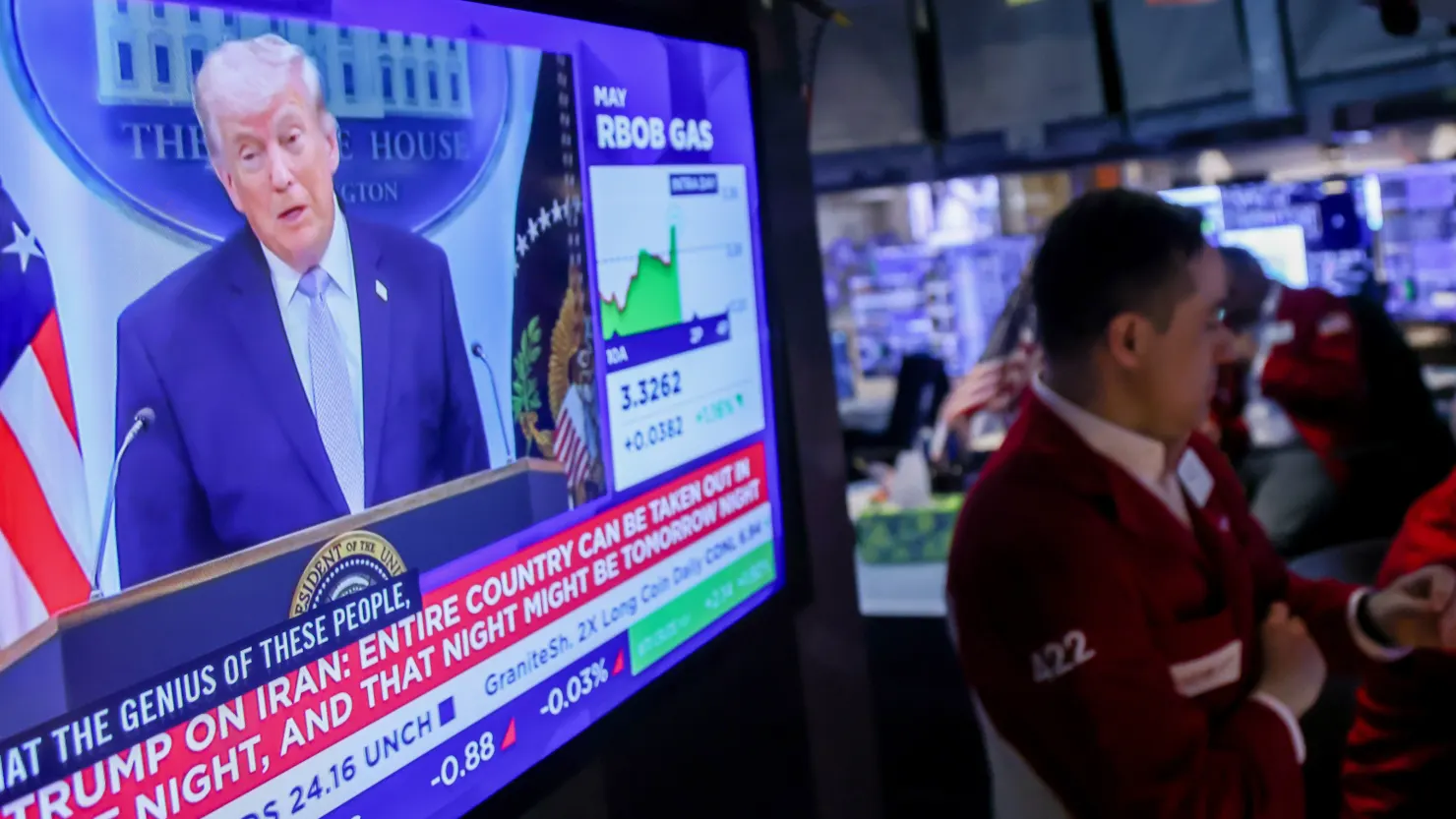



Markets Wobble as Iran Deadline Nears, Oil Climbs on Rising Tensions

CNBC, AP, NBC News, Bloomberg, the Wall Street Journal, Market Watch, and Business Insider contributed to this report.
Wall Street didn’t like what it was hearing. Oil traders did.
Stocks slid Tuesday as the clock ticked toward President Donald Trump’s self-imposed deadline for Iran to reopen the Strait of Hormuz, while crude prices pushed higher on fears that diplomacy might fail at the last minute.
The Dow Jones Industrial Average dropped about 180 points, with the S&P 500 and Nasdaq Composite both slipping roughly 0.4%–0.5%. Losses weren’t dramatic, but they were steady, shaped by a steady drip of headlines and rising unease across markets.
Oil told a different story. US crude jumped around 2%, hovering above $114 per barrel, after briefly spiking even higher earlier in the day. Brent crude held above $109. The message from energy markets was blunt: traders are bracing for disruption, not resolution.
At the center of it all is Trump’s 8 p.m. ET deadline. If Iran doesn’t reopen the Strait – a narrow passage that normally carries about a fifth of global oil supply – the US has threatened strikes on key infrastructure, including bridges and power plants. The rhetoric has only intensified. In a post earlier Tuesday, Trump warned that “a whole civilization will die tonight,” though he also hinted that talks could still produce an unexpected breakthrough.
Investors aren’t betting heavily on that outcome.
Reports of US strikes on Iran’s Kharg Island overnight added to the tension, even as signals from both sides suggested negotiations hadn’t completely collapsed. Some progress, according to Axios, has been made in recent hours. Still, few on Wall Street seem willing to take big risks ahead of the deadline.
The result is a market stuck in wait-and-see mode. Stocks drift lower, oil inches higher, and volatility simmers just below the surface.
Bond markets are feeling it too. Treasury prices fell, pushing the 10-year yield up to around 4.36%. That’s feeding directly into borrowing costs, with the average 30-year mortgage rate climbing to roughly 6.44%, a noticeable jump from pre-war levels.
Out in the real economy, the impact is already visible. Gas prices in the US are averaging about $4.14 per gallon, with diesel nearing levels last seen during the 2022 energy spike. Government forecasts suggest gasoline could push closer to $4.30 in the near term, while diesel may climb past $5.80.
Analysts say oil remains the key variable driving everything else. As long as supply risks hang over the Strait of Hormuz, markets will struggle to find direction. One path leads to a fragile de-escalation and gradual normalization. The other points to a longer conflict, tighter supply, and persistently higher prices.
For now, traders are watching the clock.
There were a few bright spots. Broadcom shares rose about 3% after announcing expanded artificial intelligence deals with Google and Anthropic, a reminder that even in tense macro conditions, pockets of optimism still exist.
But those gains were the exception. The broader mood is cautious, even jittery. Investors have seen this pattern before – deadlines, threats, last-minute extensions – yet the stakes feel higher this time. The Strait remains partially choked, global supply chains are strained, and every new headline carries the potential to move billions.
Something will give. Markets just don’t know what – or when.


The latest news in your social feeds
Subscribe to our social media platforms to stay tuned