





Yellowstone’s massive multi-month snow-clearing convoy reaches east entrance
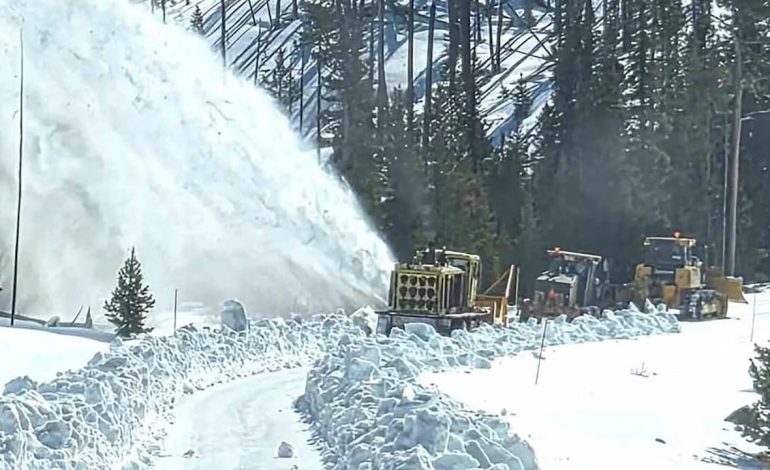

A convoy of bulldozers, snowplows, and their chainsaw-wielding operators reached Sylvan Lake along Yellowstone National Park’s East Entrance Road this week, putting crews less than 10 miles away from the park’s East Entrance. They’ve been clearing hundreds of miles of snow-covered roads since the beginning of March. There might be a record-breaking low snowpack around Wyoming, but there are still several feet of snow that needs to be cleared from Yellowstone’s roads before the summer season officially begins in mid-May.
Yellowstone’s winter season stretches from Dec. 15 to March 15. Before the park’s winter season officially ends, everything and everyone needed for the multi-week snow-clearing operation mobilizes at Mammoth Hot Springs. The coordinated effort functions more like a military convoy than a bunch of snowplows. “They usually have a bulldozer or two chained to a grader with a heavy-duty V-shaped plow leading the procession,” said Yellowstone author and winter keeper Jeff Henry. “The snowplow provides the impetus, and the bulldozer pulls the plow. That breaks up the hard-packed snow on the road.”
From Mammoth, the slow-moving convoy begins a relentless push south, following the interior roads and tearing through hundreds of miles of hard-packed, several-feet-thick snow and ice. The icy rubble is cleared by a convoy of seven massive rotary snowplows capable of clearing 4,500 tons of snow rubble and sending it to the roadside. Anything too stubborn for the multi-ton machines can be broken up by chainsaw-wielding crew members.
In 2025, the convoy departed Mammoth on March 3 and reached the Norris Geyser Basin two days later, clearing 21.6 miles of snow-covered roads. From Norris, the convoy turns eastward to Canyon Village—a shorter distance of 12.3 miles, but it can take around six days to complete. Henry said the operation is logistically impressive. “They’ll set up camp at places like Lake Village and Canyon Village once they reach them,” he said. “They’ll stay in the buildings with a mess hall and a cook and use them as a base for the next several weeks. That way, they only have to drive down on Monday and back on Thursday at the end of their work week.”
Clearing the bulk of the interior roads is the easy part. The convoy usually has the northern half of the Grand Loop Road cleared for regular vehicles by the beginning of April. That’s when the effort gets trickier. The convoy usually departs Fishing Bridge for a three-day push along the much higher, narrower road to reach the East Entrance in early April. Once the East Entrance is reached, the convoy will head back down and clear the road from Grant Village to the South Entrance. The final stretch from the West Thumb Geyser Basin to Old Faithful is cleared by the beginning of May.
The final two phases of the operation are clearing the Dunraven and Beartooth passes. “Beartooth Highway is always the last thing they plow,” Henry said. The Wyoming Department of Transportation has mostly finished its effort to clear U.S. Highway 14/16/20 to the East Entrance and anticipates removing road barriers by April 13. Regardless, the East Entrance won’t officially open until at least May 1.
Henry has spent nearly 50 years working as a winter keeper at Old Faithful, clearing snow from building roofs to prevent collapse. For him, the convoy is a noisy reminder that winter is over. “It’s incredibly noisy, incredibly smelly, and shatters the winter isolation,” he said. “The plowing operation is the ultimate example for me.”



The latest news in your social feeds
Subscribe to our social media platforms to stay tuned