




A giant green fireball lit up the skies across five western states on Wednesday night, outshining city lights for a few dazzling seconds before exploding over northeastern Wyoming. The American Meteor Society has received over 30 eyewitness accounts of the fireball from Wyoming, Colorado, Montana, Nebraska, and South Dakota. It was seen as far north as Billings, as far south as Denver, and as far east as North Platte.
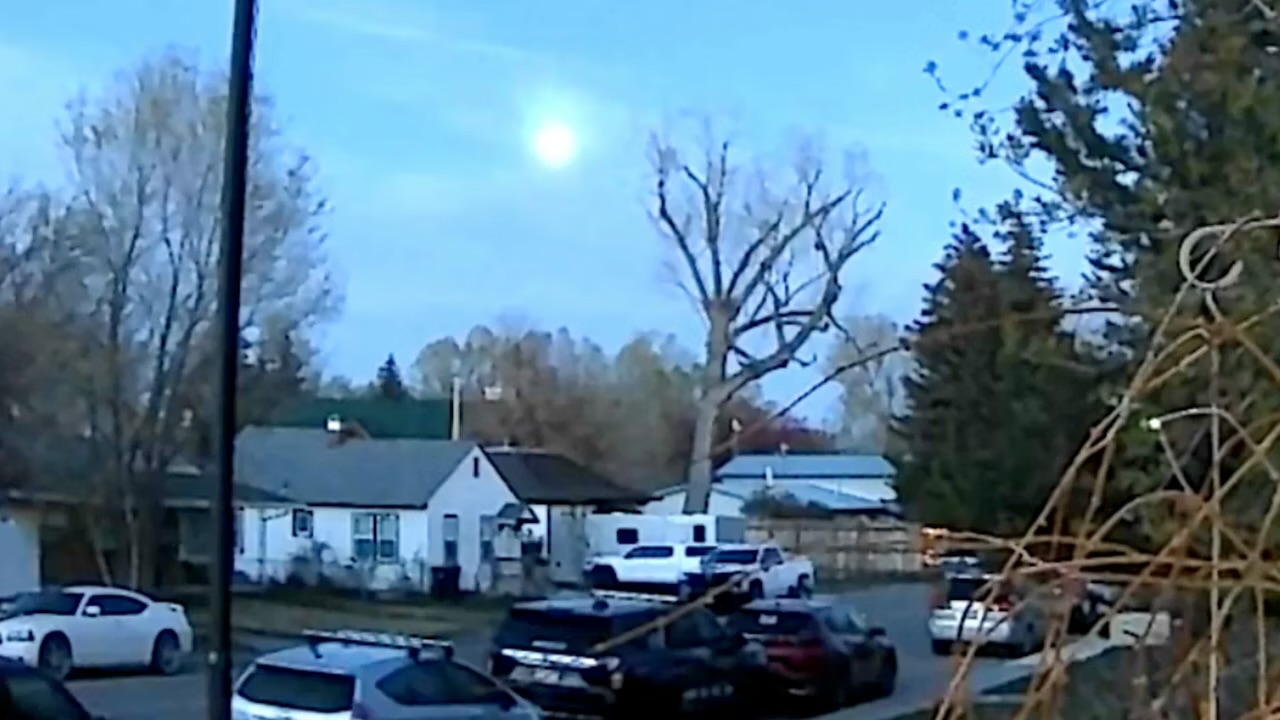
Casper resident Steven Smathers didn’t see the fireball with his own eyes but realized he’d captured it after checking his doorbell cameras. “My camera recorded it at 8:24 p.m. last night,” he said. “I didn’t see it myself, but it definitely lit up the sky and overpowered the streetlights.” Lander resident Dan McOmie got a similar video from his home at 8:20 p.m., showing the fireball descending at a sharp angle before disappearing in a blaze of light.
The AMS defines a fireball as “a very bright meteor, generally brighter than magnitude -4,” making it brighter than anything else in the night sky except a full moon. Hundreds of fireballs fall to Earth every day, but most are too small to be seen or cannot be seen during daylight hours. Even though this fireball was seen in five states, the AMS plotted its trajectory entirely over Wyoming. It appeared right at the northern edge of Converse County before soaring into and disintegrating over Campbell County, northeast of Wright.
“Everything indicates that it actually exploded before it terminated,” said retired Wyoming State Climatologist Jan Curtis. “There was an increase in brightness, where it kept getting brighter and brighter, until there was a final burst. It’s very common for meteors to do that.” Curtis said the “instantaneous brightness” of fireballs comes from their short-lived interaction with Earth’s atmosphere. They’re moving at such high speeds, around 60 miles per second, that the resistance of the atmosphere quickly and spectacularly tears them apart. “That makes them almost as bright as the moon,” he said.
Most people who saw Wednesday night’s fireball reported it was bright green, the most common color of fireballs. “Fireballs don’t have the same brilliance in color,” Curtis said. “Some are just iron, while others are more like stone with different minerals, elements, and other compounds that are outgassed as it burns up.” Most meteors are primarily composed of iron and magnesium, which burn green at high temperatures. A meteor with a more diverse elemental composition can include a spectrum of blues, yellows, purples, pinks, whites, and reds.
Max Gilbraith, planetarium coordinator at the University of Wyoming, was intrigued by the number of fireballs seen on Wednesday night. The Wyoming event was one of four reports across the U.S. that night, within a few hours of each other, suggesting they were connected to “a parent object” that scattered across the skies of North America. “There might have been one object that broke apart,” he said. “They’re too spatially and time-related to have not been close to each other, at least gravitationally, at some point.”
According to the AMS, the first quarter of 2026 “produced what appears to be a significant surge in large fireball events” with 2,046 total events worldwide. “Whether this reflects a genuine change in the near-Earth meteoroid environment, an amplification of reporting through AI and social media, or some combination of both, we cannot yet say definitively,” the agency said. “What we can say is that the question deserves both public awareness and scientific attention.” Gilbraith added, “Seeing four fireballs all over North America in the span of one night is pretty exciting.”



The latest news in your social feeds
Subscribe to our social media platforms to stay tuned