




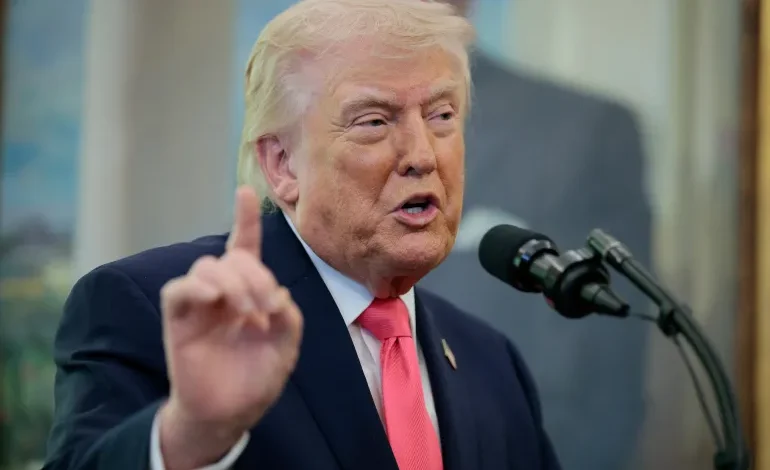


United States President Donald Trump has escalated his criticism of NATO, using a White House meeting with Secretary-General Mark Rutte to underline growing tensions over the alliance’s role in the war on Iran.
Writing on Truth Social shortly after the talks, Trump struck a blunt note: “NATO wasn’t there when we needed them, and they won’t be there if we need them again”.
The comments followed a two-hour meeting in Washington, held just a day after the United States and Iran agreed to a ceasefire. The timing made the disagreement harder to ignore. For weeks, Washington had been pressing allies for more direct involvement. Many declined to go beyond defensive support, refusing to open airspace or deploy forces to help secure the Strait of Hormuz.
Ahead of the meeting, White House spokesperson Karoline Leavitt framed that reluctance in sharper terms, saying allies had “turned their backs on the American people”. She also quoted Trump directly: “They were tested, and they failed.”
The language has revived a familiar question around Trump’s approach to the alliance — not just frustration, but the possibility of a deeper shift in US commitment. The president has previously described NATO as a “paper tiger”, and his latest remarks have again raised concern among Western partners about how far he is willing to push that critique.
Trump also returned to another long-running pressure point, briefly reviving his threat to take control of Greenland, a self-governing territory of Denmark, which is itself a NATO member.
“Remember Greenland, that big, poorly run, piece of ice!!!”, he wrote, echoing earlier claims that control of the island is tied to US national security.
Rutte, often described as a steady interlocutor with Trump, acknowledged the tension but tried to reframe it. Speaking to CNN, he described the meeting as “very frank” and “very open”, while emphasizing that European allies had provided meaningful support, even if not uniformly.
“I was also able to point to the fact that the large majority of European nations have been helpful, with basing, with logistics, with overflights, with making sure that they live up to the commitments,” Rutte said.
“What the US did with Iran, they could do because so many European countries lived up to those commitments. Not all of them, and I totally understand his disappointment about that, but it is, therefore, a nuanced picture,” he added.
Rutte also pushed back against suggestions that European governments broadly viewed the war as unlawful, arguing instead that there was support for weakening Iran’s military capabilities. At the same time, he warned that prolonged diplomacy could risk a “North Korean moment” — a scenario where negotiations drag on until a country crosses the nuclear threshold.
He avoided directly answering whether Trump had discussed withdrawing from NATO, leaving that question hanging in the background.
Founded in 1949, NATO has long been the central framework for Western security cooperation. But the current dispute highlights a recurring tension: how much alignment the alliance can sustain when its leading member is increasingly willing to test its limits.


The latest news in your social feeds
Subscribe to our social media platforms to stay tuned