




EXCLUSIVE: $741 Grocery Trick: Why You’re Paying More and Getting Less


The inflation headlines have cooled. Consumer prices are no longer spiking the way they were a year or two ago. But household budgets are still feeling the squeeze, and according to new data, part of that squeeze is happening in silence. The problem is not just higher prices. It is smaller packages.
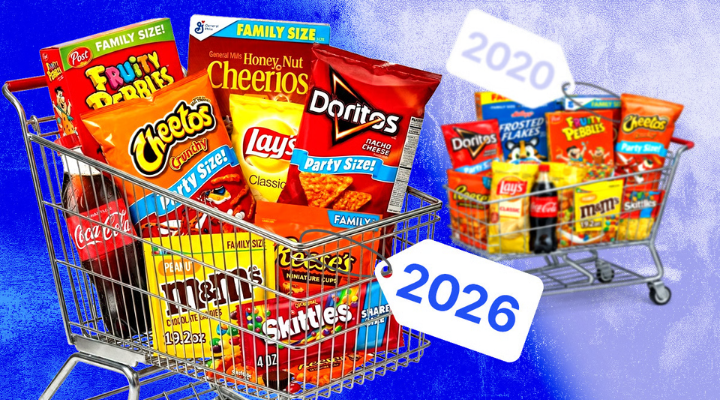
Sam Bourgi, a finance analyst and researcher at InvestorsObserver, has been tracking the price and package size of America’s most popular grocery brands (Frosted Flakes, Doritos, M&M’s, Coca-Cola, Campbell’s) across six years, from 2020 to 2026. The findings show a deliberate, two-step strategy that has left the average family of four paying an extra $741 per year for the exact same groceries. And about $41 of that increase comes not from higher sticker prices, but from shrinkflation: getting less product for the same money.
The Wyoming Star asked Bourgi to break down how widespread the strategy is, why consumers keep missing it, and whether there is any sign of reversal.
Asked how widespread shrinkflation has become across the consumer goods sector, Bourgi said it is no longer a niche tactic.
“It’s become extremely widespread. What started as a niche tactic is now standard practice across much of the consumer goods sector, especially in packaged food, household staples, and personal care. Companies are under constant pressure from higher input costs and margin expectations, and shrinkflation has become one of the most effective ways to manage both without triggering immediate consumer pushback.”
So why do consumers keep missing it? Bourgi explained that the price tag often does not change in a meaningful way.
“Most consumers shop based on sticker price, not unit price, so when the package gets smaller while the price stays the same or rises slightly, it’s much less noticeable. The change is subtle, and unless you’re tracking weight or volume over time, it’s easy to miss.”
The data from InvestorsObserver reveals a clear sequencing. Multiple brands (Doritos, Frosted Flakes, and M&M’s) raised the price first, then shrank the package about a year later, after consumers stopped paying close attention. Asked how intentional that sequencing is from a business strategy perspective, Bourgi did not hedge.
“It’s very intentional. Companies typically push through price increases first, especially during periods of broad inflation when consumers expect it. Once pricing resistance builds, they shift to reducing package sizes to protect margins without drawing as much attention. It’s a way to extend pricing power more gradually and less visibly.”
Which products have seen the most aggressive price-per-unit increases since 2020?
“Based on the report data, the most aggressive increases have been concentrated in snacks, cereal, and cleaning products. These categories tend to combine frequent purchases with flexible packaging, making them ideal for both price hikes and size reductions.”
Take Coca-Cola as a case study. The data shows that the same Coca-Cola beverage is sold in several sizes at dramatically different price points. A two-litre bottle cost $1.89 in 2020 and now costs $2.79. A 12-can pack rose from $4.89 to $8.89. But the mini can tells the most striking story: buying the same Coca-Cola mini cans costs 127% more per ounce than the 2-litre bottle.
“The simplest advice we can give any Coca-Cola drinker right now is to buy the 2-litre. Our data shows it’s the best value format by a wide margin, and that gap has only grown since 2020. The mini can costs more than twice as much per sip. Most people had no idea,” Bourgi said.
M&M’s recorded a 102% increase in price per ounce over the period — the only product in the analysis to fully double. A box of Frosted Flakes now costs 51% more per serving than in 2020, and there are fewer servings inside. By contrast, Skittles and Reese’s Miniatures kept the same sizes while raising prices. Ice cream brands like Ben & Jerry’s, Breyers and Häagen-Dazs raised prices over six years without reducing package sizes at all.
That last point matters.
“That matters because it proves the shrinkflation strategy was a choice, not a necessity,” Bourgi said. “If rising costs forced brands to shrink packages, every brand would have done it. They didn’t.”
So how should consumers actually protect themselves? Bourgi’s answer is straightforward.
“That’s become the most reliable way to compare value. The sticker price alone doesn’t tell the full story anymore. Looking at price-per-ounce or per-serving helps cut through both shrinkflation and price increases, and it’s often the only way to make apples-to-apples comparisons across brands and package sizes.”
Asked whether the trend is accelerating, stabilising, or beginning to reverse, Bourgi was clear.
“It’s not reversing. If anything, it’s becoming more embedded in how companies manage pricing. The pace may fluctuate depending on input costs and consumer demand, but the strategy itself isn’t going away. Shrinkflation has effectively become a standard tool in the pricing playbook. Also, prices rarely ‘come down.’ Inflation is cumulative. The Consumer Price Index measures annual price fluctuations, so while the pace of price hikes is slowing, the cumulative effect over time remains.”
By 2025, most prices stopped rising but remained well above 2020 levels. Several brands held prices steady, while a small number recorded declines. Package sizes did not return to earlier levels. Products reduced between 2022 and 2024 kept smaller sizes, and no brand restored previous volumes.
The human impact is uneven.
“No one is surprised by growing prices these days, but the issue with shrinkflation is the silence around it,” Bourgi said. “You can clearly see when gas prices grow or rent rises — but in this case, you don’t notice when you start to overpay for less. It lands hardest on those who can afford the least.”
The data also shows that responses to shrinkflation vary by age. Baby boomers (70%) identified more cases than Gen Z (48%) and millennials (54%). But Gen Z reported the highest share of respondents who stopped purchases due to shrinkflation (80%). Younger shoppers may be missing the trend, but when they catch it, they walk away.



The latest news in your social feeds
Subscribe to our social media platforms to stay tuned