





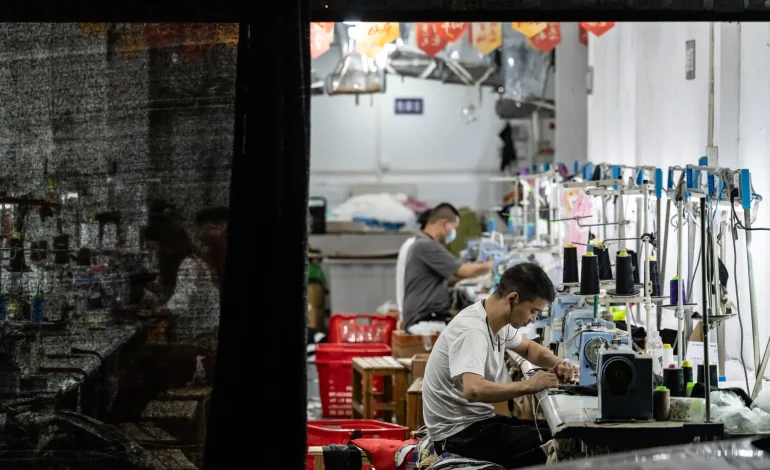

China’s once-thriving garment manufacturing sector is grappling with a new reality as fresh US tariffs and the closure of a key tax loophole threaten the viability of small factories that have long relied on American e-commerce markets, the New York Times reports.
For years, small garment producers in China, especially in Guangzhou, capitalized on platforms like Amazon, Shein, and Temu to sell directly to American consumers. Central to their success was a US import rule allowing goods under $800 to enter duty-free, enabling ultra-competitive pricing on items like dresses, socks, and tops. That era has come to an abrupt halt.
With the new tariffs and tax rule changes under the Trump administration now in effect, many small-scale factory owners say their already-thin profit margins have disappeared entirely.
“You can’t sell anything to the United States right now,” said Liu Miao, a factory owner in Guangzhou who previously sold wholesale clothing through Amazon. “The tariffs are too high.”
The garment sector’s challenges extend beyond US trade policy. Rising domestic supply chain costs, faltering Chinese consumer demand, and persistently high urban rents have combined to create a perfect storm. The slowdown is especially acute for companies whose success has been tied to export e-commerce, a key contributor to China’s economic growth over the past decade.
Some factories, like the one run by Liu Bin—who specializes in stylish casual wear—have already begun relocating operations to other provinces such as Jiangxi to cut costs. Others are eyeing countries like Vietnam, where production costs are lower, though they are wary of expanding tariffs targeting Chinese-linked operations there as well.
As orders from US-focused platforms like Shein and Temu decline, factory lines are being paused and neighboring businesses are shuttering. Temu recently announced it had stopped shipping goods from China to American buyers altogether. Shein has reportedly offered incentives to support supplier relocations abroad, though demand remains down across all platforms.
In response to the shifts, China’s government has urged factories to pivot to domestic e-commerce markets. Yet with consumer confidence low amid broader economic concerns—especially after the property market downturn—selling domestically may not offset the drop in exports.
Former shop owner Zhang Chen, now a delivery driver, says the decline in consumer demand has made retail unsustainable.
“In 2020, business wasn’t coming back, and in 2021, it still wasn’t coming back,” he said. “By 2022… it looked like it was never coming back.”
Factory owners are also confronting the reality that automation and technological modernization—hallmarks of other Chinese industrial sectors—have not yet reached their labor-intensive operations. Millions of workers depend on garment jobs that remain highly manual and price-sensitive.
Despite these difficulties, some manufacturers remain hopeful that demand for inexpensive, mass-produced fashion items will persist in the US.
“Where else are they going to buy all this?” said Han Junxiu, who sells novelty socks on Shein and Temu.
She questioned whether the US could feasibly enforce new duties on the millions of packages shipped daily.



The latest news in your social feeds
Subscribe to our social media platforms to stay tuned