





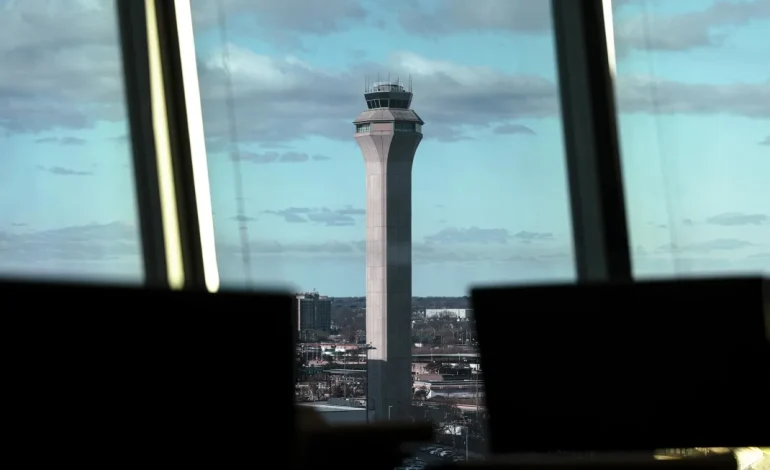

A persistent and worsening staffing shortage among air traffic controllers, coupled with outdated technology, has caused major delays at Newark Liberty International Airport for seven consecutive days—marking one of the most prolonged operational disruptions in recent memory at a major US airport.
Newark Liberty, one of the busiest airports in the nation and a key hub for United Airlines, has seen an average of over four-hour delays and numerous cancellations each day. The Federal Aviation Administration (FAA) cited staffing constraints as a primary factor in the delays and issued a Ground Delay Program on Sunday evening.
Multiple underlying issues have contributed to the disruption. The air traffic control facility responsible for Newark’s airspace has been understaffed for years. According to United Airlines CEO Scott Kirby, more than 20% of FAA air traffic controllers assigned to Newark walked off the job last week, further straining an already fragile system.
Additionally, one of the airport’s main runways is currently closed for rehabilitation, further limiting operational capacity. Technology failures have also played a critical role. Kirby noted that the outdated FAA systems—described as relying on floppy disks and copper wiring—have failed on multiple occasions, leading to diverted flights and compounding the delays.
Transportation Secretary Sean Duffy confirmed that these system shortcomings were a contributing factor and called for urgent modernization of air traffic control infrastructure nationwide. He pledged a multi-year overhaul aimed at implementing “state-of-the-art” systems that could better handle modern traffic volumes. However, Duffy warned that this overhaul could take three to four years to complete.
“The system we’re using is safe,” Duffy said, “but it’s old and increasingly unreliable.”
Meanwhile, safety concerns are growing among travelers and aviation professionals. Passengers have voiced unease about both staffing shortages and equipment reliability.
“They’re doing longer shifts, as a flyer that’s making me feel very nervous,” said one traveler, Geraldine Wallace.
Others have expressed similar concerns, citing the broader context of recent aviation incidents across the country.
The FAA has acknowledged that staffing levels nationwide are at their lowest in nearly three decades. As of September 2023, only about 70% of FAA air traffic control positions were filled by fully certified personnel. Including trainees, that figure rose to 79%. Hiring new controllers has been hampered by strict certification requirements, high stress, and long hours.
In response, the FAA has launched a national hiring campaign, aiming to recruit over 2,000 new controllers in 2025. Incentives include a 30% increase in starting salaries, a $5,000 academy completion bonus, and $10,000 bonuses for those accepting assignments at hard-to-staff facilities.
Despite these efforts, United Airlines announced on Friday it would cancel 35 daily roundtrip flights from Newark. Kirby said the airline had no choice given the “near-term structural FAA staffing issues” and called on the government to align the airport’s flight schedule with its operational capacity.
An anonymous air traffic controller reportedly told a news outlet that the situation at Newark is “not safe,” warning travelers to avoid flying through the airport until conditions improve.
The delays come amid renewed public scrutiny of aviation safety, following several high-profile air accidents earlier this year. The FAA and other federal officials have pledged to investigate recent system failures and staffing issues. Acting FAA Administrator Chris Rocheleau said:
“We need to make sure the controllers have the proper equipment and that they’re appropriately staffed.”
With input from CNN and the Guardian.



The latest news in your social feeds
Subscribe to our social media platforms to stay tuned