



ANALYSIS: Pashinyan’s Showdown with the Armenian Church — and a Country Split over Peace on Baku’s Terms
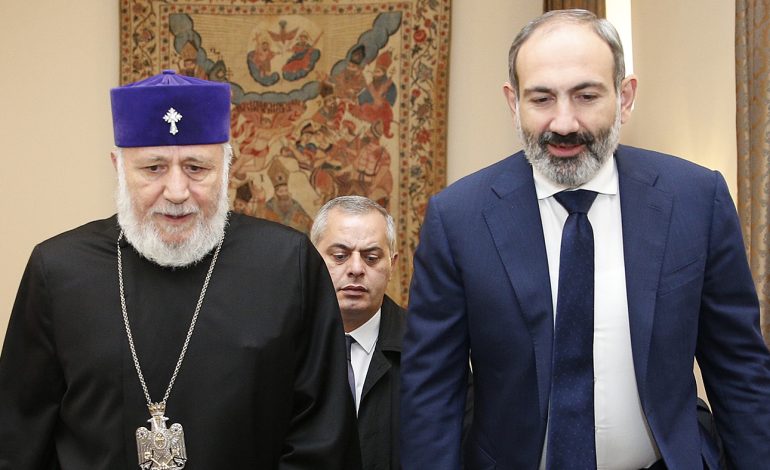

Armenia is on the cusp of what many abroad call a breakthrough: a US-brokered peace with Azerbaijan. At home, though, it’s tearing open one of the country’s oldest fault lines — the rivalry between throne and altar — and forcing Armenians to answer an uncomfortable question: how far are they willing to go for peace if the price is paid in identity?
Prime Minister Nikol Pashinyan has made himself the face of a pragmatic pivot — away from Moscow’s unreliable security umbrella and toward a deal that normalizes ties with Azerbaijan (and eventually, relations with Turkey and others). That has put him in direct conflict with the Armenian Apostolic Church and its leader, Catholicos Karekin II.
This isn’t just a 2025 squabble. The “state vs. church” push-and-pull runs like a thread through Armenian history, dating back to the first Christian state. Early katholicoi crossed kings — and paid for it. Later monarchs imposed their own preferred patriarchs. Under Ottoman and Persian rule, the Church was often the national proxy. In the 18th century, two rival katholicoi backed opposite sides of an Armenian revolt. Tsar Nicholas I even tried to rename the Church the “Armenian Gregorian Church” in 1836 to downplay its apostolic claims.
Through it all — especially in Soviet times — the Church became the keeper of Armenian identity: from sanctuaries to mountain chapels (matury) and khachkars planted where even tractors couldn’t topple them. For many faithful, the most potent symbol of that identity was Artsakh (Nagorno-Karabakh). That’s why the Church balks at “ceding Karabakh definitively,” even after battlefield defeats. As one historian-theologian put it, the Church remains the symbol that binds a global Armenian nation with many attitudes — but one identity.
Internationally, the August 8, 2025 deal mediated by President Donald Trump is framed as a long-awaited reset. Domestically, it’s combustible. Senior clergy have led protests against concessions, with Archbishop Bagrat Galstanyan fronting the Sacred Struggle movement rooted in the 2024 “Tavush for the Motherland” demonstrations. The government says it foiled a coup plot and has jailed figures tied to the movement — deepening the standoff with Karekin II.
Why the fury now? Two big reasons:
- Constitutional landmines. Baku says no treaty while Armenia’s Basic Law points back to the Declaration of Independence, language Azerbaijan sees as a claim on its territory. Translation: amend the Constitution or forget a deal.
- The “Zangezur corridor.” A land link across Armenia to Azerbaijan’s Nakhchivan enclave is politically toxic for many Armenians.
Fresh polling from the Armenian office of GALLUP International (sample ~1,100) shows the country is conflicted but shifting:
- 58% oppose changing the Constitution “at Azerbaijan’s request,” calling it an internal matter.
- 1% think amendments are a trap — Baku wouldn’t sign anyway.
- 2% would back changes if they truly deliver lasting peace.
- 7% are undecided.
Context matters: in 2024, a whopping 80.3% opposed amendments. That’s a 22-point drop in resistance in a year — not a mandate, but not static either. Roughly 60% also oppose the Zangezur corridor.
Why the drift? Pashinyan has spent years talking directly to citizens — especially younger Armenians — about a “real Armenia” that recognizes Karabakh as part of Azerbaijan and trades myth for survival. Critics say that’s naïve or capitulatory. Supporters call it overdue realism.
Another signal that the ground has shifted: the OSCE formally shuttered the Minsk Group. For Azerbaijan, that’s a diplomatic win and the end of an era. For Armenia, it’s a narrowing of options. Baku’s position is blunt: no constitutional cleanup, no treaty, no open borders, no unblocked trade. Azerbaijan can wait. Armenia, hemmed in and economically strained, can’t.
Pashinyan’s answer is equally blunt: push constitutional changes via referendum after parliamentary elections — and get it done even if the Constitutional Court balks. Notably, that hard line didn’t trigger the kind of mass backlash many expected.
Here’s the strategic risk that doesn’t fit neatly on a ballot: the Church is one of Armenia’s core instruments of soft power. By some estimates, more than 70% of Armenians live outside Armenia. Many of those communities connect to the homeland through Church networks. If Yerevan and Echmiadzin turn each other into permanent enemies, the state could find itself cut off from its most reliable global amplifier — precisely when it needs diaspora leverage the most.
That’s why scorched-earth tactics are dangerous for both sides. Forcibly replacing church leadership would violate the Church’s independence and backfire. Continuing to use pulpits as opposition platforms will shred the Church’s claim to be a national unifier.
What comes next
- Pashinyan’s gamble: hold elections, seek a referendum, sell constitutional reform as the price of normal life — open borders, transit, investment — and bet that war fatigue beats nostalgia.
- The Church’s counter: defend identity red lines (Karabakh above all), mobilize the faithful at home and abroad, and warn that “peace at any price” unravels the nation’s story.
- Society’s mood: still skeptical of rewriting the Basic Law under pressure — but clearly more open than a year ago.
The paradox is stark. The same institution that preserved Armenian identity when there was no state now fears the state is bartering away that identity. The same prime minister who broke with the old, Moscow-aligned order argues that clinging to sacred myths will keep Armenia poor, isolated, and permanently vulnerable.
There’s a narrow path between these truths. It runs through a constitutional process the public can own; clear, verifiable peace terms; and a basic handshake between altar and cabinet: the Church stays out of partisan regime change, the state safeguards the Church’s voice and independence. Anything less, and Armenia risks winning a treaty while losing the societal cohesion it needs to make peace stick.


The latest news in your social feeds
Subscribe to our social media platforms to stay tuned