


EXCLUSIVE: A Fragile Pause. Inside Trump’s Gaza Ceasefire — What it Could Mean for Palestinians.
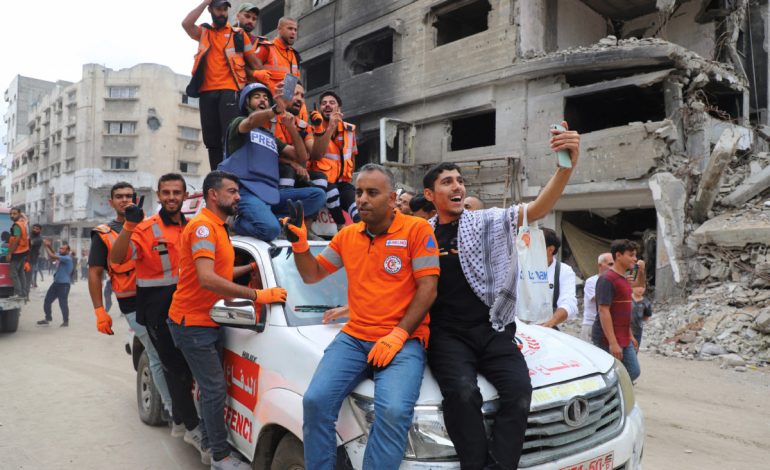

After two years of genocide, Gaza has a ceasefire and a roadmap. The White House says it’s the first phase of a sprawling “20-step” framework brokered with Egypt, Qatar, and Turkey; Israel’s war cabinet has signed on, and Hamas has agreed to release hostages as part of a staged truce and prisoner exchange. Whether this becomes a turning point or just another pause depends on what happens next — disarmament talks, governance in Gaza, and whether a credible path to Palestinian statehood is real or rhetorical.
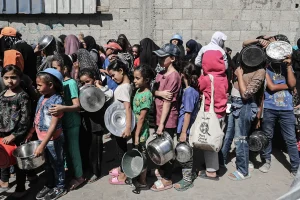
Since October 2023, Gaza has absorbed an intensity of destruction that UN bodies back in 2024 already compared to the worst devastation seen since World War II. Independent tallies and UN assessments converge on the scale: tens of thousands killed, many more injured or missing, entire neighborhoods erased, public health and schooling systems gutted. UN development economists warn that even in optimistic scenarios, rebuilding the housing stock alone would run past 2040; under more constrained conditions, it could take decades longer. Poverty and job loss have surged, with the war wiping out livelihoods and slamming Gaza’s already fragile economy into freefall.
Facts on the ground are not just about buildings. International investigators and rights entities have chronicled patterns of targeting, siege, and humanitarian obstruction. In September, the UN Human Rights Council’s Commission of Inquiry released a report concluding that Israel has committed genocide in the Gaza Strip, a determination that will reverberate through courts, parliaments, and diplomacy for years — contested by Israel and its allies, but now part of the official UN record. The OHCHR followed with public materials summarizing findings and the applicable law. These sit alongside broader histories of the Gaza war and the Gaza–Israel conflict that track how repeated escalations and blockades welded a development crisis to a human-rights catastrophe.
None of this is abstract in Gaza. It’s the daily math of survival: where to sleep, what to drink, whether clinics still function, whether schools can reopen, and if food can actually reach a neighborhood without being shelled on the way in. Even for those who live, the war’s toll is engraved into public health and the economy — a multi-decade rebuild with no guarantee of political stability to protect it.
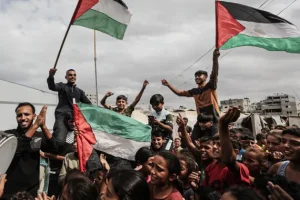
US officials have pitched a phased deal: an immediate truce tied to hostage releases and Israeli withdrawals from defined zones; a second phase that sets up a temporary Palestinian administrative mechanism for Gaza and codifies deeper Israeli pullbacks; a third phase that gestures toward a recognized Palestinian state if milestones are hit. The details vary by document and day, but the spine is consistent across leaks and official readouts. The Times of Israel published a “21-point” US blueprint for ending the war and creating a pathway to statehood; the White House has campaigned for international buy-in; and contemporaneous reporting has tracked a US “20-step” structure used in the talks. None of this ends the hard parts — weapons, borders, elections, refugees — but it explains how negotiators finally got to “yes” on a ceasefire.
Khalil Shikaki, Professor of Political Science, and Director of the Palestinian Center for Policy and Survey Research (Ramallah), one of the founders of the Arab Barometer, a member of its steering committee, and senior fellow at the Crown Center for Middle East Studies at Brandeis University, put it bluntly:
“The current Israel-Hamas ceasefire agreement reached on 8 October 2025 is a major turning point in the Gaza War. The agreement has succeeded this time due to the great commitment by the US president and the unprecedented high level of involvement from the major regional powers, including most importantly Egypt, Qatar, and Turkey. This agreement was also made possible by the fact that it is, in theory at least, part of the larger Trump Peace Plan for ending the Gaza war and resolving the larger Palestinian-Israeli conflict. Anchoring the ending of the war in that plan allowed all the parties to make concessions that they were unwilling to make in previous rounds of negotiations: for Hamas, this meant the release of all the hostages while the Israeli army is still in Gaza and for Israel, the willingness to end the war before Hamas has been disarmed. It is difficult to speculate about the durability of the current agreement. Only the continued personal involvement of the US president and the regional players can ensure a sustainable ceasefire. However, the second phase of the Trump Plan requires agreement on the transitional arrangements related to the formation of a temporary Palestinian committee to administer the Gaza Strip, as well as the disarmament of Hamas and the full Israeli withdrawal from the Gaza Strip. This is extremely difficult to agree on in the absence of an agreement on the larger question of the future of the conflict, the creation of the Palestinian state in the third phase of the plan within the context of a two-state solution. Ultimately, this is the crux of the problem whose resolution would ensure the survivability of the current agreement as well as the success of the negotiations on the second phase of the Trump plan.”
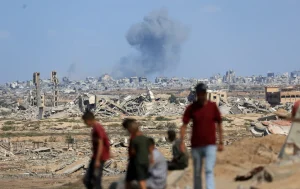
The first hours of a truce are always messy. Even as Israel approved the ceasefire, strikes and shelling didn’t instantly stop; that friction showed up in early reporting from the Strip. Al Jazeera’s breakdown of the deal describes how withdrawals would unfold neighborhood by neighborhood, how the hostage-for-prisoner exchanges are sequenced, and which guarantors are supposed to enforce violations. Those same reports note Hamas’ insistence on written guarantees that the war truly ends, not just pauses. In parallel, the diplomatic machinery around the deal — Cairo and Doha channels, US envoys — kept grinding to keep the sequencing intact.
David Mednicoff, Chair of Judaic and Near Eastern Studies at the University of Massachusetts-Amherst, warns against complacency:
“Neither Netanyahu’s government in Israel nor Hamas, left to their own decisions, has a strong interest in ending the war… Any hopes for an actual end to the war… is based on the fact that neither President Trump nor Arab Gulf leaders want the war to continue, and have put more pressure on Netanyahu and Hamas to end things now. Given this, there is some real chance, although certainly not a probability, that the war will end, with an exchange of hostages and a move towards some change in Gaza… Because the far-right members of Netanyahu’s coalition may bring the government down if the deal goes through, and Hamas will likely be denied a role in Palestinian reconstruction, moving forward from a cease fire is tricky. More generally, what appears to be the Trump Administration’s lack of clear commitment to Palestinian ownership in reconstruction in Gaza, Netanyahu’s broad opposition to Palestinian self-governance in Gaza or the West Bank, and most other parties’ clear commitment to helping Palestinians rebuild their lives in Gaza, will lead to very messy negotiations over what will happen in the devastated territory after a ceasefire. Despite the above, President Trump and the major Arab governments in the region seem determined to continue pressing for an end in this terrible war, and there is a sense among analysts that this effort is different as a result.”
Phase two is where revolutions and roadmaps go to die. The plan envisions a temporary Palestinian committee taking over civil administration in Gaza as Israeli forces withdraw. But who sits on that committee, who controls the police, and whether Ramallah’s recognized government is allowed to govern are still open fights. One version of the plan discussed by US and regional interlocutors punts the final status question while demanding Hamas’ disarmament — a sequencing that, historically, has baited conflict rather than ending it. The White House’s own language is soaring — “global support” for a “bold vision” — yet it leaves deliberate ambiguity on the mechanics that matter most to Palestinians day to day.
That ambiguity collides with law and precedent. A UN commission’s genocide findings frame the obligations on states to prevent future atrocities and hold perpetrators to account; UN briefings have underscored the need for independent, Palestinian-led governance if aid and reconstruction are to be anything more than photo-ops. If you’re a Gulf finance minister crunching numbers, you’re not wiring tens of billions into a rubble pile without ironclad guarantees the war won’t restart — and that local authorities can actually govern.
Stephen Zunes, Professor of Politics and International Studies at the University of San Francisco and longtime analyst of US policy and nonviolent movements, sketches the knife-edge:
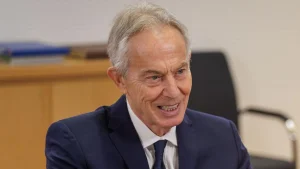
“The first phase of the ceasefire plan will likely be successful. The subsequent parts are a question. Let’s remember that the first phase of the ceasefire agreement in January was also fully implemented, but then Israel — with Washington’s support— resumed the war two months later. This could happen again… Israel has been a bit vague on the timetable and the extent of the withdrawal. And Israel has violated their withdrawal agreements in Lebanon and Syria in recent months without objections from the United States… Hamas’s disarmament is an issue… They are holding out on that issue as their last bargaining chip to make sure that other demands, including guarantees of a permanent ceasefire and a total Israeli withdrawal, are implemented. The administration of the Gaza Strip must be in Palestinian hands. Any long-term neocolonial administration with Donald Trump and Tony Blair at the helm, as is being proposed, will lead to widespread resistance… Israel’s refusal to allow Palestine’s internationally-recognized government based in Ramallah to govern the Gaza Strip could sabotage the whole deal. The costs of reconstruction are going to be astronomical, given the level of devastation… At least Trump is no longer talking about razing the entire territory, expelling the population, and setting up the whole enclave as a Mediterranean resort. No plan will lead to real peace between Israelis and Palestinians unless it is premised on equal rights for Israeli Jews and Palestinian Arabs, either in a viable two-state solution or a single bi-national state with guaranteed equal rights for both.”

If guns go quiet and stay quiet, immediate wins look like basics that haven’t been basic in years: free movement for aid; coherent, Palestinian-led civil administration; schools reopening; clinics restocked; families reunited; detainees coming home; a public conversation inside Palestinian society about leadership, legitimacy, and the political horizon. If the plan’s later phases take root, you could see a consolidated West Bank–Gaza governance track re-emerge, border regimes adjusted, and a real debate on statehood timelines move from rhetoric to road-mapping. That is the best-case arc the White House wants the world to believe is possible.
History says that promises without enforcement are invitations to relapse. The data says Gaza cannot take another round like the last two years. And the diplomacy says that a ceasefire built on hostages and timelines, without an enforceable horizon of rights and sovereignty, will bleed legitimacy fast. If the “20 steps” are a bridge to real statehood, Palestinians will feel it soon in permits, policing and paychecks. If they are theater, people will know just as quickly — and the truce will curdle back into trauma.
For now, the ceasefire is real, the map is changing, and the window is open. Whether it stays open is up to the guarantors who signed the plan and the leaders who say they back it.


The latest news in your social feeds
Subscribe to our social media platforms to stay tuned