





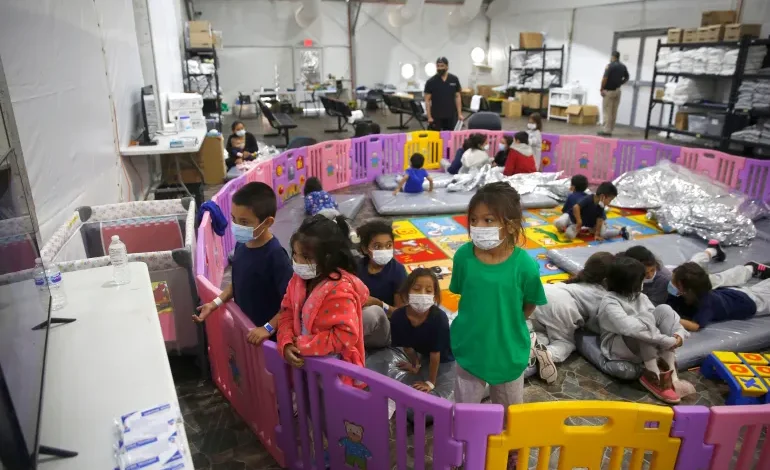

Hundreds of immigrant children in the United States have been held in federal custody far beyond a court-mandated 20-day limit, according to recent court filings, a development that legal advocates say signals a deeper breakdown in oversight and child welfare protections inside the US immigration system.
The filings, submitted late Monday in a long-running federal case governing standards for the detention of migrant children, reveal that some minors were held for more than five months, despite rules designed to prevent prolonged custody. Conditions described in the documents include inadequate medical care, contaminated food and extended confinement in facilities never intended to hold children for weeks or months at a time.
To shed light on what this moment means for immigration enforcement and child protection, the Wyoming Star spoke with Jennifer Podkul, chief of global policy and advocacy at Kids in Need of Defense (KIND), an organisation that provides legal services to unaccompanied migrant children.
Flores under strain
At the heart of the dispute is the Flores Settlement Agreement, a landmark 1997 legal settlement that established basic standards for the treatment and release of minors in immigration custody. The agreement, rooted in a 1985 lawsuit over the detention of a teenage girl named Jenny Flores, limits how long children can be held and requires that they be kept in safe, sanitary conditions.
According to court filings, US Immigration and Customs Enforcement (ICE) acknowledged that roughly 400 children were held beyond the 20-day limit between August and September. Advocates argue the issue is systemic rather than isolated, driven by transportation delays, legal processing bottlenecks and medical needs, explanations they say do not justify extended detention.
For Podkul, the pattern is deeply troubling.
“Since it took effect in 1997, the Flores Settlement Agreement has provided basic child welfare standards and safeguards, coupled with meaningful third-party oversight, to ensure fundamental protections for all minors in U.S. immigration custody,” she said. “The prolonged detention of unaccompanied children that we’re seeing increasingly is exactly what the agreement was meant to prevent.”
She pointed to the origins of the Flores case itself, the two-month detention of a 15-year-old with little oversight, as a warning the system appears to be repeating.
Conditions and consequences
The filings describe children being held in hotels, permitted for only 72 hours, for longer periods, as well as injuries and delays in medical treatment. One child reportedly waited two days to be seen after an eye injury; another suffered a broken foot. Families also reported moldy food and meals containing worms.

Podkul stressed that how children are treated in custody has long-term consequences.
“The way DHS and HHS detain, process, treat, and release minors has a profound impact on children’s abilities to access needed social services, legal representation, and humanitarian protection,” she said.
In her view, the current situation underscores why the Flores framework remains essential.
“It’s clear that Flores is needed now more than ever to ensure that basic child welfare standards and legal obligations are upheld and that we are not holding children in custody indefinitely, causing them grave harm.”
The Trump administration has sought to end the Flores agreement, arguing it constrains enforcement flexibility. Advocates counter that the agreement is one of the few mechanisms preventing children from being warehoused without oversight.
What could change
Asked what realistic reforms could prevent similar violations in future enforcement cycles, Podkul outlined several policy paths KIND has long supported.
“Codifying Flores into law with mandatory reporting and penalties for noncompliance would transform Flores from a settlement agreement into a binding statutory obligation,” she said.
She also called for structural accountability, including an independent office focused solely on children’s welfare.
“An Ombuds Office for unaccompanied children could play a vital role in receiving and responding to complaints raised by children and others, and in identifying, preventing, and helping to address violations of laws and policies.”
Finally, Podkul argued that alternatives to detention already exist, and are more humane and cost-effective.
“Expanding the use of licensed, small-scale, family-based settings for children’s care would be cost-effective, trauma-informed, and consistent with child welfare principles.”
To sum up:
ICE did not respond to requests for comment on the filings. Chief US District Judge Dolly Gee, who oversees Flores compliance, is scheduled to hold a hearing next week that could determine whether the court intervenes further.
For advocates, the moment represents a test of whether the US immigration system is willing, or able, to uphold its most basic promises to children.



The latest news in your social feeds
Subscribe to our social media platforms to stay tuned