



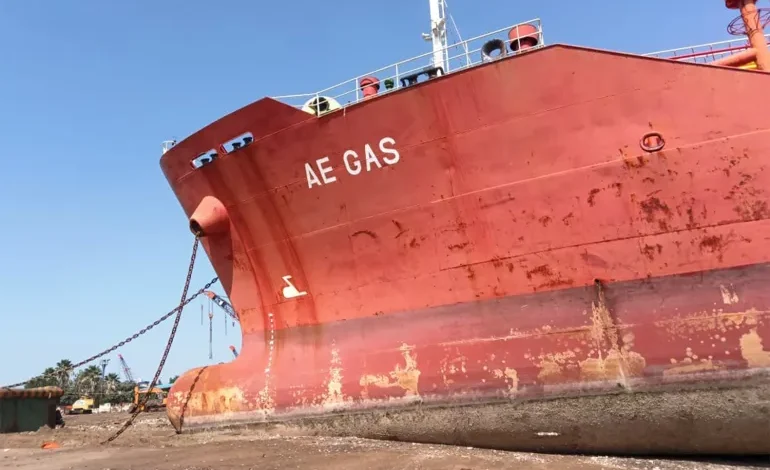

On the windswept coast of the Arabian Sea in Gujarat, Ramakant Singh scans an empty horizon where towering hulls once crowded the shore.
“In the olden days, ships lined up at this yard like buffaloes before a storm,” the 47-year-old says. “Now, we count the arrivals on our fingers.”
Ramakant works at Alang, the world’s largest ship-breaking yard, in Bhavnagar district, also the home state of Prime Minister Narendra Modi. For two decades, he has earned his living cutting apart oil tankers and cargo ships that once sailed from Europe and East Asia to meet their end on this beach.
Thanks to its gently sloping shoreline and dramatic tides, Alang became the backbone of India’s ship recycling industry in the 1980s. Vessels could be driven ashore at high tide, then dismantled cheaply by hand. Over the years, more than 8,600 ships, about 68 million tonnes of light displacement tonnage, have been broken here, accounting for almost all of India’s ship recycling and roughly a third of the global total.
Today, that dominance is fading.
Across the world’s oceans, an ageing fleet of cargo ships, cruise liners and oil tankers is approaching retirement. Of the roughly 109,000 vessels still operating, nearly half are over 15 years old. Each year, around 1,800 ships are declared unfit to sail and sold off through international “cash buyers” based in hubs like Dubai, Singapore and Hong Kong, before ending up in South Asian yards.
Alang once absorbed a large share of that traffic. Ships would be beached, then dismantled by hundreds of workers who salvaged everything from steel plates and engines to cables, cupboards and lifeboats — all resold into construction and manufacturing markets.
But over the past decade, arrivals have slowed to a trickle. Where rows of massive hulls once resembled high-rise buildings against the town’s low rooftops, only a handful of vessels now dot the coastline.
“Earlier, there was plenty of work for everyone,” says Chintan Kalthia, who runs one of the few yards still operating. “Now, most of the workers have left. Only when a new ship beaches do a few come back. My business is down to barely 30 or 40 percent of what it used to be.”
Industry data shows how sharp the fall has been. In 2011–12, Alang dismantled a record 415 ships. Today, of the 153 plots developed along its 10-kilometre coast, only about 20 are active — and even those are running at roughly a quarter of capacity.
“What’s happening in Alang has multiple causes,” says Haresh Parmar, secretary of the Ship Recycling Industries Association of India. “The biggest is that shipowners simply aren’t retiring vessels.”
After the COVID-19 shock, global shipping rebounded with a vengeance. Demand surged, freight rates soared and profits hit record highs. Rather than scrap ageing ships, owners have kept them sailing well past their usual lifespan.
Geopolitics has added another twist. Israel’s war in Gaza and attacks on commercial vessels in the Red Sea by Yemen’s Houthi rebels have disrupted one of the world’s busiest trade corridors. Many ships now avoid the Suez Canal altogether, rerouting around the Cape of Good Hope, a longer, costlier journey that has further tightened capacity and pushed rates higher.



The latest news in your social feeds
Subscribe to our social media platforms to stay tuned