


Canadian Nuclear Waste Deal Raises Eyebrows — and Could Put Wyoming on the Route

The original story by David Madison for Cowboy State Daily.
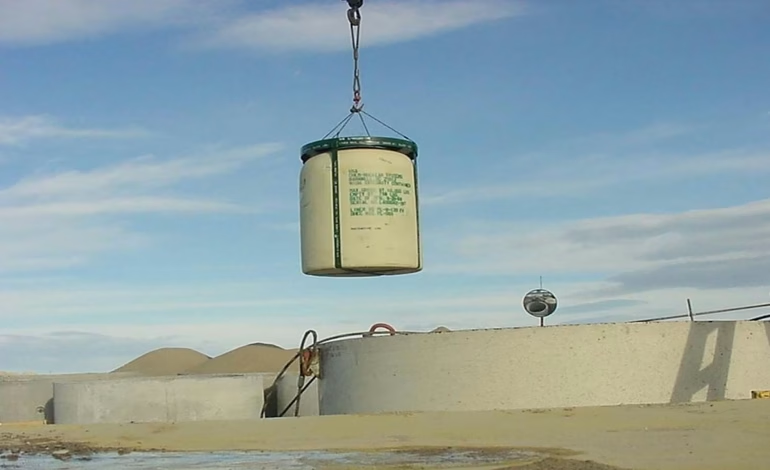
A Utah company wants to bring radioactive waste from Canada into the United States — and critics say that could mean nuclear material rolling straight through Wyoming.
The company at the center of the controversy is EnergySolutions, which operates a low-level radioactive waste disposal site near Clive, Utah. Last week, the Northwest Interstate Compact approved EnergySolutions’ request to import more than 1.3 million cubic yards of radioactive waste from Ontario, Canada.
Environmental watchdogs say it’s a historic move — and not in a good way. If it goes through, it would mark the first time foreign nuclear power waste is permanently disposed of on US soil.
EnergySolutions, meanwhile, is celebrating. The company recently released a slick “Mission Impossible”-style promo video hyping its January conference in Salt Lake City, complete with talk of “top secret updates,” small modular reactors, and a “global surge in nuclear energy.”
Opponents aren’t impressed.
“I think they’re wildly overhyping themselves,” said HEAL Utah executive director Lexi Tuddenham.
She argues EnergySolutions has long been a waste disposal company, not a nuclear innovation powerhouse — and that the flashy marketing is more about attracting investors than protecting communities.
The Clive facility sits just south of Interstate 80 — a major east-west corridor. And that’s where Wyoming enters the picture.
“It is possible that some of those transport routes will go through parts of Wyoming,” Tuddenham said.
The problem, she added, is that many of the details remain fuzzy: exact shipping routes, the specific radioactive isotopes involved, and how frequently waste would be moved.
The waste is classified as Class A low-level radioactive waste, but critics say that label can be misleading.
“Low-level does not mean harmless,” Tuddenham said, warning that long-lived isotopes — including plutonium — could be part of the shipment. “There’s a transport risk. That affects air, land, water, and potentially the food chain.”
Asked directly whether plutonium from Canada could pass through Wyoming communities, Tuddenham didn’t mince words:
“It’s absolutely possible.”
The Canadian waste is just the start. According to EnergySolutions’ own presentation, the company plans to expand disposal capacity at Clive. Under the current deal, Ontario’s waste would make up 15% of the expanded capacity, with the remaining 85% reserved for US generators.
Utah lawmakers are on board. State legislation requires EnergySolutions to pay up to $30 million if it applies for expansion approval before the end of 2025 — money that would fund Utah’s nuclear strategic plan.
“If they’re willing to pay $30 million just to fast-track this,” Tuddenham said, “you have to wonder how much they expect to make.”
This also isn’t EnergySolutions’ first attempt to import foreign waste. A similar proposal involving Italy back in 2007 fell apart after Utah’s governor shut it down. Critics say this time the company lined up political support before going public.
That question has frustrated activists on both sides of the border.
Canada already selected a site in northwestern Ontario for a deep geological repository for used nuclear fuel — hundreds of meters underground. Yet low-level waste from Ontario is still being sent to Utah.
“I don’t know why they can’t take care of their own waste,” Tuddenham said, noting that Canadian environmental advocates share the same concern.
Canada’s Nuclear Waste Management Organization says the Utah shipment isn’t its call, pointing instead to Ontario Power Generation. Neither EnergySolutions nor Ontario Power Generation responded to requests for comment.
The deal isn’t final yet. EnergySolutions still needs export authorization from Canada and approval from the US Nuclear Regulatory Commission.
But critics aren’t optimistic about federal oversight slowing things down.
“The NRC has never denied an import for nuclear processing,” said Diane D’Arrigo of the Nuclear Information and Resource Service. “So I expect this will be rubber-stamped.”
For Wyoming residents, the concern is simple: even if the waste ends up buried in Utah, the journey to get there may run straight through the Cowboy State — raising fresh questions about safety, transparency, and whether the US should be taking the world’s radioactive leftovers at all.



The latest news in your social feeds
Subscribe to our social media platforms to stay tuned