

With input from the New York Times, ABC News, the Guardian, USA Today, CBS News.
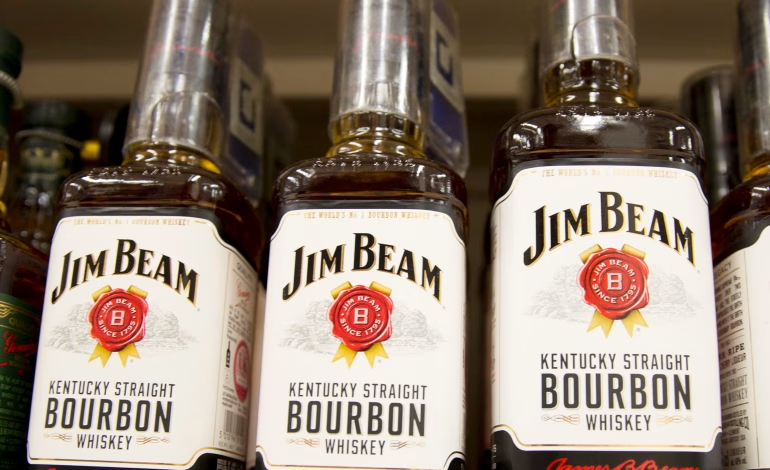
Jim Beam — the biggest name in bourbon — is basically calling a timeout.
The brand announced it’s shutting down production at its flagship Clermont, Kentucky, distillery for all of 2026, starting Jan. 1. It’s a pretty jaw-dropping move for a company that helped power bourbon’s two-decade growth streak — and it’s also a loud signal that the American whiskey market is in trouble.
Beam (owned by Japan’s Suntory Holdings) says the Clermont shutdown will last the whole year, though the company is keeping plenty running: its bottling operation and visitor center at Clermont stay open, and it will continue distilling at its other Kentucky sites, including the larger facility in Boston, Ky., plus its smaller craft/experimental operation. It’s also still making whiskey at Maker’s Mark in Loretto, which Suntory owns, too.
The big question hanging over Clermont: what happens to workers. Jim Beam hasn’t said whether staff will be furloughed, relocated, or cut — only that it’s still figuring out how to handle the workforce.
Because the broader booze business is hitting a wall. Across wine, beer, and spirits, sales are down about 5% over the past year, and the whiskey side has been taking punches from multiple directions.
One of the biggest is simple: too much whiskey, not enough buying.
After years of expansion — and especially the pandemic era, when homebound consumers supercharged the bourbon craze — distillers ramped up production, poured money into expansions, and stuffed warehouses with barrels meant to age for years. Now Kentucky alone has about 16.1 million barrels aging. That’s a mountain of inventory, and it’s expensive to sit on.
And it’s not just Jim Beam. The slowdown has already pushed other giants to cut back:
- Diageo paused distilling at its Cascade Hollow facility (George Dickel) in Tennessee.
- Brown-Forman (Jack Daniel’s, Old Forester) announced layoffs of roughly 650 employees, about 12% of its workforce.
- Contract distiller MGP Ingredients reported a 19% drop in third-quarter sales.
- Several whiskey companies have slid into receivership, including Garrard County Distilling Co. and Uncle Nearest.
Economics and politics are also stirring the pot. Analysts point to fallout tied to President Trump’s tariffs, including a major hit to exports — especially to Canada, where consumer backlash and provincial control over liquor sales have virtually shut down American whiskey in a market that used to matter a lot. Overall, US whiskey exports are down about 9% from 2024, according to the Distilled Spirits Council.
The uncertainty also makes it harder to build new growth engines in regions like South Asia, sub-Saharan Africa, and Southeast Asia, places US producers had been eyeing as future big-volume markets.
Even more uncomfortable for legacy brands: the next generation drinks differently. Polling and industry chatter suggest young consumers are drinking less overall, and when they do drink, they’re often choosing stronger, pricier bottles — fewer pours, more “premium.”
That’s not great news for Jim Beam’s core workhorse, White Label, the affordable 80-proof staple that built the brand’s dominance.
Whiskey writer Fred Minnick summed it up bluntly: consumers aren’t exactly lining up for basic 80-proof bottles the way they used to — but “elevated” brands still move. That helps explain why luxury-heavy players like Sazerac can keep expanding (it recently announced a $1 billion expansion, largely at Buffalo Trace) even while mainstream producers pull back.
Old-timers in Kentucky have heard this story before. Bourbon hit record production highs in the mid-1960s too — and then demand cratered for years as drinkers moved to vodka, rum, or just less alcohol overall. The result back then was brutal: long oversupply, collapsing prices, and distillery closures.
That’s why Jim Beam’s 2026 pause feels bigger than one company’s operational tweak. It looks like an industry recalibration — maybe the start of a longer, messier reset.
Or, as Minnick put it: a punch in the gut for bourbon country.

The latest news in your social feeds
Subscribe to our social media platforms to stay tuned