




China Points Finger at Taiwanese “Smugglers” in Undersea Cable Cut — Taipei Calls It Hybrid Warfare
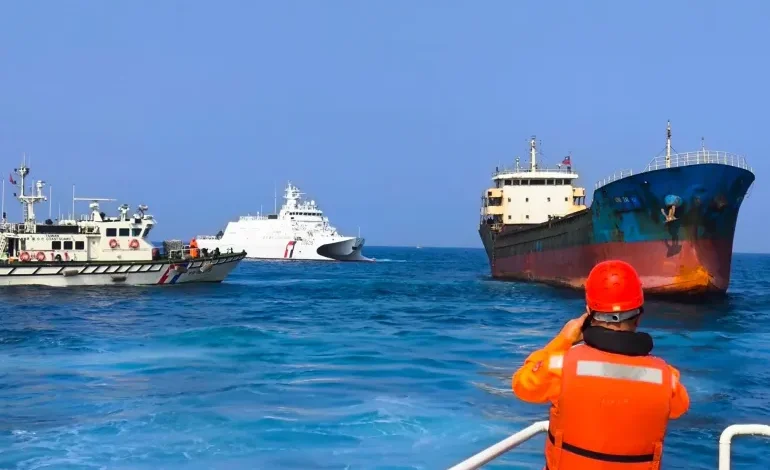

China says two Taiwanese men were really calling the shots on a ship accused of damaging undersea cables near Taiwan earlier this year — and it’s framing the whole thing as a smuggling case, not sabotage. Taipei isn’t buying it, saying the February incident fits a familiar pattern of “grey zone” pressure tactics, Al Jazeera reports.
China’s public security bureau in Weihai, in the eastern province of Shandong, said Wednesday that an investigation found two Taiwanese nationals controlled the Togo-registered Hong Tai 58, a Chinese-crewed vessel linked to the cable damage. According to Chinese officials, the ship was part of a long-running operation smuggling frozen goods into China.
In comments carried by Chinese state media, China’s Taiwan Affairs Office accused Taiwan’s ruling Democratic Progressive Party (DPP) of playing politics — saying the party falsely claimed Beijing deliberately used the Hong Tai 58 to sabotage an undersea cable in order to “stir cross-Strait confrontation.”
Taiwan, however, has argued the severed cable was a form of hybrid warfare — low-level coercion that’s hard to prove and easy to deny. These “grey zone” incidents can look like accidents on paper while still sending a message.
Beijing has rejected any suggestion of wrongdoing, calling the cable damage a routine maritime incident that Taiwan “exaggerated.”
The case has already produced real-world consequences. In June, a Taiwanese court sentenced the ship’s Chinese captain to three years in prison, ruling that the cable damage was intentional. Seven other Chinese crew members were sent back to China without being charged, though Beijing says they were interviewed as part of the mainland investigation.
In a new escalation, the Weihai public security bureau offered a reward of up to 250,000 yuan (about $35,569) for information leading to the two Taiwanese suspects. The bureau identified them only by surnames — Chien and Chen — and said they’ve been on a Chinese customs wanted list since 2014.
Taiwan’s Mainland Affairs Council pushed back hard, saying China has no jurisdiction over Taiwan and urging Beijing to produce evidence rather than publicizing names and dangling rewards.
“Without concrete evidence, publicly announcing names and offering rewards is not a civilized practice,” it said, calling it another example of political manipulation and cross-border repression.
Undersea cables are basically the plumbing of the modern internet, carrying the vast majority of global data traffic. They’re also vulnerable — not just to deliberate damage, but to anchors, fishing activity, shifting sea floors, and aging infrastructure. Industry data suggests 100 to 200 cable faults happen worldwide each year, and proving intent can be extremely difficult.
Around Taiwan, cable breaks have become a regular anxiety point. Since 2023, there have been at least 11 cable breakdowns in the area, though some were later ruled accidental or blamed on old equipment. Similar concerns have surfaced in the Baltic Sea since Russia’s invasion of Ukraine, where governments have struggled to build legal cases even when suspicions run high.
For now, the Hong Tai 58 case is turning into a political tug-of-war: China says it’s a smuggling operation with Taiwanese masterminds, while Taiwan sees something darker — a pressure campaign hiding in plain sight.



The latest news in your social feeds
Subscribe to our social media platforms to stay tuned