



The Washington Post, Al Jazeera, and AP contributed to this report.
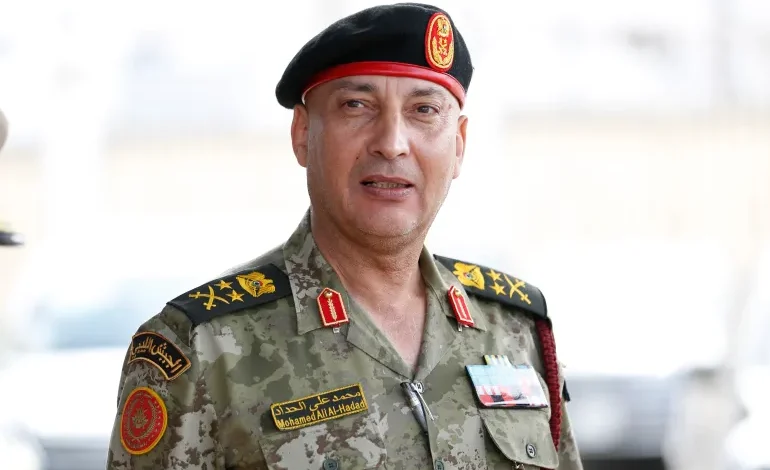
Libya is in mourning after Lieutenant General Mohammed Ali Ahmed al-Haddad, the country’s army chief of staff, was killed when a private jet crashed in Turkiye while flying back to Tripoli from an official visit to Ankara.
Al-Haddad’s death — along with four senior Libyan military officials and three crew members — has hit hard in a country still split by rival governments and armed groups. Many Libyans saw him as a rare unifying figure in a deeply divided political landscape. The Tripoli-based authorities have announced three days of national mourning, with flags lowered and official events suspended.
Turkish officials say the aircraft, a Dassault Falcon 50, took off from Ankara’s Esenboga Airport on Tuesday evening heading for Tripoli.
Minutes after departure, the jet reported an electrical malfunction and asked to make an emergency landing. Air traffic control directed it back toward the airport and emergency procedures were activated — but the plane vanished from radar while descending, and contact was lost.
The wreckage was later found near Kesikkavak village in the Haymana area, south of Ankara. Turkish search-and-rescue teams were dispatched, and authorities later said they had recovered the cockpit voice recorder and flight data recorder (the “black boxes”). A full investigation is now under way, led by prosecutors and aviation authorities, with Libyan officials also inspecting the crash site.
Al-Haddad was Libya’s chief of the General Staff — the highest-ranking military position in the country’s armed forces — and had held the post since 2020.
He worked under the UN-recognised Government of National Unity (GNU) in Tripoli and was closely involved in efforts to pull together rival armed factions, especially in western Libya where powerful militias hold territory and political influence. Supporters and observers often described him as a firm figure who pushed for stronger state military institutions and resisted militia pressure.
His influence also extended beyond Tripoli. Despite Libya’s split between the western government and a rival eastern administration led by commander Khalifa Haftar, condolences came from both sides — a sign of the broad respect he carried in a fractured country.
Everyone on board died. Alongside al-Haddad, the Libyan officials reported killed include:
- General al-Fitouri Ghraibil, head of Libya’s ground forces;
- Brigadier General Mahmoud al-Qatawi, director of the Military Manufacturing Authority;
- Mohammed al-Asawi Diab, senior adviser;
- Mohammed Omar Ahmed Mahjoub, military photographer.
Three crew members were also killed, though their identities were not immediately released in the information provided.
Libyan Prime Minister Abdul Hamid Dbeibah called it a “tragic loss,” saying Libya had lost officials who served with discipline and commitment. Haftar’s eastern forces also issued condolences, describing the crash as a painful national loss.
In Turkiye, officials said the crash site was difficult to work through — with wreckage spread widely — but that the black boxes had been recovered and analysis had begun. A Libyan delegation, including family members, traveled to Turkiye to support the investigation and help with arrangements.
The big immediate question is what this means for Libya’s already fragile military and political balance.
Libya’s Presidential Council has named General Salah Eddine al-Namrush as acting chief of staff until a permanent replacement is announced. Analysts and officials warn that replacing al-Haddad won’t be simple: he played a key role in keeping lines open between competing power centers — especially in western Libya — at a time when unity is still more goal than reality.
For now, both countries say they’re focused on the investigation — and on bringing the victims home — as Libya begins three official days of mourning.


The latest news in your social feeds
Subscribe to our social media platforms to stay tuned