


New Sage Grouse Plan Sparks Wyoming Showdown: “Holiday Gift” to Industry or Business-as-Usual?

The original story by for WyoFile.
A fresh federal rewrite of the West’s sage grouse playbook is setting off another dust-up in Wyoming, where conservation groups say the imperiled bird just got “screwed over” again — and state leaders insist the protections are still very much alive.
On Monday, the Bureau of Land Management rolled out revised land-use plans covering roughly 50 million acres of public land across eight Western states. Wyoming is the big prize in that footprint: 26.6 million acres governed by a new state framework that runs 66 pages before you even get to the maps and appendices. It’s a management zone bigger than Kentucky.
Environmental advocates didn’t mince words. They called the rewrite reckless — a “holiday gift” to private industry — and promised to haul the Trump administration to court.
“Every president starting with Obama has screwed over these iconic Western birds,” said Randi Spivak, public lands policy director at the Center for Biological Diversity, adding the group will keep fighting until the grouse and its habitat get the protection they believe it deserves.
Wyoming officials and allies counter that the new plan reflects updated science and changing conditions on the ground — and that it’s designed to protect sage grouse while also keeping land management practical under the BLM’s multiple-use mandate. In the plan’s introduction, Wyoming’s acting BLM director Kristina Kirby says the revisions aim to conserve grouse, avoid an Endangered Species Act listing and reduce regulatory burdens.
Bob Budd, who chairs Wyoming’s Sage Grouse Implementation Team, said he’s comfortable with where things landed.
“Protections are still there,” he said. “The commitment to manage [for conservation] is as strong as it’s ever been.”
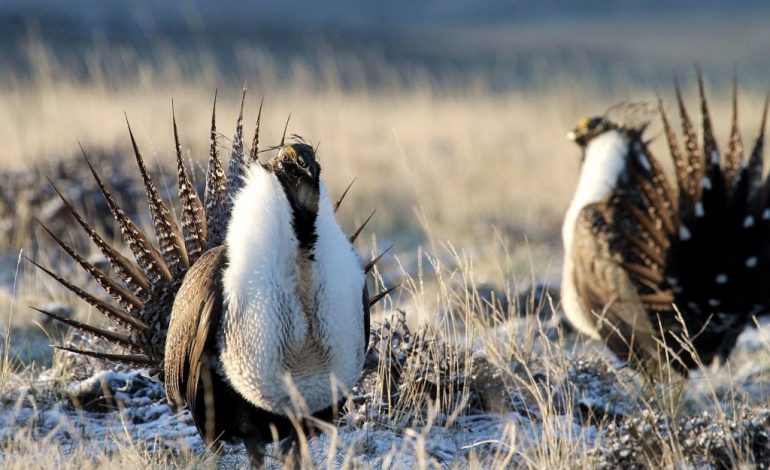
Wyoming holds the largest concentrations of greater sage grouse on the planet — about 40% of the global population — and the bird’s long decline has been the backdrop for years of political trench warfare. Conservation groups cite data showing the species is down nearly 80% from 1968 to 2023 and argue the federal approach has been steadily weakened since the landmark 2015 plans.
Their big complaint this time: the rewrite strips key guardrails in the most famous chunk of grouse country — the Red Desert “Golden Triangle,” home to the world’s largest breeding grounds (leks).
Under the new plan, critics say:
- The Golden Triangle loses its “area of critical environmental concern” designation.
- A major development restriction known as “no surface occupancy” is removed from key habitat, potentially allowing more roads, pads, pipelines and other surface disturbance.
- Grazing standards tied to nesting concealment — including the well-known 7-inch “hiding cover” benchmark — are softened or removed, which advocates say could leave nests exposed.
Western Watersheds Project executive director Eric Molvar warned the changes could hollow out grouse habitat, and WildEarth Guardians said dropping grass-height standards risks livestock grazing down the cover sage grouse rely on during nesting season.
Wyoming’s response is basically: you’re looking at the wrong scoreboard.
Gov. Mark Gordon said the rewrite recognizes decades of Wyoming-led conservation and that the state will keep investing in sage grouse protection “alongside responsible development.”
Budd also pushed back on the grass-height fight, calling the 7-inch hiding-cover rule a standard that can’t be met everywhere, every year — and saying it fuels a “false narrative.” The goal, he argues, should be healthy ecosystems, not one-size-fits-all tape-measure management.
And on the Golden Triangle, Budd says the idea that protections have vanished is overstated. Wyoming’s core-area strategy still applies, he said, and removing a blanket “no surface occupancy” label doesn’t automatically greenlight drilling rigs. The new federal plan, he argues, still allows officials to apply NSO restrictions where they’re the best tool.
He pointed to modern directional drilling as a potential middle ground: companies can sometimes reach resources from miles away, reducing surface impacts — though likely with seasonal limits and other safeguards.
The temperature is already high and the next step looks predictable: court. Conservation groups say they’re preparing lawsuits, while Wyoming officials say the rewrite is a realistic update that keeps grouse conservation intact without freezing development.
Either way, the bird at the center of the fight — and the sagebrush sea it depends on — is headed back into the political crosshairs, right where it’s been for the last decade.



The latest news in your social feeds
Subscribe to our social media platforms to stay tuned