



Gaza: A Deadly Week, Political Noise, and a Fragile Christmas

AP, ABC News, Anadolu Ajansı, Euronews, and Al Jazeera contributed to this report.
Gaza is officially in a ceasefire that’s been in place for more than two months. On the ground, though, the line between “truce” and “active conflict” keeps blurring — with fresh reports of Israeli fire, new political sparring over the future of the strip, and Palestinian Christians trying to mark Christmas in the middle of rubble and displacement.
On Wednesday, medical sources cited by Anadolu reported that one Palestinian was killed and 12 others were injured in Israeli attacks across the Gaza Strip — despite the ceasefire. The reported incidents weren’t limited to one spot: gunfire in Jabalia in the north, a drone strike in eastern Khan Younis that injured three people collecting wood near an army-controlled “yellow zone,” and further reports of airstrikes, shelling, and heavy gunfire in Gaza City’s eastern Al-Tuffah area and around Al-Bureij refugee camp in central Gaza.
The picture that emerges isn’t one major offensive — it’s a steady drip of violence, often around contested edges and military-restricted areas, that still leaves civilians paying the price.
According to Gaza’s media office (as cited in the material you provided), Israel has committed 875 ceasefire violations since Oct. 10, resulting in more than 400 Palestinians killed and over 1,100 injured. The same source claims that since October 2023, Israeli attacks have killed nearly 71,000 Palestinians and injured more than 171,100.
These figures are politically charged and disputed in wider international debate — but inside Gaza they function as something else too: proof, for many Palestinians, that the ceasefire is not a protective shield so much as a pause with loopholes.
At the political level, Israeli Defence Minister Israel Katz briefly poured fuel on a long-running fear in Gaza: the idea that Israel might return to settlements inside the strip. In remarks made at a West Bank settlement, Katz suggested Israel would establish “pioneer groups” in northern Gaza “in place of” the settlements evacuated in 2005 — language that spread quickly and drew criticism.
Then came the walk-back. Katz’s office later said his comment was made in a “security context” and insisted Israel “has no intention” of building settlements in Gaza.
That rapid backtrack matters. It highlights a core tension: even if Israel’s official line rejects reoccupation or settlement-building, voices inside its politics keep testing the boundaries — and every test lands in Gaza as a threat, not a talking point.
A US official (speaking anonymously in your provided material) condemned Katz’s remark bluntly: the more Israel provokes, the less Arab countries will want to work with it, and Washington expects all sides to stick to ceasefire commitments.
Meanwhile, violence isn’t confined to Gaza. In the occupied West Bank, there was a reported settler attack overnight into Tuesday in As Samu’ (near Hebron): a home was attacked, tear gas (or pepper spray, according to police) was used, and Palestinian children were taken to hospital. Police said five settlers were arrested on suspicion of trespassing, damaging property, and using pepper spray.
Even when arrests happen, Palestinian officials frame these incidents as part of a broader, protected pattern — and the wider context you provided reinforces why: the UN humanitarian office has said settler attacks hit very high levels, especially during olive harvest season, a crucial economic period.
Put together with the Gaza violations, it adds up to a regional reality Palestinians often describe as continuous pressure — through military action, restrictions, and settler violence — regardless of whether a “ceasefire” headline is active.
If you want a human snapshot of what “fragile calm” looks like, it’s the story of Mustafa and Nesma al-Borsh.
They tried to carve out one small celebration: a modest wedding in a tent in Al-Tuffah, Gaza City, with around 40 people. As the night ended, Israeli shelling hit a building next to the tent — a vocational facility turned shelter where families, including Mustafa’s relatives, were staying and where the couple planned to live after the wedding.
Mustafa says he went from groom to rescuer in minutes: pulling people out, retrieving bodies, waiting hours for ambulances that required coordination to enter. He says he’s still wearing the wedding suit, stained with the blood of his eight-year-old nephew, who later died.
It’s a brutal illustration of how civilians experience this phase of the war: not as “after,” but as a stop-start loop where planning for life — marriage, housing, normal routines — keeps getting wiped out.
Against that backdrop, Palestinian Christians are trying to celebrate Christmas with something close to normal — or at least something that resembles it.
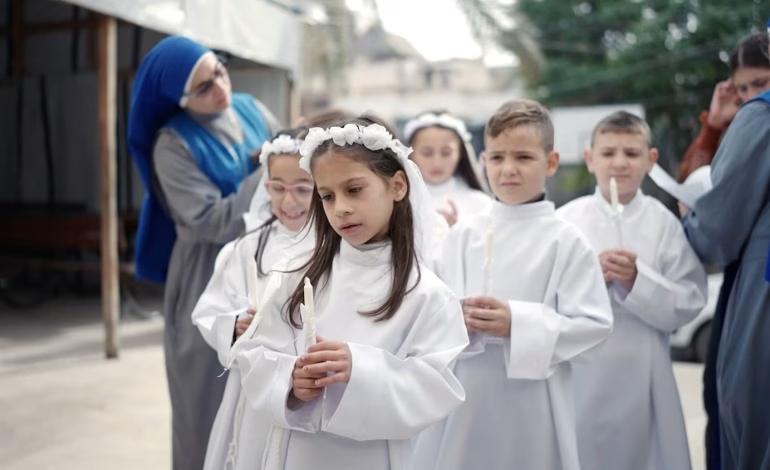
In Gaza, the small remaining Christian community has been putting up trees, baking pastries, and creating a festive atmosphere for children even while displaced. A coordinator at a Christian center inside Al-Ahli Hospital described this Christmas as “a new beginning” they hope can turn into lasting peace and stability — with the reality check that catastrophic housing, schooling, and poverty remain unresolved.
In Bethlehem, meanwhile, thousands gathered in Manger Square for Christmas Eve celebrations, with the city trying to breathe after two years of scaled-down holidays. Even there, the war’s shadow is obvious: unemployment, checkpoints, and an economy tied to tourism that has been crushed.
What connects Gaza and Bethlehem isn’t just faith — it’s the same theme: celebration as an act of endurance, not escape.
The current moment is defined by contradiction:
- A ceasefire that has reduced large-scale fighting, but doesn’t stop lethal incidents.
- Political messaging that says no settlements, while influential figures still gesture toward them.
- Communities trying to rebuild daily life — weddings, Christmas — while violence and uncertainty keep interrupting.
If this ceasefire is supposed to be a bridge to something more stable, the question now is whether the bridge is being reinforced — or quietly dismantled, piece by piece, by violations, provocations, and the sheer weight of unmet needs on the ground.

The latest news in your social feeds
Subscribe to our social media platforms to stay tuned