



The original story by David Madison for Cowboy State Daily.
Wyoming could be standing at the edge of the country’s next big energy shift as geothermal power gains serious traction in Washington and across the West. New federal policies, bipartisan legislation and fresh lease sales are giving the long-overlooked energy source a real boost — and the state’s deep oil-and-gas know-how could suddenly be an asset in a whole new industry.
After a chaotic year in Congress — marked by early recesses and a 43-day federal shutdown — momentum around geothermal didn’t stall. It quietly built pressure. Now, it’s starting to erupt.
In recent weeks, the US House Subcommittee on Energy and Mineral Resources held a legislative hearing on nine geothermal bills designed to speed up permitting and expand leasing on federal land. At the same time, the Bureau of Land Management held a competitive geothermal lease sale in Idaho, offering 18 parcels covering about 70,000 acres.
BLM also rolled out a major policy shift, directing state offices to hold annual competitive geothermal lease sales — doubling the frequency required under existing law.
“This shift reflects the Department’s commitment to accelerating the development of reliable, steady-state baseload energy,” the agency said, tying geothermal directly to the administration’s push for American energy dominance.
What’s turning heads is how much agreement there is across party lines. Republicans and Democrats alike are backing geothermal as a clean, reliable power source that doesn’t depend on wind or sunshine.
Among the proposals gaining steam:
- A Utah bill to force quicker federal reviews of geothermal permits;
- An Idaho proposal requiring yearly geothermal lease sales;
- A Nevada-backed plan extending oil-and-gas permitting shortcuts to geothermal projects.
Wyoming Rep. Harriet Hageman sits on the subcommittee but didn’t sponsor any of the bills or speak during the hearing, instead keeping her focus on oil, gas and coal. Still, lawmakers from neighboring Western states are all-in.
Subcommittee leaders say geothermal can provide round-the-clock power, good-paying jobs and long-term energy security — especially on federal land.
A recent report from the US Geological Survey flagged Wyoming’s western edge as part of a vast Great Basin geothermal reserve that could theoretically generate 10% of current US electricity demand.
But zooming in paints a more tempered picture.
Most of Wyoming’s geothermal resources are below 200 degrees Fahrenheit, which limits large-scale electricity production. And the state’s hottest zone — Yellowstone — is strictly off-limits.
A 2022 study for the Wyoming Energy Authority found the state better suited for direct-use heating (think buildings and infrastructure) rather than massive power plants. The most promising areas were around Rock Springs and the Powder River Basin, though still behind geothermal hotspots like Nevada, Utah and Idaho.
Even so, Wyoming has something geothermal companies desperately need: experience underground.
“We call it hydraulic stimulation. Oil and gas calls it fracking,” said Rob Podgorney of the Idaho National Laboratory. “It’s the same physics.”
Federal policy isn’t the only driver here. Private money is flooding in.
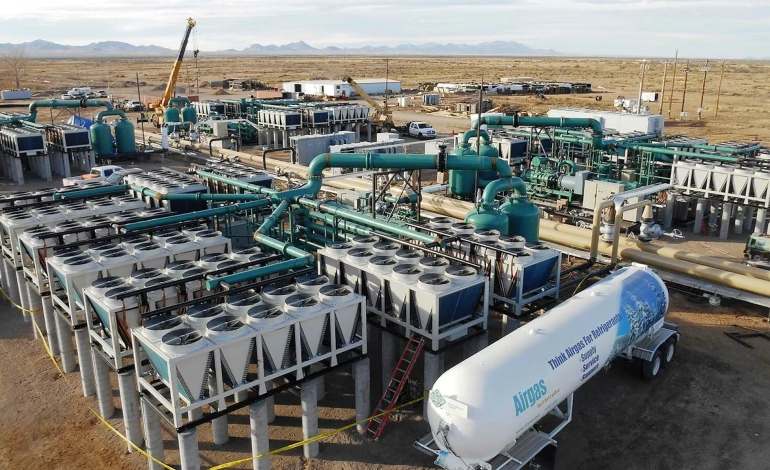
Fervo Energy, which is building the world’s largest enhanced geothermal project in Utah, raised $462 million late last year from heavyweight investors including Google, Bill Gates’ Breakthrough Energy Ventures and Tesla co-founder JB Straubel.
Its Cape Station project is set to deliver 100 megawatts by 2026, with plans to scale up dramatically in the years that follow.
Elsewhere, companies are using artificial intelligence to locate geothermal reservoirs that were previously invisible — a major breakthrough for an industry that’s struggled with exploration risks.
One reason geothermal is suddenly hot again: AI and data centers.
Electricity demand is skyrocketing, and data centers need massive amounts of reliable power — and cooling. Studies suggest enhanced geothermal could meet a majority of that growth by the early 2030s, potentially at lower cost than traditional power sources.
The newly renamed National Laboratory of the Rockies recently found that geothermal-based cooling could slash data center energy costs by two-thirds.
Federal officials say the goal now isn’t picking winners among energy sources — it’s meeting demand, fast.
Even if most geothermal power plants pop up in neighboring states, Wyoming still stands to benefit. Oil-and-gas workers can retrain quickly — sometimes in just days — and supply chains already exist.
As one geothermal CEO told Congress, this is a chance to scale a new energy industry using the workforce Wyoming already has.
Geothermal may not replace Wyoming’s fossil fuels anytime soon. But between federal policy, private investment and surging energy demand, it’s no longer a fringe idea — and the state could find itself closer to the center of the next Western energy boom than expected.



The latest news in your social feeds
Subscribe to our social media platforms to stay tuned