





No Wreaths, Just Receipts: China’s One-Child Era Gets Dragged Online after Top Enforcer Dies

CNBC, the New York Times, Reuters contributed to this report.
China just lost one of the most powerful faces of its old population-control machine — and the internet responded like it was opening a long-delayed comment section.
Peng Peiyun, the former head of China’s Family Planning Commission (1988–1998), died in Beijing on Sunday, just shy of her 96th birthday. State media went with the respectful script, praising her as an “outstanding leader” for her work related to women and children.
Weibo, however, did not RSVP to the memorial.
One of the top reactions making the rounds was blunt and grim:
“Those children who were lost, naked, are waiting for you over there.”
Not exactly a eulogy — more like an indictment. The point of the posts wasn’t just Peng the person, but what she represented: the years when family planning wasn’t a policy debate so much as a state mandate enforced by local officials with frightening power.
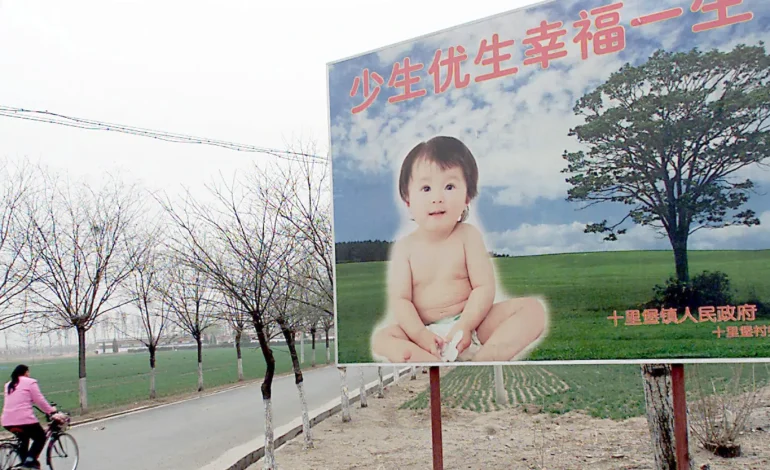
China’s one-child policy ran from roughly 1980 through 2015, and for many families the memory of it is tied to coercion: forced abortions, sterilizations, heavy fines, and relentless pressure to meet birth quotas. Peng’s commission years (1988–1998) fell right inside the period many Chinese remember as the peak of enforcement intensity.
And Peng’s portfolio leaned heavily rural — a place where big families weren’t “traditional values,” they were often old-age security. If you didn’t have children, who would care for you later? Add the cultural preference for sons, and the policy collided with reality in ugly ways: abandoned infant girls, sex-selective abortions, and a gender imbalance that still haunts China’s demographics.
So when Peng died, a lot of the public reaction wasn’t mourning. It was something closer to: You can’t just close the file and expect the people inside it to disappear.
The irony, and it’s the kind that keeps showing up in Weibo posts, is that the policy was launched because leaders feared the population would explode out of control — and now China is stuck with the opposite problem.
China’s population, once the world’s largest, has been shrinking. It fell behind India in 2023, and last year dropped to about 1.39 billion, declining for the third year in a row. The 2025 figure is expected next month, and experts warn the downtrend could accelerate.
That’s why one of the more cutting online takes hit harder than it looks at first glance:
“If the one-child policy had been implemented for 10 years less, China’s population would not have plummeted like this!”
It’s a counterfactual, sure — but it captures a real public mood: anger that a policy designed for one era stayed in place too long, and now the country is paying for it in another era.
There’s another layer here: by the 2010s, Peng reportedly shifted her stance publicly, saying the one-child policy should be eased. That’s not nothing. It suggests she recognized the long-term risks.
But online, that nuance doesn’t buy much forgiveness — because families remember the policy’s consequences in personal, permanent terms.
One Weibo user framed it in haunting arithmetic:
“Those children, if they were born, would be almost 40 years old, in the prime of their lives.”
That’s what this argument really is: not abstract demographics, but ghost population math — the lives that never happened, and the families shaped around that absence.
Today, the government is doing the policy equivalent of slamming the brakes and flooring it at the same time. It’s trying to raise births with childcare subsidies, longer maternity leave, and tax benefits. The message has flipped from “limit births” to “please have kids.”
But reversing behavior is harder than enforcing it. Younger people cite high living costs, job insecurity, brutal work culture, housing prices, and the sheer expense of raising children. Also: after decades of being told “one is enough,” a lot of people internalized the idea that kids are optional — or unaffordable — or both.
And the stakes are big. A shrinking, aging population means fewer workers supporting more retirees. That’s pressure on economic growth, on pension systems, on healthcare — and on already debt-stressed local governments that will have to fund elder care at scale.
Because Peng’s passing landed right in the middle of China’s demographic anxiety spiral — when the state is urgently trying to rebuild a birthrate culture it once dismantled.
State media can frame Peng as a loyal official and a leader. Social media is framing her as a symbol of a system that took choices away, and left scars behind — and then, years later, discovered it needed the very people it prevented from being born.
In other words: Beijing wants more babies now. But the internet is still arguing about the babies it didn’t let happen then.



The latest news in your social feeds
Subscribe to our social media platforms to stay tuned