




President Donald Trump has cracked the door open on marijuana policy, but in Wyoming, Republican leaders are making it clear they’re not walking through it.
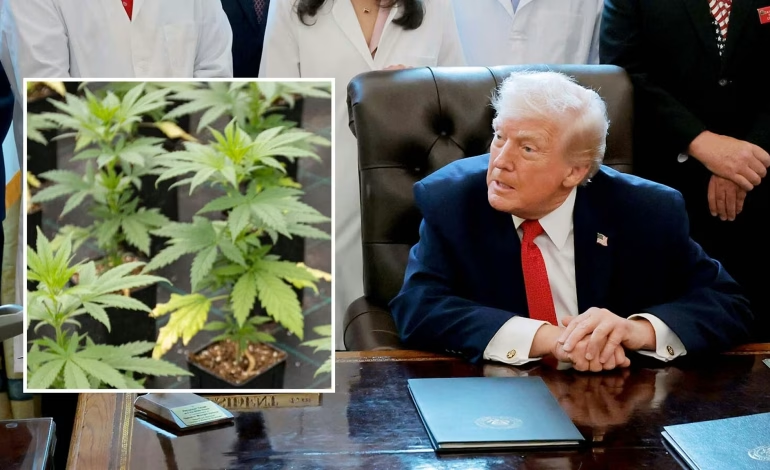
Trump signed an executive order on Dec. 18 directing his attorney general to begin reclassifying marijuana from Schedule I — the federal government’s most restrictive drug category — to Schedule III, which recognizes some medical uses and lower abuse potential. It’s a notable shift for a president closely associated with tough-on-crime rhetoric, and it’s putting him slightly out of step with Wyoming’s MAGA-aligned leadership.
State GOP leaders say the move doesn’t change their bottom line: marijuana, medical or otherwise, is still a no-go in Wyoming.
“We still have a zero-tolerance approach,” said Bryan Miller, chair of the Wyoming Republican Party.
Marijuana remains illegal in the state, and the party passed a resolution in 2022 opposing both recreational and medical legalization — a stance it reaffirmed heading into the 2023 and 2025 legislative sessions.
Miller argued that Trump isn’t actually legalizing marijuana, just calling for more study.
“I see what the president’s doing as trying to remove it as a cultural issue and move it into the pharmaceutical realm,” Miller said.
That could mean tighter controls, not looser ones. Personally, though, Miller added:
“I’m not a fan of marijuana in any form.”
That resistance runs deep in the Legislature.
House Speaker Chip Neiman, R-Hulett, said Wyoming lawmakers have little interest in easing marijuana laws.
“I don’t believe there’s an appetite for it in Wyoming,” Neiman said. “Look at Colorado. Look at other states dealing with the consequences.”
If Trump wants more research, Neiman said, fine — but letting marijuana loose in Wyoming isn’t happening anytime soon.
Rep. Rachel Rodriguez-Williams, who chairs the Wyoming Freedom Caucus, was even more blunt.
“The science is clear: marijuana is harmful,” she said in an email.
The caucus, she added, has no interest in legalizing a drug “known to be harmful” just to generate revenue.
Whether the Freedom Caucus actually holds a House majority is unclear, but its influence is undeniable — and firmly anti-marijuana.
Not everyone on the right sees Trump’s move as a problem.
Tyler Lindholm, Wyoming state director for Americans for Prosperity, called the president’s order a rare — and healthy — moment of disagreement between Trump and Wyoming conservatives.
“I think Trump is right on this,” Lindholm said. “It needs to be looked at.”
Lindholm said Wyoming should at least rethink how harshly it prosecutes marijuana possession, especially with neighboring states moving in the opposite direction. Marijuana is fully legal in Colorado and Montana, legal for medical use in Utah, Nebraska and South Dakota, and illegal only in Idaho and Wyoming in the region.
“Do we really want to keep criminally prosecuting people for this?” he asked. “That’s a conversation worth having.”
Trump’s order doesn’t immediately change the law. Federal regulators still need to approve the reclassification, and if they do, Wyoming Attorney General Keith Kautz would have to decide whether the state aligns its drug schedules or formally rejects the change.
So far, Kautz hasn’t taken a position, noting only that Wyoming lacks a framework for prescribing marijuana.
Meanwhile, Interim US Attorney Darin Smith has said federal prosecutors will continue to aggressively pursue marijuana cases until told otherwise.
Opponents of legalization point to studies linking cannabis use — especially high-potency products — to mental health risks, particularly for adolescents. Supporters counter that the FDA has found “credible scientific support” for marijuana’s use in treating pain, nausea and appetite loss, and that rescheduling could finally allow large-scale, peer-reviewed research.
Trump’s order reflects that tension: it doesn’t endorse widespread use, but argues the lack of solid research has left doctors and patients in limbo.
In Wyoming, though, that nuance isn’t moving the needle.
For now, Trump may be signaling a softer federal stance on marijuana — but in the Cowboy State, Republican leaders are holding the line, even if it means parting ways with a president they usually follow without hesitation.


The latest news in your social feeds
Subscribe to our social media platforms to stay tuned