

Trump, Tankers and “Take the Oil” Politics: Why Critics Say Venezuela Is the Latest Target

The Guardian and CNN contributed to this report.
The Justice Department isn’t the only place dropping documents this week — in Washington’s foreign policy world, the latest headline is President Donald Trump openly floating the idea of keeping Venezuelan oil seized from intercepted tankers. And to critics, it’s not just tough talk — it’s part of a bigger pattern they describe as right-wing “resource imperialism,” where security claims, regime-change language and resource grabs start to blur into one storyline.
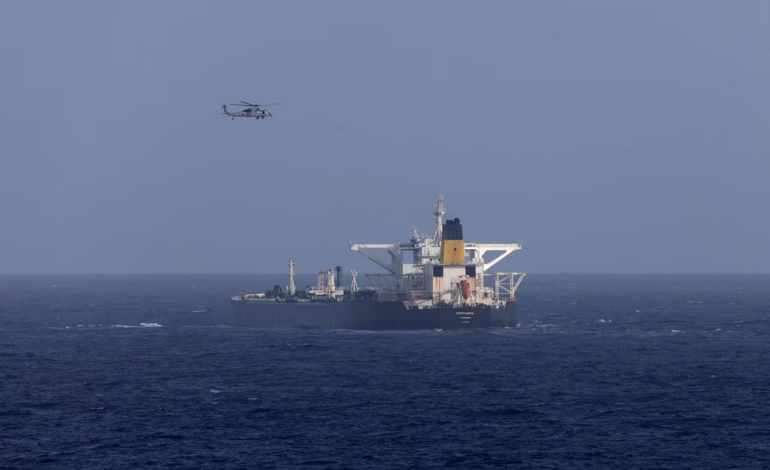
In recent weeks, the Trump administration has ramped up pressure on Venezuela, leaning heavily on drug-trafficking allegations as a justification. The US has intercepted two tankers carrying Venezuelan oil and is reportedly pursuing a third, while stepping up political attacks on President Nicolás Maduro.
Trump has leaned into the optics. On Monday, he suggested that oil seized from Venezuela could effectively become a US asset: maybe sold, maybe stored, maybe used for strategic reserves — and, he added, the ships could be kept too.
To Trump’s opponents — and even some uneasy observers who aren’t exactly Maduro fans — the script sounds familiar: national security framing + moral panic + oil.
This month, the administration reportedly described fentanyl tied to Venezuela as a “weapon of mass destruction,” a phrase that instantly triggers comparisons to the lead-up to the Iraq war, when WMD claims were used to sell a major military and political campaign that also sat on top of massive oil interests.
That doesn’t prove a war plan is imminent. But critics argue it’s the same political rhythm: portray the target state as an emergency threat, then expand the menu of “solutions,” including pressure, seizures, and the implied option of force.
Experts who track this stuff say Trump’s comments fit a long-running worldview: that US power gives it the right to control or extract foreign resources.
Trump has said versions of this for years. During his first campaign, he argued the US shouldn’t have fought in Iraq — but since it did, it should have taken the oil as “reimbursement.” Later, he framed oil control in Syria as a reason to keep US troops in place near eastern oilfields, hinting that American companies could benefit.
The Venezuela tanker talk sounds like the same instinct, just updated: not boots on the ground, but seizures at sea — plus political pressure aimed at Maduro.
One analyst describes the administration’s global energy approach as less about markets and more about leverage: threats, sanctions, and aid pressure used to secure inputs for a broad fossil-heavy strategy (with renewables treated as the odd one out).
That’s part of the reason the tanker seizures land as more than a one-off enforcement move. To critics, it reads like policy-by-power: if the US can stop you selling your oil — or physically take it — then it’s not just “sanctions,” it’s a form of control.
This same logic shows up in other places, too.
Trump has talked repeatedly about rare earth minerals — essential for batteries, phones, EVs and weapons systems — and has pushed hard on access, including with allies. Greenland keeps coming up in his orbit, framed as “national security,” but also tied to the island’s mineral deposits. And the administration struck a deal with Ukraine giving the US preferential access to minerals and uranium in exchange for continued support.
When Trump pressures allies to drill more — like urging the UK to open the North Sea — it fits the same worldview: national greatness equals fossil dominance, and the “green” agenda is treated like a threat.
Another layer here is the US-China rivalry. Analysts argue Washington’s scramble to control energy and industrial supply chains isn’t happening in a vacuum — it’s happening in a world where China is also competing for influence, access and narrative dominance.
That’s why Venezuela matters beyond Caracas: China has long been tied to Venezuelan oil flows and financing, and Beijing has framed US actions as bullying and unilateralism — while also using the moment to reinforce its broader argument that America shouldn’t be the global referee.
Trump’s Venezuela comments aren’t just a stray line at a press gaggle — they land inside a consistent pattern: resource-first geopolitics dressed in security language.
Supporters may see it as hard-nosed bargaining and a way to weaken Maduro. Critics see something darker: the normalization of a blunt idea — that powerful countries can treat weaker countries’ resources as prizes, especially when you can wrap the move in drugs, terrorism, or “strategic reserves.”
Either way, the message to the world is loud: this isn’t just about Venezuela — it’s about how this White House thinks power should work.


The latest news in your social feeds
Subscribe to our social media platforms to stay tuned