


The Hill and Vatican News contributed to this report.
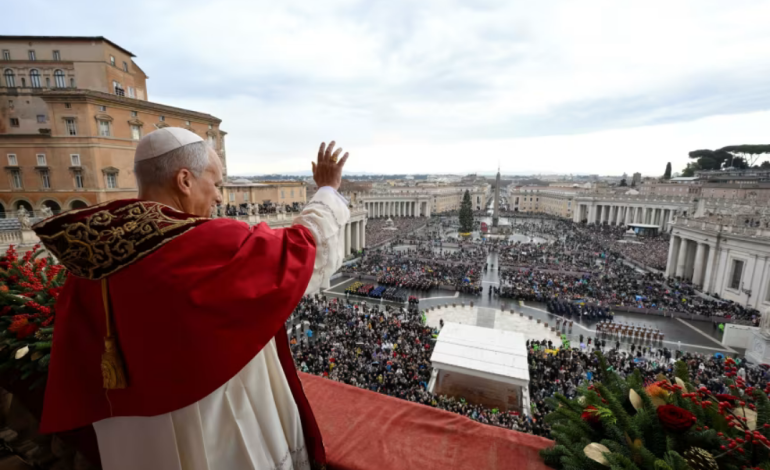
Pope Leo XIV delivered his first Christmas message as pontiff on Thursday, and he didn’t ease into the role quietly.
In front of a crowd of about 26,000 packed into St. Peter’s Square, the first US-born pope used the Vatican’s annual “Urbi et Orbi” address to push a simple point: the world doesn’t change through big speeches — it changes when people actually sit with each other’s suffering.
“If he would truly enter into the suffering of others and stand in solidarity with the weak and the oppressed, then the world would change,” Leo said, according to the Associated Press.
From the central balcony of St. Peter’s Basilica, Leo ran through a grim list of places where daily life has become unstable or outright dangerous — including Sudan, South Sudan, Mali, Burkina Faso and Congo. He also urged the international community to work toward “justice, peace and stability” in Lebanon, and appealed for attention and calm in the Palestinian territories, Israel and Syria. He added prayers for what he called “the tormented people of Ukraine.”
But the tone wasn’t just geopolitical — it was personal. Leo spoke about young people pushed into war and the gap between political rhetoric and the reality of the front lines.
He lamented “young people forced to take up arms, who on the front lines feel the senselessness of what is asked of them, and the falsehoods that fill the pompous speeches of those who send them to their deaths.”
And he kept returning to the same theme: peace isn’t a slogan — it’s a habit. He framed it as something that starts when people stop talking at each other and start listening.
“There will be peace when our monologues are interrupted and, enriched by listening, we fall to our knees before the humanity of the other,” he said, according to the AP.
In remarks also highlighted by Axios, the pope widened the lens beyond war to economic and social hardship — pointing to people who’ve lost everything, including families in Gaza; communities in Yemen; migrants and refugees crossing the Mediterranean or traveling through the Americas; workers stuck in low wages; and people behind bars in harsh conditions.
“Jesus took upon himself our fragility, identifying with each one of us,” he said, describing those facing hunger, poverty, displacement and unemployment.
For a new pope — and a historic one — it was less a ceremonial Christmas greeting and more a message with teeth: if leaders and ordinary people don’t treat human suffering as real and urgent, “peace” will stay stuck in speeches.


The latest news in your social feeds
Subscribe to our social media platforms to stay tuned